
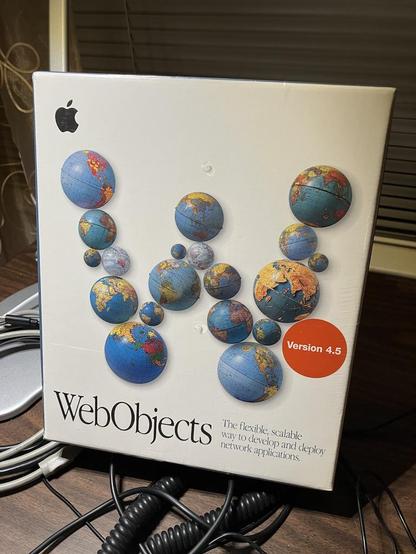
Ah, WebObjects. This set of software frameworks was used to build enterprise-level websites, the iTunes Store being a notable example. 4.5 was the first version to "only" cost $699 instead of the $50,000 that NeXT used to charge. And the last version to use Objective-C... it all got rewritten in Java for the 5.0 release, beginning a slow decline until it was officially discontinued in 2016.
@_the_cloud one of Apple's internal payroll sites ran on WebObjects from the early 2000s until mid 2018. When I joined corporate, I gave HR my old employee ID, so I was able to access my old apps, and pull up all my old paystubs from my time in Apple Retail, circa 2005. It was pretty wild to see such an ancient site before they started requiring SSO to be enabled for all internal apps in 2019.
@theirongiant Before myPage was retired in 2024, it had been running for a Very Long Time. I wonder if it was a WO app? It was around in 2000 at least, as I found an old email mentioning it then, but I think it had been around a few years before that, maybe 1998 or so.
@_the_cloud @theirongiant As curiosity, I was probably the last person who had a full time job maintaining the WO branch used by iTunes Store, after WO was publicly deprecated. I don’t want go back to Java coding but I loved doing this. Learned a whole lot and got to implement a few features I always wanted in the framework. πŸ˜ƒ
@_the_cloud Did you ever get to tour the VG3 data center when it had the tray loader Xserves? They were the only ones that could run WebObjects 4.5.1 after the Java version was released, so that whole data center had racks and racks of them (visible from the lobby, behind a glass wall) as the App Store front end. For years. They were SO LOUD.
@wklj No, never got that tour. There was a rack of Xserves in a server closet in IL1 and that was loud enough; I'd imagine you'd need hearing protection going into a data center full of them.
@_the_cloud Indeed, lol. And a lot of the rest of the data center at the time (this was 20+ years ago) was running HPUX and AIX, etc., but that was also all behind the wall of Xserves at the front which was like 20 racks of them, but you couldn't see anything but the Xserves through the glass. No surprise, really :-)
@_the_cloud over 20 years ago I worked with WebObjects for our national telco. Memories! @eloy

@_the_cloud

We still use WO (but are slowly migrating to our own modern Swift-based framework). We have about 1.5M lines of WO code. It is rock solid (still).

Here one of the WO docs in PDF: https://developer.apple.com/library/archive/documentation/LegacyTechnologies/WebObjects/WebObjects_5/DeployingWebObjects/DeployingWOApps.pdf

@tuparev @_the_cloud My absolute favorite of Apple docs is this one:
https://leopard-adc.pepas.com/documentation/WebObjects/DesktopApplications/WODesktopApps.pdf

291 pages finest documentation of mostly forgotten tech.

@lazarus @_the_cloud

I prefer the Objective-C version πŸ˜‚

@tuparev @_the_cloud Of WebObjects or of desktop apps?
@tuparev @_the_cloud Well, I love Objective-C and its apps, but it has always been bound tightly to the Apple ecosystem. The Java version is Apple tech (including most Cocoa patterns), but implemented with cross platform ability. Cocoa-like apps running on my Linux machine. I just love it. πŸ˜‰
Plus: Objective-C WO apps were two tier apps accessing the database directly. Java WO apps are three tier, using the application server and having a nice controller system to create layouts.

@lazarus @_the_cloud

In reality, very few production systems were deployed on non-Apple hardware/software. I was training many teams around the world, and 90%+ used some form of OpenStep. Java was more a marketing move.

BTW, after EOF 3.1 the Obj-C version were 3-tier too.

@tuparev @_the_cloud Uh, interesting. But yes, makes sense, Apple wasn't sure about the success of ObjC.
Ok, never read about Cocoa three-tier apps in the docs though. That always applied to Java clients only.