 A Tale of Two Meeples
Over the years we've become quite good at knowing what works for us - beautiful beige Euros, and what doesn't - games involving speed, making things up, or a ticking clock. Knowing ourselves as we do, we can avoid those things that we know are going to turn us off a game before we even have to play it. But what happens when you find something that turns you off in a game that you otherwise love?
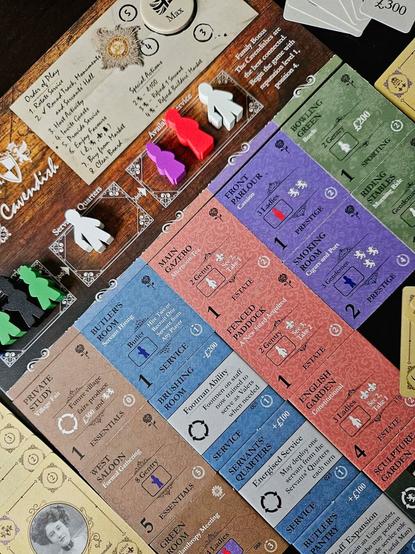
A few weeks ago Obsession found its way back to the table. We both really enjoy it, but there is a certain time commitment to playing it, so it doesn't come out as often as it should. It had been almost 6 months since we last played, so of course, we needed a slight refresher on the rules. "How many objective cards do you draw each courtship phase?" "I'll check the rulebook."
The information we needed was pretty simple. It really shouldn't have taken all that long to find. But the rulebook for our edition of Obsession comes with so much information that trying to confirm a simple step takes so much longer than is necessary. Rather than following a linear progression, the information you need is interspersed among other facts and figures that distract from the game at hand.
So for us, our big gaming turn off really has to be poorly composed rulebooks. Extra information is great, but that's where an appendix comes in. The rulebook should clearly and concisely show how to set up the game, how to play, and how to score. It should flow the same way that the game does, one step to the next, in chronological order. It should allow you to pick it up, check a rule, and get back to the business at hand, playing the game.
This isn't to say that we're turned off from playing Obsession. On the contrary, the more we play it, the more we enjoy it. We love the extra turns that you get in the long game and thematically the game has always clicked. Maybe we just need to print a cheat sheet to help with those hard to remember rules!
#boardgames
A few weeks ago Obsession found its way back to the table. We both really enjoy it, but there is a certain time commitment to playing it, so it doesn't come out as often as it should. It had been almost 6 months since we last played, so of course, we needed a slight refresher on the rules. "How many objective cards do you draw each courtship phase?" "I'll check the rulebook."
The information we needed was pretty simple. It really shouldn't have taken all that long to find. But the rulebook for our edition of Obsession comes with so much information that trying to confirm a simple step takes so much longer than is necessary. Rather than following a linear progression, the information you need is interspersed among other facts and figures that distract from the game at hand.
So for us, our big gaming turn off really has to be poorly composed rulebooks. Extra information is great, but that's where an appendix comes in. The rulebook should clearly and concisely show how to set up the game, how to play, and how to score. It should flow the same way that the game does, one step to the next, in chronological order. It should allow you to pick it up, check a rule, and get back to the business at hand, playing the game.
This isn't to say that we're turned off from playing Obsession. On the contrary, the more we play it, the more we enjoy it. We love the extra turns that you get in the long game and thematically the game has always clicked. Maybe we just need to print a cheat sheet to help with those hard to remember rules!
#boardgames
 Jerk
Jerk