
New side project: I'm making WebBee 🙈

It is a conversational web-dev agent – one that doesn't burn the planet or steal other people's code. They can turn English language into structured English language. Add components, install packages, scaffold pages, run framework CLIs. All that without requiring a ton of RAM or scraping open source :)

WebBee is a little silly, but fully deterministic, and you can teach them routine tasks.
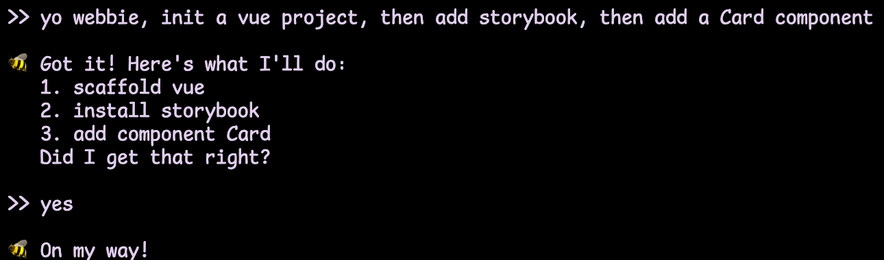
It doesn't use LLMs but a neural network for intent classification, based on supervised learning.

This is way less resource-wasting.

It can make use of MCP server and exposes itself as MCP server too. It also comes with an OpenAI-compatible REST interface, so it can be integrated into IDE-integrated chat agents.

If something isn't clear, they ask back before doing stuff. For example:

User: I want to add a component.
🐝 what do you like the component to be named?

MCP tools are a bit tricky for webbee. This is especially the case for multi parameter tools.

But whenever webbee struggles how to use a tool, it asks the user how to do that, and learns it.

The "AI" part of webbee is not generative AI but a classification task: it is trained to understand a limited subset of english.
Also, WebBee can handle pronouns. In terms of getting the context. No, not only queer folks use pronouns. Turns out pronouns are part of the english language.
It cannot compete with the heavier LLMs, but it doesn't want to.

@lea @astraluma this sounds like the kind of NLP project that's seemed like a slam-dunk to me as all of the *gestures* craze unfolds. It's a powerful tool for human-interface boundaries and it's sad to see so attempts to take advantage of our ability to do that deterministically!

Anywhere that I can read more about the design, or still cooking?

@SnoopJ still cooking a bit :) but going to publish a first release soonish as open source :) @astraluma
@lea What library are you using for the network?
@drwho right now I'm dabbling with torch. Evaluating if I can ditch it :)

@drwho the network architecture itself is using a transformer (the same thing LLMs use) but only one layer (look for keywords/pronouns and the relations to other keywords).

I was able to ditch torch in the runtime so it is pure c++ and straightforward to run in the browser as a wasm module. What's still there is pytorch used for generating the model.

@drwho A former approach used a BiGRU (bidirectional gated recurrent unit). It is more lightweight. Worked also well but not 100% accurate and failed for more complex sentences. A biGRU iterates the sentence from left to right and from right to left to look for keywords. The transformer looks at every word in parallel and is able to find relations to other words and can find out where "he/she/it" relates to.
@drwho bigger networks (the ones burning the planet and scraping the whole internet) work similar, but use multiple layers and analyze multiple aspects of a sentence this way.
@lea Hmmm... Do you think it would be useful to try as a command parser?