 SwooshBakery624 [they/them]
Vim's lead maintainer has fully lost his goddamn mind
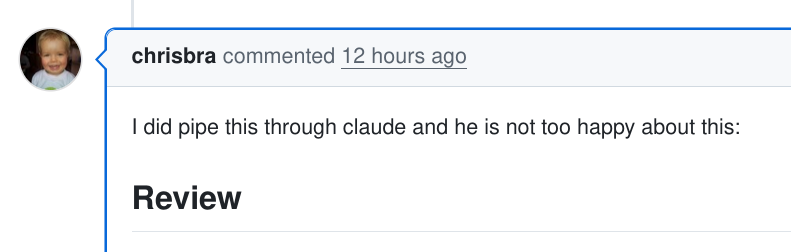
Vim's lead maintainer has fully lost his goddamn mind
It’s such a monumental waste of LLMs to include these slop phrases.
Employee 1 enters a prompt to send a slop mail that is so garbage it is unbearable to read using a brain.
So employee 2 either summarizes the slop mail using an LLM too or skips obtaining the information entirely and just goes straight to answering by prompting the next slop mail.
I wonder if that’s by design - to make interacting with slop so painful that human-to-human communication will not happen without a LLM in between anymore.
I originally meant to leave a much shorter comment; apologies.
I can’t code to save my life. However I find your observation interesting. The way I see it, AI, no matter where, is eroding human to human interactions. It becomes the middleman for everything.
It’s really obvious with personal research. A couple years ago if you wanted to start say, growing tomatoes in your backyard, you would have searched people’s comments on a variety of media platforms, would have read a few books or blogs. You would have asked questions to a bunch of people with some experience, left a like or upvote on people posting photos of their tomatoes, you would have used your own judgement to discern what consisted good quality advice and what not.
It would have taken you days. But all that interaction is very rewarding especially for those authoring comments, blogs, books, and photos of their experiences. Because nobody makes something just to be ignored.
Now LLM does all that process for you. In a matter of seconds. And giving no feedback or interaction to anyone whose information was used. It’s depressing, but I’m intrigued to see how it plays out.
I agree. Specifically for your example I think the transformation has been going on for a while with the aggressive monitization of internet content / the ad industry and the general downfall of google search. LLMs could to be the final nail in the coffin for nieche expertise on the broader internet.
I too am curious to see how AI companies will try to overcome the lack of human generated content to train their models on.
I spent literally all day yesterday working on this:
sciactive.com/human-contribution-policy/
I’ve started to add it to my projects. Eventually, it will be on all of my projects. I made it so that any project could adopt it, or modify it to their needs. It’s got a thorough and clear definition of what is banned, too, so it should help any argument over pull requests.
Hopefully more projects will outright ban AI generated code (and other AI generated material).
If you vibe-code it and use an LLM to respond to reviews, it is really easy to tell.
If you know what you’re doing and just using an LLM to speed up boilerplate writing, honestly who cares. It is technically copyright infringement but so many people are doing it that it’s not likely to be a problem.
I think this policy is overblown a bit. A better policy is “you need to understand, and be responsible for, what every part of your contribution does”. Enough to tell lazy vibecoders to fuck off, and allows for some flexibility in your tooling if you know what you’re doing.
Ok that’s really funny and I do agree with you, but I think you might be coming at this a little… unhinged. The issue with this is that it is unenforceable and honestly somewhat pointless. If AI tools are not up to scratch, then that will always be reflected in the quality of the code. Bad code is bad code, it doesn’t matter what made it. A lot of people seem to think AI is synonomous with bad code, and if that is the case, simply ban bad code.
The issue they are going to run into is twofold:
Firstly, what qualifies as “using AI”? Admittedly I haven’t actually read their licensing, but I’m just going to take a guess and say that it bans all forms of AI used anywhere in production. Almost every compiler I use these days has auto predict. It’s rarely useful, but if it does happen to guess the rest of the code I was already going to type, and I accept that, did I use AI to assist my coding? Back in the day before it was an llm the auto predict was actually decent, so not all of them use AI. How would you even know whether your is AI or not?
The second issue is an issue of foresight. When the AI tools do become up to scratch, that will be reflected in the quality of their code. Suddenly AI generated code is faster, more efficient, and easier to understand all simultaneously. Anyone using this license is effectively admitting that theirs is the inferior option.
It’s always hilarious to me when people ask whether something is AI slop. I dunno man, has your ability to detect whether something is good been reduced to AI slop? If it’s good, it’s good. If it’s not, it’s not. Either you like it or you don’t. Feels very similar to transphobes saying they can always tell. If that’s true, and AI really is always going to worse, you should never have to ask whether something is AI slop, you should just be able to tell. Otherwise it’s just slop, no ai necessary.
Firstly, what qualifies as “using AI”? Admittedly I haven’t actually read their licensing, but I’m just going to take a guess and say that it bans all forms of AI used anywhere in production. Almost every compiler I use these days has auto predict. It’s rarely useful, but if it does happen to guess the rest of the code I was already going to type, and I accept that, did I use AI to assist my coding? Back in the day before it was an llm the auto predict was actually decent, so not all of them use AI. How would you even know whether your is AI or not?
So two things. First, it’s a policy, not a license. Second, the definition of AI generated is very clear in the policy.
I don’t know why you would criticize it without reading it, but the main problems with AI generated code are legal, not quality, and they are also clearly laid out in the policy.
Yes it does. Folks who just want to screech went crazy. Like, two of you actually engaged and brought valid concerns.
You actually think Lemmy is better behaved 🤣🤣🤣🤣
It’s the same mindset as “You don’t need a perfect lock to not get robbed, you just need one better than your neighbors.”
If a vibecoder sees this they will simply move onto the next project.
“AI generated” means that the subject material is in whole, or in meaningful part, the output of a generative AI model or models, such as a Large Language Model. This does not include code that is the result of non-generative tools, such as standard compilers, linters, or basic IDE auto-completions. This does, however, include code that is the result of code block generators and automatic refactoring tools that make use of generative AI models.
As “artificial intelligence” is not that well defined, you could clarify what the policy defines “AI” as by specifying that “AI” involves machine learning.
“Generative AI model” is a pretty well defined term, so this prohibits all of those things like ChatGPT, Gemini, Claude Code, Stable Diffusion, Midjourney, etc.
Machine learning is a much more broad category, so banning all outputs of machine learning may have unintended consequences.
this is cool
you should make a post about this somewhere here on Lemmy
people should know about it
hi, i have strong feelings about the use of genai but i come at it from a very different direction (story writing). it’s possible for someone to throw together a 300 page story book in an afternoon - in the style of lovecraft if they want, or brandon sanderson, or dan brown (dan brown always sounds the same and so we might not even notice). now, the assumption that i have about said 300 pager is that it will be dogshit, but art is subjective and someone out there has been beside themselves pining for it.
but this has always been true. there have always been people churning out trash hoping to turn a buck. the fact that they can do it faster now doesn’t change that they’re still in the trash market.
so: i keep writing. i know that my projects will be plagiarized by tech companies. i tell myself that my work is “better” than ai slop.
for you, things are different. writing code is a goal-oriented creative endeavor, but the bar for literature is enjoyment, and the bar for code is functionality. with that in mind, i have some questions:
if someone used genai to generate code snippets and they were able to verify the output, what’s the problem? they used an ersatz gnome to save them some typing. if generated code is indistinguishable from human code, how does this policy work?
for code that’s been flagged as ai generated- and let’s assume it’s obvious, they left a bunch of GPT comments all over the place- is the code bad because it’s genai or is it bad because it doesn’t work?
i’m interested to hear your thoughts
I put a lot of this in the reasoning section of the policy, but basically there are legal, quality, security, and community reasons. Even if the quality and security reasons are solved (as you’re proposing with the “indistinguishable from human code” aspect, there are still legal and community reasons.
Legal
AI generated material is not copyrightable, and therefore licensing restrictions on it cannot be enforced. It’s considered public domain, so putting that code into your code base makes your license much less enforceable.
AI generated material might be too similar to its copyrighted training data, making it actually copyrighted by the original author. We’ve seen OpenAI and Midjourney get sued for regurgitating their training data. It’s not farfetched to think a copyright owner could go after a project for distributing their copyrighted material after an AI regurgitated it.
Community
People have an implicit trust that the maintainers of a project understand the code. When AI generated code is included, that may not be the case, and that implicit trust is broken.
Admittedly, I’ve never seen AI generated code that I couldn’t understand, but it’s reasonable to think that as AI models get bigger and more capable of producing abstract code, their code could become too obscure or abstracted to be sufficiently understood by a project maintainer.
This is super cool!
Did want to offer one language critique, it’s easy to jump to the word human as the opposite of AI-made, but there are a lot of therians and adjacent entities in the software engineering space. It would be wonderful to find language that is a pro-“human” policy that avoids that word and instead focuses on people of all sorts of identities so as not to be othering.
Sounds strange to some I’m sure, but this has been coming up more and more with coworkers I’ve had across several companies. It’s kind of like moving from “he or she” to “they”, a great example is the writings of beeps a prominent software engineer on the GOV.UK site and its accessibility beeps.website/about/nonhuman/
Regardless if any changes are made thanks for reading and your policy writeup, again very cool :D
I would be fine to include more inclusive language, except that I want to be in line with the wording the US Copyright Office uses, as a major goal of this policy is to ensure that every contribution is copyrightable. They specifically use the word human, and go so far as to say that it is only human authorship that can make something copyrightable.
There was a landmark case where a chimpanzee took a selfie, and the courts decided that the picture could not be copyrighted. In the court’s decision, again, it’s specifically “human” authorship that was the requirement for copyright.
In my opinion, “person” would be a better term to use, since the personhood of the author is really what matters, but since this is meant to provide legal protection, I’m pushed toward the term “human”.
honestly, an amazing and respectable answer with solid reasoning
up to you if you’d like to add a footnote, either way I’m rooting for you this is good stuff
I added several quotes from the copyright office’s guidance that show their specific usage of the term “human authorship” to the More Information section. :)
One interesting thing is that they explicitly say that a work that is “authored by non-human spiritual beings” can only qualify for copyright protection if there is “human selection and arrangement of the revelations”, and even then, only the compilation is copyrighted, not the “divine messages”.
Couldn’t help but notice the casual gendering of Claude to “he” as well.
Someone somewhere made the important observation not long ago that computer assistants tended to be gendered female when more like a secretary (Siri and Alexa) but now that AIs are “intelligent” and powerful … Claude now has to be a male.
Especially weird (and telling?) when it is objectively gender neutral as it’s not human.
Couldn’t help but notice the casual gendering of Claude to “he” as well.
“Claude” is a male given name. If you think it’s actually a problem, blame Anthropic for giving their LLM a gendered name. I’ve never gendered AI assistants, but I’m not going to begrudge people who do when it’s in the name (or in the case of old Siri, the voice, which would later be the default rather than only option).
Women named “Claude” exist, but they’re staggeringly outnumbered by men to a point where most people don’t even know of women named “Claude” – let alone would immediately associate it as masculine.
it’s extremely telling however the shift in marketing
And your hypothesis doesn’t fall apart now why, exactly? AI assistants are more secretary-like than they’ve ever been. “Write me an email.” “Proofread my work.” Beyond that, people are using LLMs as substitutes for significant others.
And yet now, Microsoft migrated “Cortana” to “Copilot”, Siri is more gender-neutral than ever, Alexa still exists off massive brand recognition, and other major AI services are called e.g. “ChatGPT”, “Claude”, “DeepSeek”, and “Grok”. Collectively, that’s gender-neutral.
At most, the hypothesis used to be true but isn’t anymore, because you can literally make an LLM act like a tradwife now if you’re so debased inclined, yet the names are broadly neutral. The MIT Press has a good, lengthy article about the history of gender in speech synthesis, as an aside.
Yes, because the person I was replying to said:
Couldn’t help but notice the casual gendering of Claude to “he” as well.
“Casual gendering” is implying the Vim author calling Claude “he” was totally out of the blue. It’s not “casual”; it’s something Anthropic baked in by giving it a male name.
Sure, I know what “casual” means and that out of the meanings, a more apt one I should’ve chosen would’ve been “incidental”. That doesn’t change my overall point that they’re putting the entire onus of the gendering on the author as though it isn’t the same as someone calling Alexa “she”.
Replace this entire scenario with someone calling Alexa “she”: the accusation of “casual gendering” would obviously be ridiculous, because Alexa has a popular female given name.
Not blaming anyone, this is social commentary.
But like the neutral “it” is right there.
In a world that’s both charged around gender and pronoun usage, and focused on the nature and value of LLMs … I think it’s weird that there isn’t more commonly pushback enforcing the non-human neutral for the simple reason that it’s an objective fact amidst a swampy pool of (mis-)information synthesis.
A little like the bechdel test, I feel like it’s the casualness and indifference around this gender bias (at least at the moment) that’s interesting and telling.
Or maybe, just maybe, it has a guys name.
Good Lord y’all made up since crazy shit to whine about.
Oh no! Another issue! I’m a jellyfish and can only respond to a limited number of stimuli at a time because I have not centralised nervous system capable of organising my critiques into diverse and disparate arguments! I can only talk about vanishingly simple problems that are one-dimensional enough for me to tunnel vision on repeating the same talking points, preferably no longer than a dozen syllables total to accomodate not having a long-term memory centre due to my aforementioned lack of a brain 🪼🥺
I am very tired and have gone absolutely overboard on this comment, to the person I’m responding to pls don’t take this personally, more rational, less sleepy me doesn’t want to be a troll. But SERIOUSLY? You’re argument isn’t even “this isn’t a problem”, it’s “I can’t see the value in doing a full deconstruction of this novel ethical scenario and just want to be a sheep saying it’s bad for the reason my favourite shepherd says so, not because of healthy discussion of ALL the pros and cons.” Reminds me of those cringe posts from a couple months ago where people were saying “the epstein files are a distraction! don’t forget about my favourite political issue {insert valid issue}”. I’m going to be a hypocrite for a second bc this long arse comment is 1,000,000x worse than yours, but consider why you’re commenting before you hit post next time.
I wonder what Bram’s stance would have been on AI.
Anyway, looks like it’s time to learn emacs.
The learning curve is a bit steep, but if you already figured out – and felt comfortable in – Vim, it shouldn’t be that hard.
Some people suggest Doom Emacs or evil, but I enjoy learning ‘vanilla’ first, then going for some framework or customization layer afterwards, if I do it at all.
 Mothra
 u/lukmly013 💾 (lemmy.sdf.org)
 PlutoniumAcid
 Scubus
 Jared White ✌️ [HWC]
 thethunderwolf
 Magnum, P.I.
 maegul (he/they)
 TheTechnician27
 UltraGiGaGigantic
 xep
xep Brummbaer
 AeonFelis