 Lafargue
[Compare Brandom's reworking of Hegel as a neo-Aristotelian for whom truth is exactly Logos as judgement]
Page 70: "Because Dasein's characters of Being are defined in terms of existentiality, we call them "existentialia". These are to be sharply distinguished from what we call "categories" - characteristics of Being for entities whose character is not that of Dasein."
Page 73 (summarizing Scheler): "Acts are something non-psychical. Essentially the person only exists in the performance of intentional acts, and is therefore essentially *not* an object."
Page 89: "When Dasein directs itself towards something and grasps it, it does not somehow first get out of an inner sphere in which it has been proximately encapsulated, but its primary kind of Being is such that it is always 'outside' alongside entities which it encounters and which belong to a world already discovered."
Ok, pretty sure I've reached the point (in the discussion of Descartes) where I gave up last time I tried to read this, so it's all progress from here
I will say, it's much easier to read this thing having worked through Aristotle's Metaphysics somewhat carefully. Presumably it would be easier still if I knew the scholastics.
One of the interpretive challenges with Heidegger, imho, is to distinguish the bits of his apparatus that are broadly irrationalist from the bits that are specifically fascist. Fascism is a subset of irrationalism - there are plenty of non-fascist or indeed anti-fascist irrationalisms.
Page 160: "According to the analysis which we have now completed, Being with Others belongs to the Being of Dasein, which is an issue for Dasein in its very Being. Thus as Being-with, Dasein 'is' essentially for the sake of others."
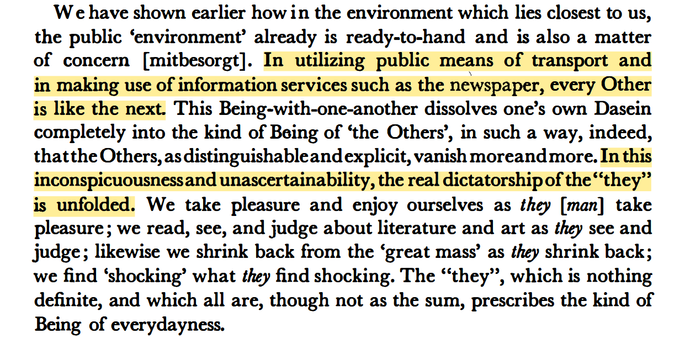
Quite funny that you have all this maximally abstract stuff about the existential analysis of Dasein as preparatory to fundamental ontology's uncovering of the forgotten question of the meaning of Being, etc. etc., but he can't stop himself from sharing this little mini-rant about how horrible public transport is
I don't really understand what he's doing in Chapter V - 'Being-in as such'. The discussion of "projection" (pages185-6) is I guess somewhere in the space of Aristotelian potential? not sure.
General architectonic so far has been reasonably clear. Introduction: We've forgotten the question of Being, we need to revive the question. That's because we've been using the wrong philosophical approach - both the standard interpretation of Aristotelian categories, and then the Kantian version of that categorial approach in German idealism, bind us to categories that occlude the real ontological issues, keeping us at the level of the 'ontic' - Aristotelian substance (beings) rather than Being
So we need to start by outlining a successor-concept to the Aristotelian/Kantian categories of the understanding. That is, we need an analysis of the nature of 'Dasein' (human cognition/agency). Heidegger distinguishes between 'categories' (which apply to non-human objects of understanding, etc.) and 'existential' analysis, which applies only to Dasein itself. So the whole book is basically an 'existential' analysis of the framework via which Dasein processes the world.
The idea is that if we get these existential categories right, we open a way to some kind of contact not just with substance/beings/the ontic but with Being itself, because we're no longer occluding our relationship to Being with crappy categories.
Then the early chapters are: I) Outlining the project of the existential analysis of Dasein; II) Dasein's basic relation to the world; III) physical space (analogous to Kant's treatment of space, though Heidegger takes Descartes as his contrastive case); IV) a first pass at intersubjectivity - relation between Dasein and other subjects (in the form of the disgusting masses - the "They');
p. 186: "Understanding is either authentic, arising out of one's own Self as such, or inauthentic."
p. 200: "Our fore-sight is aimed at something present-at-hand in what is ready-to-hand." [in Brandom's neopragmatist terms, we're talking about the transformation of skillful coping disposition into explicitated assertion.]
Getting out over my skis a bit here, but Brandom interprets Heidegger as a pragmatist on the basis of sections like this one. That is, Heidegger is saying that "presence-to-hand" in the form of our relation to objects available to description via assertion (the logos) emerges out of "readiness-to-hand": for Heidegger ontology has been stuck at the level of this kind of presence-to-hand of the logos (what Derrida will later call 'logocentrism').
Brandom is interested in the pragmatism/Ryleian explanation of "knowing that" in terms of "knowing how" - so Brandom interprets this chapter of Being and Time as making a basically Ryleian/pragmatist point. And that's not wrong.
But really all this presence-to-hand / readiness-to-hand stuff is throat-clearing, for Heidegger. This is a first pass critique of 'logocentrism' - the Aristotelian/Kantian form of metaphysics which focuses on beings/substance/the ontic as logos. But Heidegger's own standpoint isn't a pragmatist one - it's not like he's just substituting readiness-to-hand for presence-to-hand. This is all preparatory to a more (in Heidegger's view) fundamental critique of metaphysics.
So yes, you can stop at Chapter V and see Heidegger as a particularly pretentious Ryleian - but this isn't really 'Heidegger', interpreting this way just ignores the whole thrust of the project.
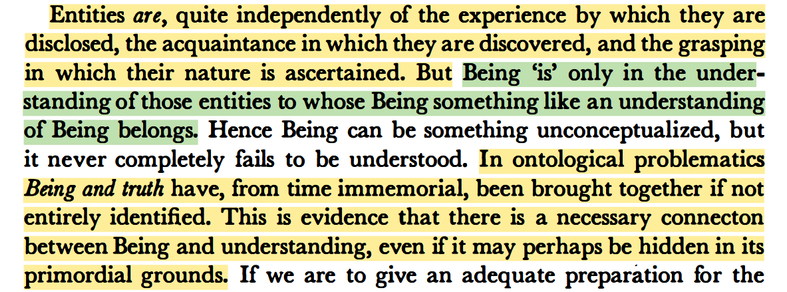
Page 228: "Being 'is' only in the under standing of those entities to whose Being something like an understanding of Being belongs."
Ok, starting to get to the 'real stuff' with this anxiety business (in Chapter VI). Have some inchoate Thoughts about this but need a bit more processing time - will try to remember to come back to this.
Very broadly speaking, we've got three different categories of intentionality operating in the text. There's presence-to-hand, which Heidegger thinks traditional philosophy is stuck in. Then there's readiness-to-hand, which Brandom and others interpret as Heidegger's pragmatism, but really this is close to a feint - a first pass critique of 'logocentrism' which doesn't amount to much more than throat clearing.
But then with the treatment of anxiety in Chapter VI we start to get to categories of intentionality which necessarily and structurally do not have objects. Page 231: "That in the face of which one has anxiety is not an entity within-the-world." "That in the face of which one is anxious is completely indefinite." "Anxiety 'does not know' what that in the face of which it is anxious is."
Heidegger's going to use this as a wedge to open up the space of thought that does not have any kind of entity as its object - ontological rather than ontic thought.
So the basic question for interpreting Heidegger, imo, is: does this move actually make sense? How should we interpret objectless thought?
In psychoanalysis (just to follow my own idiosyncratic train of thought for a moment) we basically have two answers to this question: the Freudian (pre- and/or anti-Heideggerian) and the Lacanian (post- and/or pro-Heideggerian).
The Freudian attitude here, speaking VERY loosely (this would need a lot of caveating) is: when you have 'free-floating anxiety' - anxiety without an object - what's actually going on, most of the time, is that you're suppressing your awareness of the real object of your affect. So the Freudian approach is 'deflationary' - these 'free floating' moods can be explained in terms of regular desire, and the disavowal of regular desire.
The Lacanian project, again speaking very loosely, is to re-interpret the Freudian apparatus in a Heideggerian key - that is, to treat Freud's treatment of desire as really thematising 'existential'(/'ontological') structural features of desire as always-already objectless.
I am on the Freudian-Humean rather than the Lacanian-Heideggerian side of this debate over the nature of desire - but I want to given the Lacanian-Heideggerian side of things its due.
Anyway - I think the question of how to think about "objectless intentionality" is the (or at least a!) core issue in the interpretation/reception of Heidegger. This is the heart of things, imvho.
So the basic disagreement here is one of 'psychodynamics'. Is Heidegger right that anxiety does not flee from any entities-within-the-world? Or is (as the Freudian but not the Lacanian analysis of psychodynamics argues) this 'existential' treatment of anxiety itself a disavowal of the more 'concrete' relation to entities-within-the-world that is actually driving the affect?
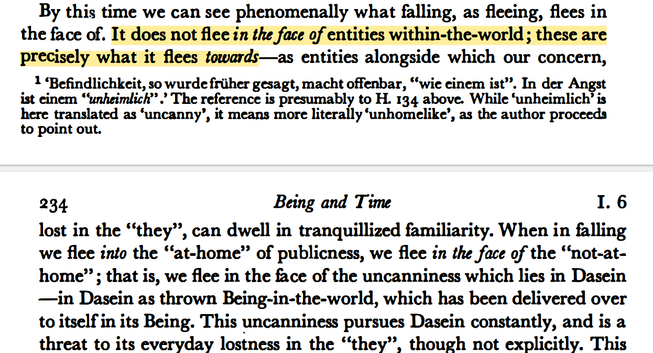
And this is also obviously relevant to the analysis of Heidegger's politics - is Heidegger's basic problem-space "ontological", and his 'mistakes' within the "ontic" realm of politics therefore 'secondary', or is Heidegger's treatment of "ontology" itself a disavowed engagement with the everyday world of the "ontic"?
Page 234: "Moreover, under the ascendancy of falling and publicness, 'real' anxiety is rare. Anxiety is often conditioned by 'physiological' factors."
Imo this is basically the same move as Kant, in the second Critique, arguing that, yes, ok, we may in practice follow the moral law out of individual motives and gratifications, but we can excavate a purer mode of respect for the categorical imperative which is not the result of these 'heteronomous' motives.
Feel confident that I've got ahold of the central thread here tbh - obviously this is all still Division One though
Page 236: "Dasein is always 'beyond itself', not as a way of behaving towards other entities which it is *not*, but as a Being towards the potentiality-for-Being which it is itself. This structure of Being, which belongs to the essential 'is an issue', we shall denote as Dasein's "Being-ahead-of-itself"."
Ok, done with Division One. Onto Division Two, which I gather has the stuff about temporality in it, which is why I'm actually reading the book.
The concluding section of Division One is quite strongly idealist, fwiw - a form of transcendental idealism, basically, but with Heidegger's successor-concepts to the Kantian categorical synthesis, etc. Heidegger flatly says that 1) there's no truth without Dasein, and 2) there's no Being without truth. Paradoxically, then, we can (I take it) think of entities as existing independently of human cognition/action, but we can't think of Being as independent of Dasein.
This is more strongly idealist even than Kant, I think, since Kant seems to think the thing-in-itself can be properly subject-independent, whereas Heidegger is very explicit that there's no Being without Dasein. 🤷
I think the correct response to all this is just to not worry about it. Heidegger can think that there's no Being without Dasein if he wants, that's a him problem, not a me problem lol