 silence7
The Battle Over Solar on Farmland | Agrivoltaics is either a green revolution or a poison pill for good land. Depends which farmers you ask.
A significant number of crops can handle up to 30% shading and farms can install solar on frames above the crops. A few plants even do better with some shade (due to heat stress)
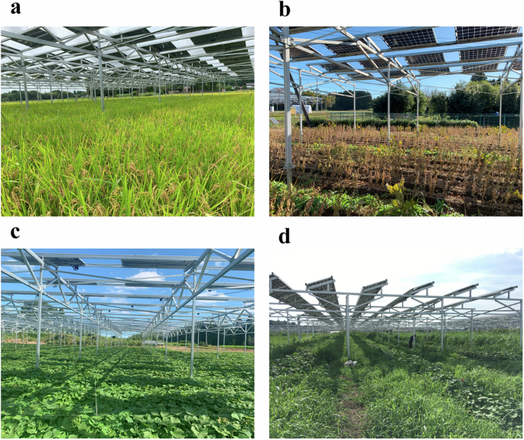
On-farm agrivoltaic impacts on main crop yield: the roles of shade avoidance, cultivation practices, and varieties - npj Sustainable Agriculture
Agrivoltaic systems, which integrate agricultural production with photovoltaic energy generation, have garnered attention for their dual-use potential. However, few studies have addressed yield variability of major staple crops, and their morphological and physiological traits in agrivoltaic systems. This study investigated yield performance and shade avoidance responses of three major Asian staple crops, rice, soybean, and sweet potato in agrivoltaic systems. We also assessed the influence of cultivation management practices, such as cultivar selection, weed control, and micronutrient fertilization, which have been overlooked in previous studies, using organically grown sweet potato. Field experiments for rice, soybean, and sweet potato were conducted in 2024, while organic sweet potato experiments in 2023–2024. Our findings revealed substantial inter- and intraspecific variation in yield responses to shading. Rice grain yield remained stable under 27% shading, whereas soybean seed yield decreased by 30% under 33% shading. Conventional sweet potato tuber yield decreased by 40% under 31% shading and further under 49% shading. Organic sweet potato tuber yield in different cultivars decreased by 26–51% in 2023 and 18–65% in 2024 under 40% shading. All crops exhibited shade avoidance responses in agrivoltaic systems, such as increased plant height and elevated shoot-to-root ratios. Among sweet potato cultivars, the degree of yield reduction was linked to the intensity of shade avoidance responses. In contrast, neither weed control timing nor micronutrient fertilization significantly affected yield. These findings underscore the importance of understanding crop- and cultivar- specific morphological and physiological responses to ensure stable production in agrivoltaic systems.
Not to mention as temperatures continue to climb, more will benefit from the shade because 30% shade will be closer to what the plants consider “normal/ideal”
 Hanrahan
some years ago an article here in Australia interviewing a sheep grazier who had solar a large solar farm, one of the things he said he’d not considered was in times of drought, the many acres of panels had water droplets in the morning condense on the panels and made drip lines of grass for the sheep, apparently enough extra growth it got him through a recent dry spell, that and shade for the sheep
That’s a great point as well…. I wish I had enough to make that big of a difference.
A significant portion of farmland in the US is used to grow corn solely for ethanol production.
If this land – and this land only – was instead used for solar farms, it would produce several times more electricity than the entire country uses, easily allowing the US to be 100% solar powered. (Not with some hypothetical future solar tech – with the tech we have right now.) Corn production for food and even for livestock food would not be reduced at all, only ditching the cornfields used for ethanol production.
Or just, you know, put some solar farms in the vast desert areas the US has, where there’s even better sun exposure and hardly ever any cloud coverage. Then they’ll be even more efficient, and most of that land isn’t used for anything anyway, except maybe some light cattle grazing. (And light cattle grazing can work perfectly fine alongside solar panels. The cows might even appreciate the shade on hot days.)
Long-distance electricity transport is exponentially lossy, and it makes people dependent on vulnerable centralized infrastructure. So your first suggestion is more practical on a national/continental scale.
Solar panels could also be placed on parking lots of dead malls and other decaying suburban infrastructure.
Why do you say that? Intuitively every kilometer takes the same fraction of the remaining electicity, which creates an exponential curve. Technically the loss fraction would be 1 minus the exponential curve, but that’s still an exponential function. Is there something about power generation that makes it a log function of distance?
Is there a reason why these just aren’t over large parking lots for covered parking?
To … keep cars dry? Seems a bit like a waste. If you are going to be building something it would be far more beneficial to build a roof for a homeless shelter than a car park.
the part of the homeless shelter that costs money isn’t the roof, so that’s a false dichotomy… not to mention loads of those kind of buildings already have PVs on the roof
and being from australia, i definitely more thought heat than wet… but either way, id probably say not for the cars… its probably for the people going to and from the cars
better to build apartment blocks and then put panels on the roof of the apartment block and people have shops right there.
industrial buildings however should be covered in panels ffs.
That would mean A) buildings having a lot more weight on the walls then designed for, which could cause problems, B) Maintenance would be an absolute nightmare. ‘Just put them in a field’ is the correct take. I know we all want the solarpunk yogurt commercial world, but mundane things like ease of construction & maintenance win 9 times out of 10.
 野麦さん
野麦さんFuck industrialized farmers. Fuck them, no lube, with a spiked bat. They pollute our waterways with their overfertilization, use synthetic urea made in middle-eastern hellholes out of natural gas and then shipped halfway across the planet on the most polluting boats possible, suck up all of our natural water in aquifers for irrigation, destroy natural landscapes and wildlife habitats, spray glyphosate over all our food poisoning consumers with cancer and decimating insect populations, suck up tax dollars to subsidize their pointless bullshit, and fill in wetlands to grow their precious cornfields. Oh, and they use diesel tractors. I seriously think that any farmer crying about agrivoltaics should be shot in the head and have their land eminent domained.