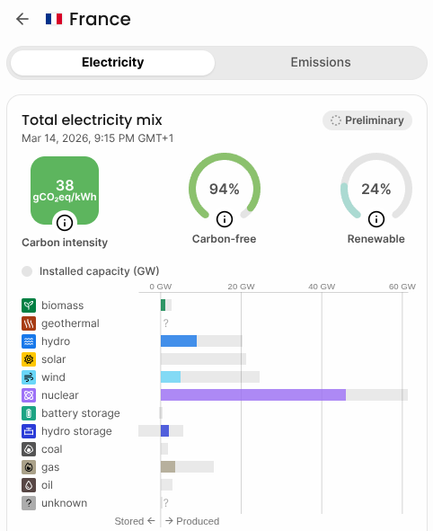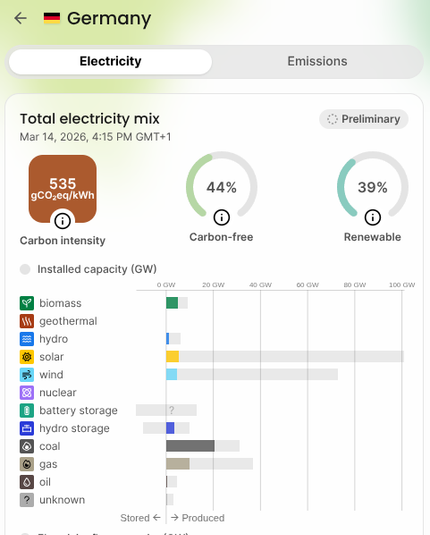
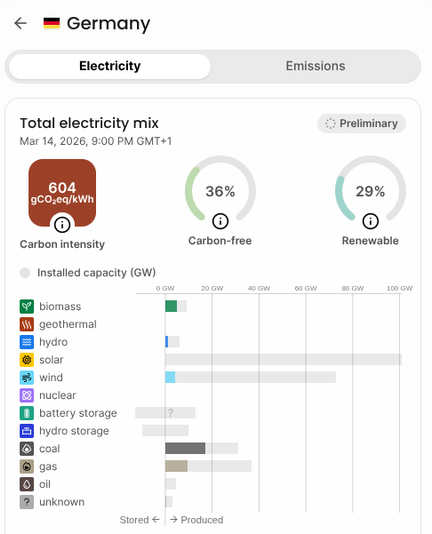
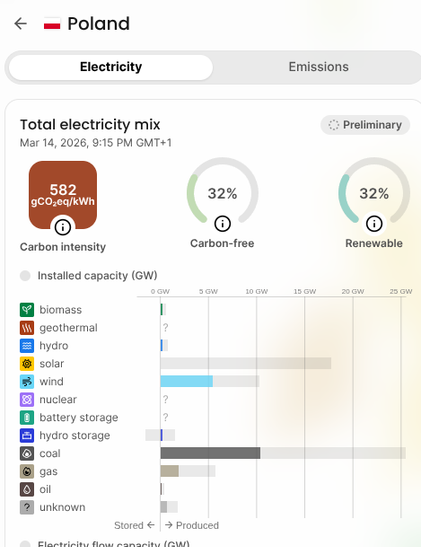
Wow, who would have expected a Dunkelflaute in March? But here it is:

  • #Germany - the “energy transformation leader with the most renewables in Europe” - 604 gCO2eq/kWh
  • #Poland - old coal baseline country that is heavily investing in wind and building its first nuclear power plant - 582 gCO2eq/kWh
  • #France - the hopeless case of old, legacy #nuclear that has “no future” and “contributes nothing to decarbonisation” (literal quotes) - 38 gCO2eq/kWh

It’s not a typo, the last number is really “38”, that is 16x less than the first number. And the whole point of #decarbonisation is to emit less CO2.
@kravietz So your theory is that people think solar panels would generate power at 9PM in March -- well after dusk -- and are now surprised this isnt the case?
kravietz 🦇 (@[email protected])

Electricity generation today 16:15 GMT#Germany 535 gCO2eq/kWh#Poland 553 gCO2eq/kWh#France 28 gCO2eq/kWhSuch a puzzling situation, what could be the difference between these three European countrie...

@kravietz https://energy-charts.info/charts/power/chart.htm?l=en&c=DE&week=11 <- better source, showing the problem: too much lignite -- as hard coal was decommissioned first to protect jobs in the east of Germany.
Energy-Charts

Die Energy-Charts bieten interaktive Grafiken zu: Stromproduktion, Stromerzeugung, Emissionen, Klimadaten, Spotmarktpreisen, Szenarien zur Energiewende und eine umfangreiche Kartenanwendung zu: Kraftwerken, Ăśbertragungsleitungen und Meteodaten

@Sweetshark

Makes perfect sense. And nuclear power was decommissioned to protect… what, climate? 🤔

@kravietz Nuclear was decommissioned because even the plant owners didnt want to do the repairs to keep them running as they were lacking maintenance for decades due to the phase out commited to after Fukushima in 2011 under Merkel.

Which wouldnt be a problem, if two things would not have happened:
* the Altmaier-Knick severely hampering #renewables in 2012
* #Suedlink / #Suedostlink being sabotaged by conservative politicians in Bavaria delaying needed network capacity

@Sweetshark

commited to after Fukushima in 2011 under Merkel

Makes perfect sense, as Germany is well-known seismic area with tons of tsunamis.

the Altmaier-Knick severely hampering renewables in 2012

But Germany never lacked renewables capacity in terms of installed power, did it? Germany has 100 GW solar, 70 GW wind, 6 GW hydro and - let’s pretend it is also low-carbon - 10 GW biomass. Yet, 24/7 electricity supply is still ensured by coal and fossil gas.

delaying needed network capacity

You mean 7000 km of high voltage lines that needed to be upgraded countrywide and using as much land and resources as a highway?

@kravietz > But Germany never lacked renewables capacity in terms of installed power, did it?
The north has decent capacity in recent years, the south didnt. This is now slowly changing because solar so dirt cheap, so the south is adding solar capacity, reducing the need for a north-south flow.

@Sweetshark

But that only means that instead of having 400% of the installed capacity versus average consumption, Germany will have say 500%, but it will still need these coal and gas plants for times such as yesterday, when there’s no sun and little wind?

@kravietz Still makes sense, given how insanely cheap solar has become. And neither the old coal and especially not the old nuclear plants would be able to do the load-following to help.
That is on network capacity and gas peakers only (Same for France when its to hot for its nuclears: it then needs needs both network capacity and German gas peakers to fill the gap).

In the shared Franco-German net with enough capacity, the mix -- except for the coal and esp. lignite -- is actually decent. That might change with France moving to more renewables -- but by that time network capacity will be helped by various energy storage options including long-term #greengas.

@Sweetshark

by that time network capacity will be helped by various energy storage options

I will kindly request that each time you hear such a phrase using future tense you read this article:

https://krvtz.net/en/posts/ideological-origins-of-energiewende.html

Because that’s precisely how in 2011 Germany engineered the consensus that nuclear phase-out and rapid decarbonisation are possible: by making lots of dubious assumptions in (then) future tense, which never materialised.

Ideological origins of "Energiewende"

Germany's one time famous #Energiewende (energy transition) program has been blamed with gradually pushing the country into the hands of #Russia gas dependency, rather high CO2 intensity of German ele

Infrastructure and Application Security