 BjarkeSS
 Hacker Memes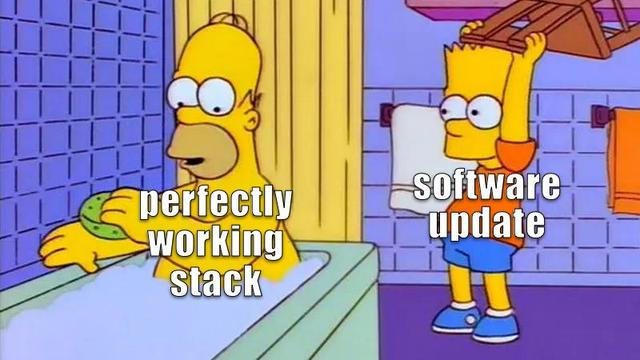
 Mimi
Mimi24H2
@i0null This is why I really really want to see a heavier focus on general stability in design and stuff to stop forcing insanely frequent (and in most cases completely automatic without option) updates.
Security stuff I get, but we get updates for just simply correcting typos and such. Sure correct them, but don't immediately issue an update for that. Turns out the not fully tested other changes in there break ten other systems...
We need more software stability. 😭
As I was thinking about updates in varous contexts, I realized that ideally we need to separate security aspect of updates from the function aspect (and, since I am dreaming, separate from changes in UI).
I remember sticking with Firefox 3.6.4 for a long time, simply because FF4 had a different UI, but it was not sustainable, because from the security point of view using an outdated browser is just not a good idea.
@VileOx @i0null There are some things where this is an actual existing thing. Linux kernels, for example, tend to have two lines, one focusing mostly on security and stability, the other on features.
I'm given to understand that Android can also do security as a separate thing (though you still get both things together when you update, there's no reason it couldn't be separated I think?)
Theoretically, yes. Android, specfically, as you have mentioned, does that. Having said that, vast majority of programs do not, hence the OP.
I can also understand the programmers who work on new and exciting features, improve security, and cannot be bothered (expecially in the unpaid F(L)OSS world) with separating the two for the benefit of a few cranky users.
I assume if there is significant demand, such features (separating security and functionality updates) would (and do!) exist.
cannot be bothered (expecially in the unpaid F(L)OSS world) with separating the two for the benefit of a few cranky users.
It's not "for the benefit of a few cranky users" though. It's for the benefit of... everyone... That's the point of, well, this whole thread. Things being more stable benefits everyone. New features should be introduced slowly, after being properly tested and etc.
I agree that the principle is good. I also see that majority do not and have not for a long time done it. In the "before" days, when everything was not connected to the internet, it was possible to have, let's call it, legacy setups for a loooong time. As soon as our computers became interconnected, just about everything, starting with OSes (Windows, Linux, Android, etc.) and continuing with the most common programs, which tend to be communicaton-oriented, require constant security updates, that are rarely separate from function updates.
There is the ideal world and there is real one.
My guess as to why something that many claim to crave is not given is threefold: first, it would objectively take more time to maintain security-only support, even for those who are client-oriented; second, it is good for 'business' (see planned obsolence), where you need to upgrade to a modern, secure and shiny version; and, finally, because we let them, even as we complain about it.
If there was a true demand, we would have popular forked versions for FOSS (see Pale Moon), popular proprietary software that does not change needlessly, but we don't.
 Nazo
Nazo Vile Ox