
Maybe you remember I got interested in Camellia crassicolumna because of the alleged causal relationship between (1) the length of time from your last caffeine intake to your head hitting the pillow and (2) the amount of deep sleep you get that night.

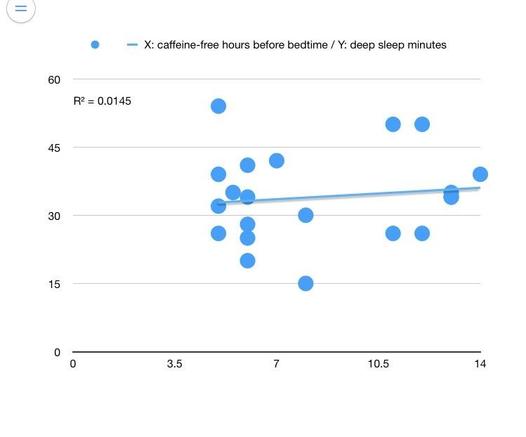
Well, I now have 21 days' worth of data in a scatter plot with a linear trendline fitted, and I’d say "scatter" is an understatement. It’s my understanding that an R^2 of 0.0145 is pitiful even in biology. I’ve tried fitting other types of curves without better results.

You might notice the absence of any values of caffeine-free hours < 5. Maybe I should take one for the team by drinking C. sinensis closer to bedtime?

Aside from that, does anyone better versed in statistics than I have something to say?
@tea

@babelcarp @tea only 21 samples for one person is way too low. The noise is going to overwhelm the data at that point, especially if you're not controlling for other factors. For example, if you were working out on some, but not all days, then you might see two stronger trends if you graphed those days separately, instead of one weak one

@wizardwes How many samples do you suggest?

@tea

@parslii @babelcarp @tea or more. Also, you should probably compare sticking to a consistent-ish timing over a period, rather than shotgunning the times over different days. That way you can better control for aspects of your life that might otherwise influence your caffeine timing.

@wizardwes I’m tempted to reply, “easy for you to say.” You’re urging me to keep up this project for 10-20 times as long as I already have.

But honestly, I don’t see the mathematical reasoning behind what you recommend.

@parslii @tea

@babelcarp @wizardwes @tea there are a lot of variables that effect how well you sleep. you aren't living perfectly choreographed days that are different only in your caffeine consumption. i think it sounds like a really messy hypothesis to test. to tease out what caffeine does to your sleep, you may need to account for other things too. how much exercise? how many calories? when did you eat or exercise? rate your stress level for the day on a scale of 1 to 10? are there seasonal things that effect your sleep?
@parslii @babelcarp @tea 100% that's why I was saying in a previous message that you'd want to do a consistent timing over a period of time, that way, hopefully, the randomness of life would balance out over that period

@wizardwes The “randomness of life” is a rubric for a set of factors that together appear to have far greater explanatory power than caffeine taken in >= 5 hours before bedtime.

@parslii @tea

@parslii I never claimed, or even imagined, that caffeine’s effect was uniquely powerful.

While, as Thomate pointed out, the jury is still out regarding the effect on deep sleep of caffeine taken in within 5 hours of bedtime, it seems pretty clear that caffeine taken earlier in the day isn’t all that consequential.

At least in my body!

@wizardwes @tea

@babelcarp Here's how I'd think about the data you have here:

I'd expect the effect of caffeine to look something like a logarithmic decay over time; nb that's not the deep sleep time, but the change in deep sleep time relative to a non-caffeinated control.

That data looks like you're well into the part of the curve where it's having essentially no effect. You could probably still measure it, but you'd need to control for confounding factors (identify sub-groups of the data and run regressions there). It's being swamped by "noise" here, but there's another way to phrase that: of the various factors affecting your deep sleep times, this is at best a minor one.

You could probably get more interesting data by drinking a bunch of tea in that 0-5h range. I suspect you'd then be able to better identify the section of the X-axis where tea has a more noticeable effect. If your goal is to drink tea as close to bedtime as you can, this might be interesting. If you're happy with a 5h cutoff, I think you have all the data you need. If your goal is better sleep, keep tracking tea, but add other dimensions, like exercise or salt intake or whatever, and you might start to find clusters where you sleep especially well or poorly.

All of the above assumes the deep sleep tracking is being reasonably measured, which might be a huge assumption (-;

@tea

@tfb Thanks; this makes a lot of sense to me.

I think I’ll play with the 0-5 hour interval. Right now I’m not feeling a strong ambition to account for all the variance in my deep sleep. Honestly, I’m feeling some cynicism about the state of “sleep science.”

@tea