
One of my favorite sites is https://etymonline.com – it adds so much nerd-joy to my life! Recently subscribed to support them, and now I wanna see if they're open to making a .ZIM file for #Kiwix 🤔

Saw this fun exchange today and [linguistics ramble loading...]

// Edited to link the EOL entry for "griffin" (to which "griffon" and "gryphon" are linked as alternatives): https://www.etymonline.com/word/griffin
There's more surprising history in there too!
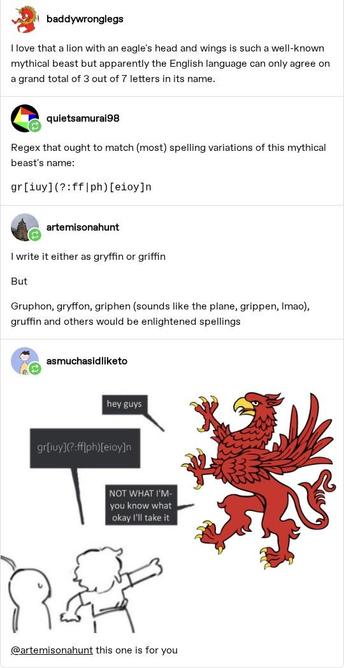
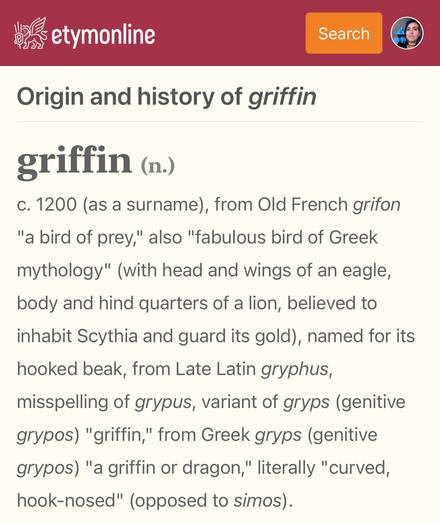
Anyways, my guess is it has to do with being an infrequently-used word (for most of us) which entered English before orthography was standardized so much.

I'm a big fan of doublets – where the same word is imported multiple times, sometimes with v different meanings, sometimes quite similar (like "warden" & "guardian"): https://en.wikipedia.org/wiki/Doublet_(linguistics)

Doublet (linguistics) - Wikipedia

In language learning, I love the surprise overlaps that teach you more about the words you already know.
Like how "parable" and "parabola" are the same word in Spanish! And French "travailler" links English "movement" and "challenges" to Spanish "work".

The inter-connections add so much dimension, and reveal the depth of history: like the vast influence of Arabic, coming from ancient scientists & the Umayyad Caliphate in Iberia. Alchemy! ✨

@alexglow I like how when animals are walking around we use the Anglo-Saxon (cow, pig, sheep), but when they're food we use French (beef, pork, mutton). Because it was Anglo-Saxon peasants who looked after the former, and it was French-speaking nobility that ate the latter.
@TomF Yesss! :D