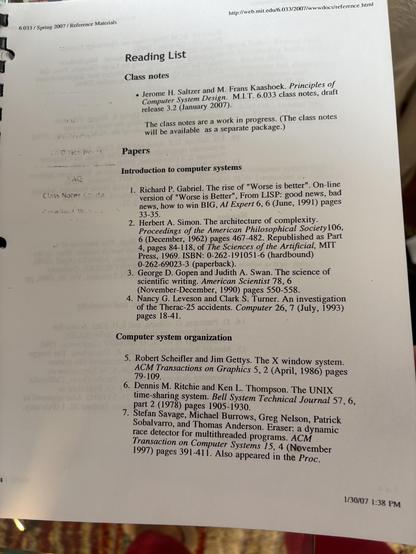
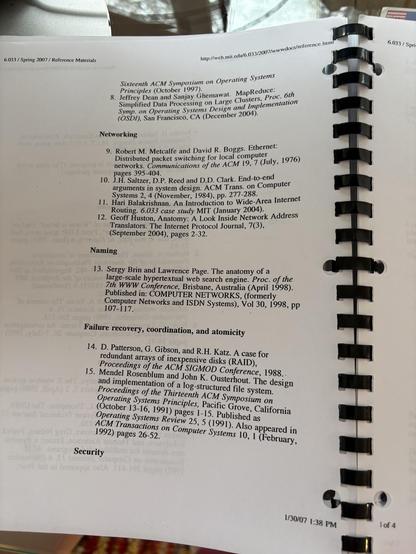
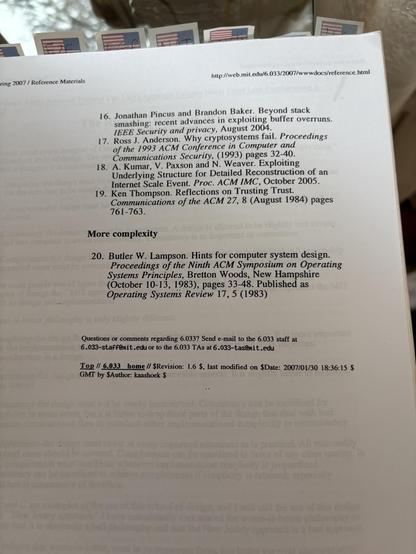
Just found the reading materials from my first systems class. šŸ˜ Pretty great list. I loved the class and many people are surprised that it didn’t involve any coding whatsoever.

(Sorry for the lack of alt text, it’s too long for Mastodon’s limits. The photos are of a bound book with the reading list replicated here: https://web.mit.edu/6.033/2007/wwwdocs/reference.html)

@irene One of the great moments of revelation that has occurred in my adult life happened when one of David Farber ("grandfather of the Internet") students told me about his work on the DCS - distributed computer system - at UC Irvine in the late 1960s.

Before that I had viewed computer networks as collections of individual computers that happened to have links. After that I changed my entire view of networking to think of them as complex distributed systems, filled with feedback loops and one-way influences via often long-latency and certainly error prone channels.

I still find that an important view of our networks and I am finding it sad that so many of us "Internet types" do not understand that clinging to the old way of thinking inhibits our ability to understand, diagnose, and repair what is becoming one of, if not our most important, lifeline, communications and system-foundational infrastructure.

@karlauerbach I love stuff like this. Stuff like this is why I do what I do (research) because I not only get to have the aha moments myself but I get to create them for other people too.

@irene My hobby horse right now (and has been for several years) is a sense that we need to step outside of our present computer/networking sense of design methods and begin to look to how living things do it.

Living stuff is robust (although it accepts the concept of death as a useful tool, something we humans don't like to accept.)

Life aims at survival, not necessarily optimum use of resources. We need to think of that more.

I don't know how to do this - my tiny little step is to recognize that living things do not "deprecate" old methods, they just layer new methods on top. Yet in our human designs we often replace what worked with what works better (or at least seems to work better even if it can't handle cases the old methods did.)

One aspect I never followed was work at Univ of New Mexico about how systems can recognize "self" from "others" - based on biological methods of immunity response.