 Randahl Fink
Those who keep complaining that wind turbines do not work when the winds are not blowing, just realized that oil does not work when the Hormuz Strait is not open.
 Globob
 ohir
ohir@Globob @randahl
> that wind turbines are not a substitute
Add to this solar and in tandem they are. You can even fill up a tank of the combustion engine car with them. [1][2][3].
In Europe we have enough materials dumped to landfills as waste to build a storage facility with a capacity of over 1 TWh storage. Perpetual batteries technology that is (was) with us for more than 100 years. Was because they unearthed research from early forties of the past century that hinted them how to cripplle those batteries using Ca, Sn, and Al additives since 1975 or so (when the first oil prices peak endangered their bottom).
[1] https://pmc.ncbi.nlm.nih.gov/articles/PMC7970114/ (open) CO₂ -> CH₄
[2] https://www.nature.com/articles/s41560-023-01314-8 (paywalled) CO₂ -> C₃H₈
[3] https://deltaliquidenergy.com/turning-the-tide-on-co2-emissions-the-path-to-renewable-propane/ [abstract of above]
@ohir @randahl Solar + wind isn’t the answer in Germany or Netherlands according to simple analysis of real-time datasets
https://energyasicit.ca/WindModel/
https://energyasicit.ca/WindModel/
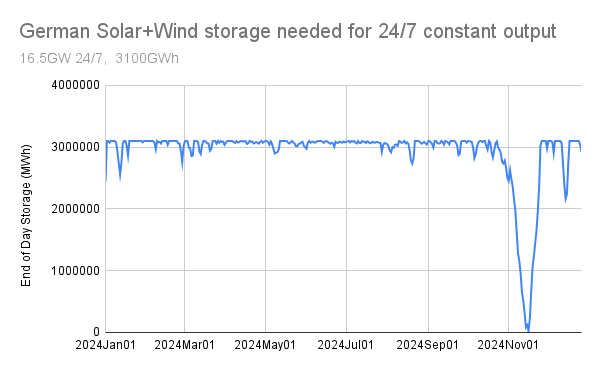
Pb-PbSO₄ batteries 80Wh/dm3, 8kWh/m3, lead: 7kg/dm3, 7t/m3
The suburban mall parking lot of 30x50m stuffed 1.5m under surface with 1m high plates gives 12MWh storage, 10MWh safe.
Highway verge 4m wide with same 1m high plates under give 32MWh per km. You can store 3TWh of above chart under some 100km of your nearest Autobahn unused otherwise grassy verge. If you'd put your battery under sides you could have 3TWh spread over some 50km.
For 3TWh you would need 2.800.000t of lead. Considering current data [1] it would be 15-20 years of the WASTE tailings processing. I.e. getting all that lead off the landfills where it goes now. If copper ore processing would care more about lead output, I think (did not digged enough), we could do such storage in 10 years.
Once again: Pb-PbSO₄ batteries are perpetual. They can last millenia. They excel at short cycles unlike lithium/sodium technology. There is a two magnitudes less toxic waste of their production than with lithium technology. You can regenerate them in-situ in fully automated way (as this is almost pure mechanical process).
And all that lead once sealed in the battery plate/case poses no toxic threat to the environment (unlike the tailings being on the landfill).
@ohir @randahl That 3TWh has essentially only one full discharge cycle per year. At $100/kWh that battery costs $100b for 16.5GW or $6b/GW. From a climate perspective there is a far better use for that wind and solar power than dumping onto a JIT grid. It is called green steel.
https://energyasicit.ca/EnergyVision/
https://energyasicit.ca/EnergyVision/
@Globob @randahl
> green steel
Yes, heavy industry using solar energy is a way to both savings and having environment recuperate a bit. Just we need to get electricity storage awareness higher.
The lead-acid storage is cheapest and cleanest of all. The only "disadvantage" it has that it is not patentable. Hence the long term "lobbying" against. I mean bribery and blackmail that started in mid seventies of the 20th century.
@Globob @randahl
> recommended depth of 50%
Car battery recommended. And true, because car battery plates endure many forces storage batteries do not. Those under the ground will move likely at earthquake time. The numbers I gave account for 80% discharge cycle. In such batteries plate frames are reinforced (thats why 80Wh/dm³ came here, instead of 115Wh/dm³ of contemporary car battery).
> recommended depth of 50%
Car battery recommended. And true, because car battery plates endure many forces storage batteries do not. Those under the ground will move likely at earthquake time. The numbers I gave account for 80% discharge cycle. In such batteries plate frames are reinforced (thats why 80Wh/dm³ came here, instead of 115Wh/dm³ of contemporary car battery).
@ohir @randahl It is worth emphasizing that green steel can use 100% of the solar and wind electrons with zero battery storage. The concept of a virtual wire reduces the grid changes required to almost zero also. Furthermore if one eliminates gas on the grid by overbuilding baseload nuclear the CO2 savings can be amplified by 10 fold. It just requires a mindset change with very little technological change.
https://energyasicit.ca/VirtualWire/
https://energyasicit.ca/VirtualWire/
@Globob @randahl
>...(replying to all three)
We, I specifically, do not talk car batteries. The less the crippled with planned obsolescence additives ones. Data in your counter "arguments" came from such assesments. Try to search real industrial/army data. Not all are buried to the cellars. Not all were burnt. Submarine batteries data are easiest to find.
Direct Industry use of solar energy needs batteries too. Usually Vanadium based ones, because China has it and those batteries have good characteristics as buffers. And direct Industry use is orthogonal to the diffused cheap storage. The ammount of solar energy we can harvest is and always will be magnitudes over our storage capacity. What I am doing is to make others aware about what is possible but got "lobbied" out. Green steel, green concrete, green any other energy intensive industry just adds up to the green kitchen in your home.