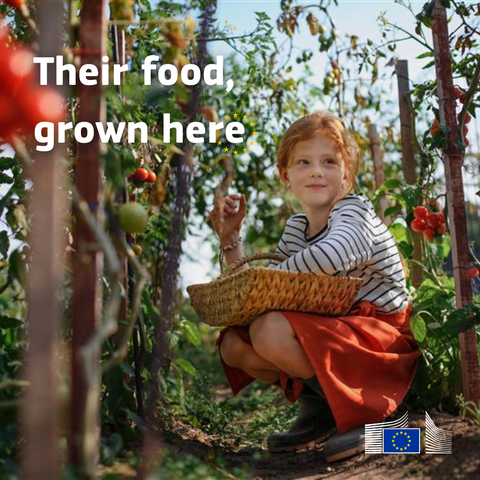
Supporting the people and ecosystems that sustain us. 🌱

We are working to ensure Europe’s food and water security remains unshakable.

This means:

✔️ ensuring farmers receive fair compensation,
✔️ using open technology to protect our water from pollution, and
✔️ rewarding the restoration of our soils and biodiversity

By valuing our farmers, our bees and our soils, we protect the health of every citizen.

Towards a more resilient, healthy Europe.
@EUCommission I hope that means you'll be addressing the 80% of CAP going to subsidise meat (ref: https://www.nature.com/articles/s43016-024-00949-4.epdf). Where are the plans to retrain farmers and how they use their land?

Additionally, honey bees are disrupting local pollinators. Honey bees as a monoculture and worked for honey are fragile and susceptible to disease, colony collapse, and a chain reaction of that. When they're gone, there are no pollinators left because we've disrupted them already.

Over 80% of the European Union’s Common Agricultural Policy supports emissions-intensive animal products | Nature Food

The European Union’s Common Agricultural Policy strongly influences the European Union’s food system via agricultural subsidies. Linking global physical input–output datasets with public subsidy data reveals that current allocation favours animal-based foods, which uses 82% of the European Union’s agricultural subsidies (38% directly and 44% for animal feed). Subsidy intensity (€ kg−1) for animal-based foods approximately doubles after feed inclusion. The same animal-based foods are associated with 84% of embodied greenhouse gas emissions of EU food production while supplying 35% of EU calories and 65% of proteins. The transition towards plant-based diets requires supportive market and policy instruments. This study investigates how and the extent to which public funds support animal agriculture by tracking subsidy flows related to the European Union’s Common Agricultural Policy across global food supply chains.
