In related news, my friend William Waites (@ww) has come up with a simple language, based on category theory, that serves as an 'agent framework'.
That is, it lets you hook up LLMs or other agents and coordinate their activity. He's done a lot of tests of this framework, and it seems to work well.
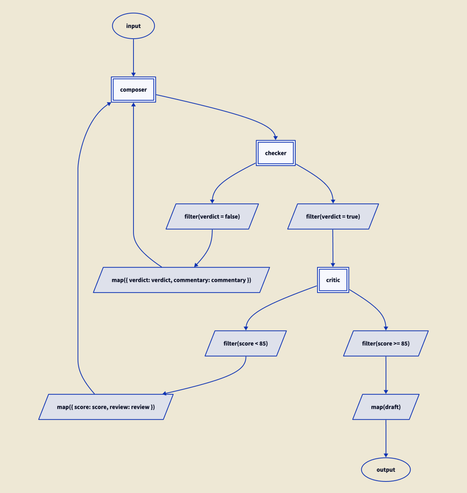
For example, suppose you're trying to write cover letter for a job application. You provide some background material (a CV, some notes, some publications) and the job advertisement. You want a network of agents to produce a good cover letter. A good cover letter has two constraints: it must be accurate, grounded in the source materials, not making things up; and it must be compelling, so that the reader wants to give you an interview.
These two constraints are in tension, and they are best served by different agents with different roles:
• The 'composer' drafts from the source materials.
• The 'checker' verifies the draft against those materials for accuracy, producing a verdict: pass or fail, with commentary.
• The 'critic', who deliberately cannot see the source materials, evaluates whether the result is compelling on its own terms, producing a score.
Frameworks like this already exist, but Waites' new language, called 'plumber', is simple, elegant, and founded on clear ideas.
Details here - it's really cool:
https://johncarlosbaez.wordpress.com/2026/03/11/a-typed-language-for-agent-coordination/
(2/2)
 John Carlos Baez
 Mans R
 SBP
SBP