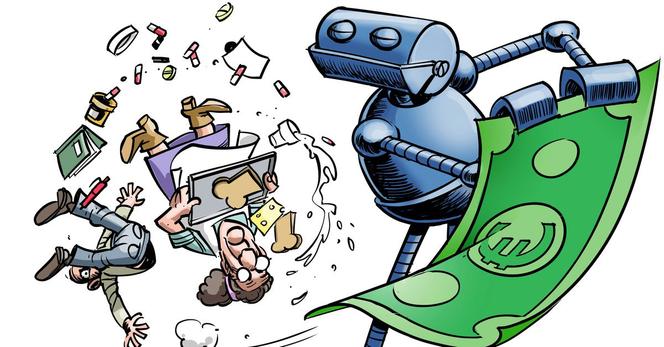
AI holt het belastingstelsel verder uit. Inzet van de techniek verhoogt productiviteit, maar dat komt niet ten goede van lonen, en er wordt in totaal niet voldoende belasting over geheven, ziet Hans Stegeman.

https://www.nrc.nl/nieuws/2026/03/11/het-meest-waarschijnlijke-ai-scenario-is-niet-massaontslag-maar-stille-erosie-a4922732?utm_source=mastodon&utm_medium=social&utm_campaign=mastodon&utm_term=20260311

Opinie | Het meest waarschijnlijke AI-scenario is niet massaontslag, maar stille erosie

Technologie: AI holt het belastingstelsel verder uit. Inzet van de techniek verhoogt productiviteit, maar dat komt niet ten goede van lonen, en er wordt in totaal niet voldoende belasting over geheven, ziet Hans Stegeman.

NRC

@tante @pluralistic

Machine translation:

The most likely AI scenario isn't mass layoffs, but silent erosion

Technology
AI further undermines the tax system. While the use of technology increases productivity, this doesn't benefit wages, and overall, insufficient tax is levied on it, according to Hans Stegeman.
Hans Stegeman is chief economist at Triodos Bank.

Two weeks ago, a scenario analysis by the American investment firm Citrini Research briefly rattled the markets. A thought experiment: what if AI significantly increased production, but the revenues barely reached households or governments? The researchers called it "Ghost GDP": economic growth that doesn't flow into wages or tax revenues. Science fiction, critics wrote. But it touches on something that has been going on for decades, and which receives virtually no attention in Dutch political debate.

@tante @pluralistic

In the early 1980s, over eighty percent of national income went to labor. Now, that's less than seventy percent. This isn't peanuts: roughly calculated, that's a shift of €6,500 per worker per year, not to wages, but to shareholders and capital owners. Total wages have grown in line with the economy over the past two decades, but only because more people have entered the workforce. Per-employee compensation has lagged behind GDP growth by 35 percentage points since 2000: production has grown by 40 percent, while real wages per employee have grown by less than 10 percent. The tax base, the wage sum on which taxes are levied, has held up thanks to a growing working population. This compensation mechanism is already working less effectively due to the aging population.
What effect will AI have on this pattern? No one knows for sure. Predictions vary widely. But early signs are telling. Research on entry-level employees in the most AI-exposed professions already shows employment declines of fifteen to sixteen percent. A large-scale Danish study of eleven occupational groups shows that two years after the widespread adoption of AI, wages and hours worked have barely risen. Productivity gains appear primarily as cost savings for companies, not as higher wages. The most likely scenario is not mass layoffs, but silent erosion: fewer new hires, higher output per employee, and a further decline in the labor market share. Perhaps gradually, but structurally.

@tante @pluralistic

Nieuwe banen leveren minder op
Wie profiteert van AI-productiviteitswinsten? In theorie kunnen werknemers waarvan de vaardigheden AI aanvullen hogere lonen bedingen. Maar Daron Acemoglu en Simon Johnson lieten in hun boek Power and Progress zien dat dit zelden gebeurt: bedrijven zetten AI structureel in als kostenbesparende vervanger van mensen, niet als productiviteitsverhogende aanvulling. Een keuze voor meer winst die gaat naar de aandeelhouder, niet naar de werkvloer. De banen die dan overblijven of nieuw ontstaan zijn ofwel de schaarse rollen waarbij mensen en AI elkaar echt versterken, ofwel de banen die AI simpelweg niet kan doen: zorg, onderwijs, kinderopvang, fysiek werk. Dat zijn ook de banen met de laagste productiviteit per uur, en dus de laagste beloning. De nieuwe banen betalen gemiddeld minder dan de banen die verdwijnen.

Nu de tweede rekening, die hierachter vandaan komt. In Nederland komt meer dan de helft van alle belastinginkomsten direct of indirect uit arbeid: loonbelasting, inkomstenbelasting, sociale premies, de btw die mensen betalen van hun salaris. Die grondslag krimpt al. AI maakt die krimp structureler. Maar er is nóg een probleem. De nieuwe banen in zorg en onderwijs zijn publiek gefinancierd, en ze worden relatief duurder naarmate de rest van de economie productiever wordt. De Britse econoom William Baumol beschreef dit mechanisme al in 1967: sectoren met lage productiviteitsgroei moeten toch meebewegen in lonen, want anders kiest niemand meer voor ze. Dat betekent stijgende kosten juist in de sectoren waarop de verzorgingsstaat het meest leunt. Een verpleegkundige of leraar moet meekomen in loon, ook als hun productiviteit nauwelijks stijgt. De belastinggrondslag krimpt terwijl de uitgaven stijgen. Twee erosieprocessen die tegelijk versnellen.

@tante @pluralistic

Dan is er nog een derde lek.De winsten die AI genereert, landen niet automatisch in de Nederlandse of enige Europese schatkist. De waarde concentreert zich bij een handvol Amerikaanse bedrijven: OpenAI alleen al heeft een waardering van vijfhonderd miljard dollar. Winstverschuiving door multinationals kost overheden wereldwijd al honderd tot tweehonderdveertig miljard dollar per jaar aan belastingopbrengsten. Dat was vóór de AI-explosie. De EU-minimumwinstbelasting van vijftien procent is een stap, maar niet meer dan dat: ze dekt niet de constructies waarbij bedrijven winst verschuiven via licenties op intellectueel eigendom. En de VS, thuisbasis van OpenAI, Google en Microsoft, heeft de minimumbelasting niet ingevoerd. Amerikaanse AI-bedrijven betalen in Europa dus vaak minder dan vijftien procent over de winst die ze hier maken. Nederland profiteert nauwelijks van de waarde die zijn burgers en bedrijven dagelijks creëren door deze Amerikaanse systemen te gebruiken.

@tante @pluralistic

VAT on AI services
The political reflex when faced with budgetary problems is always the same: raise rates. But if the tax base itself shrinks, increasing pressure on what remains yields less and less. You don't solve a tax base problem with higher rates.
Consumption taxes are the least drastic adjustment. As long as people consume, they can be taxed, even if they work less. Economists Anton Korinek and Lee M. Lockwood argued this year that VAT on AI services and levies on energy and water consumption by data centers are a more robust alternative than labor taxes. Social costs currently passed on to society would then be priced by those who caused them.
Capital taxes go further, for example, a wealth tax on AI ownership, or an additional levy on the profits companies make from owning scarce AI infrastructure. Politically challenging, but economically defensible: those with market power bear the costs of that power.
The most fundamental is public ownership. If AI systems generate a growing share of economic value, society should acquire direct stakes in the companies that capture that value. Mandatory profit transfers from platforms operating in public markets. Or a universal AI dividend, where every citizen receives a share in the public infrastructure that powers AI at birth. Norway has been doing this with petroleum for decades. There is no objection in principle to doing the same with algorithms. It sounds radical, but less radical than continuing to finance a welfare state with a foundation that is steadily eroding.
Anyone who does not face this now will pay twice later: first through lower wages, then through higher taxes.