Sigh.

So it turns out we've mapped the neural connectome of Drosophila *and simulated it in silico*.

https://flywire.ai/

Pop-sci explainer here:

https://www.rathbiotaclan.com/whole-brain-emulation-achieved-scientists-run-a-fruit-fly-brain-in-simulation/

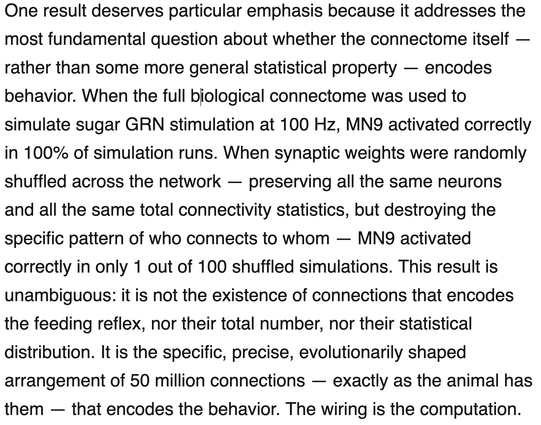
Key quote: "The step from a complete connectome to a working computational brain model is not trivial." And there's an even more important finding in this screenshot (alt text via OCR):

"The wiring is the computation".

/1
The experimenters then went on to hook up their Drosophila connectome to an anatomically detailed Drosophila body model within an open-source physics engine that "uses generalized coordinates and constraint-based contact dynamics to simulate rigid-body systems with high fidelity" including joint and antennae modeling and accurate modeling of surface adhesion—and compound eye simulation.

Lots of *really* interesting insights here.

/2

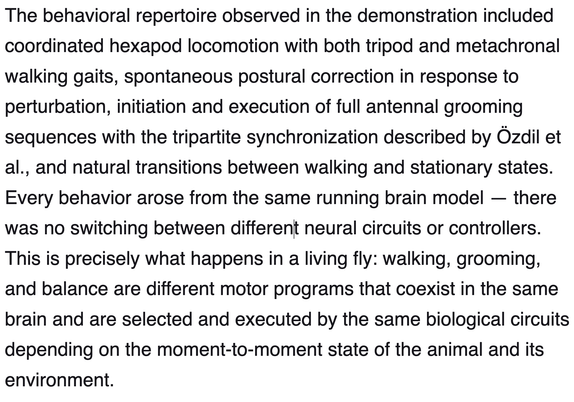
They managed to run a feedback loop between the full 127,400 neuron network in the biological connectome to the physical simulation, with feedback from proprioceptive signals received by the model "fly" in the simulation producing feedback spile trains in the simulation, and THEY GOT RESULTS (again, see alt text of screencap: it's too verbose for a toot):

/3

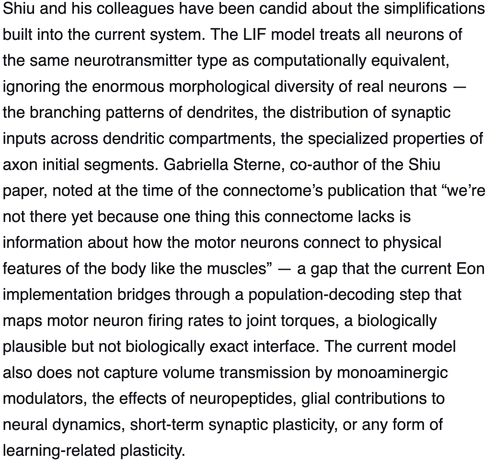
There is stuff missing, of course (alt text for screencap contains about 3 toots' worth of text explaining this): information about how the motor neurons connect to physical features of the body like the muscles, information on morphologically divergent neurons and fine detail on dendritic branching and synaptic inputs across dendritic compartments:

/4

... The next step on from Drosophila, the mouse brain, is 560 times larger—never mind a vastly more complex human brain. And to get the murine connectome we'll have to chop up *a lot* of brains: a human upload won't pass any kind of medical ethics review at this point!

But near-term, it's expected to yield "fundamentally new architectural principles for AI systems that are more sample-efficient, more robust, and more capable of behavioral generalization than current approaches"

/5

But I'm REALLY HAPPY right now because this kinda-sorta validates the key premise of the SF novel I just handed in last month (which involves serial reincarnation via destructive brain-slicing-and-imaging then imprinting onto an immature cortex, and then explores its disastrous societal failure modes).

... And it also hints that artificial consciousness might, eventually, be possible, if only via the hard path of doing it the same way we do it, only in simulation in silico.

/6 (ends)

@cstross
Certainly a more promising avenue towards AGI than stochastic parrots.

But then again, what they're doing here is copying a fly brain into a silicon black box and seeing what it does. The research has nothing to do with improving upon fly intelligence and immanentising the Fly Nerd Rapture.

#ai #llm

@mrundkvist @cstross please do not give the flybros any ideas…