The
#CRTI framework shows why many platforms collapse not from chaos but from too much order …
the full analysis is here:
doi.org/10.5281/zeno... 🦋🖖
Bifurcation Dynamics in Digita...Bifurcation Dynamics in Digital Platform Governance: The Compression–Resonance–Tension Index (CRTI) and the Singularization Hypothesis in Complex Adaptive Systems
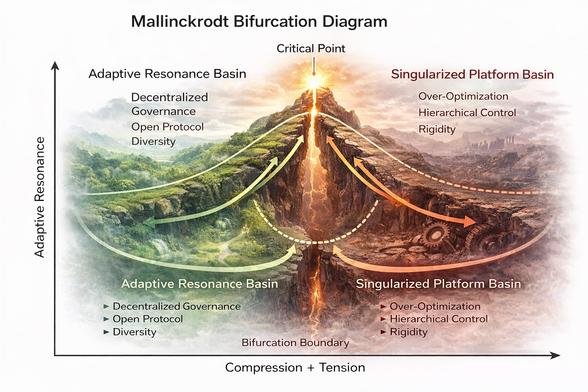
This preprint introduces the Compression–Resonance–Tension Index (CRTI) as a conceptual diagnostic framework for analyzing structural stability in complex adaptive systems (CAS). The CRTI model is based on the hypothesis that systemic fragility often emerges not from stochastic disorder, but from excessive structural compression—an over-optimization of coordination, governance, and efficiency that suppresses the adaptive diversity required for long-term resilience. The framework models system stability through the relationship: CRTI = R / (C + T) where Resonance (R) represents adaptive diversity and feedback responsiveness, Compression (C) captures structural rigidity and governance control, and Tension (T) reflects external pressures such as economic expectations, scaling constraints, or monetization requirements. Building on concepts from cybernetics and complexity science—particularly Ashby’s Law of Requisite Variety and adaptive cycle theory—the paper proposes the Singularization Hypothesis, suggesting that systems may transition from adaptive stability to structural fragility when compression and tension outpace the system’s capacity to maintain resonance. The manuscript applies the CRTI framework to the governance transition of the decentralized social network Bluesky (2026) as an illustrative case study. The analysis explores how governance parameters—including algorithmic filtering intensity, monetization pressure, governance centralization, and protocol permeability—may function as control variables within a nonlinear stability landscape. A conceptual scenario analysis demonstrates how these parameters may influence system trajectories within a bifurcation structure between two attractor regimes: an Adaptive Resonance Basin, characterized by decentralized feedback and innovation capacity, and a Singularized Platform Basin, marked by structural rigidity and diminished adaptive response. While the CRTI framework remains a heuristic theoretical model, it provides a potential analytical lens for examining resilience dynamics in digital platforms, institutional governance structures, and other complex networked systems. Keywords Complex Adaptive Systems Cybernetics Systemic Fragility Compression–Resonance–Tension Index (CRTI) Singularization Hypothesis Nonlinear Dynamics Platform Governance Network Resilience Digital Platforms Adaptive Systems Decentralized Networks AT Protocol Bifurcation Dynamics Complex Systems Theory
 Bernd von Mallinckrodt 🦋