 Josh "cortex" Millard
RE: https://mathstodon.xyz/@mjd/116201545705819330
that's the stuff baby
RE: https://mathstodon.xyz/@mjd/116201545705819330
that's the stuff baby
Boy this is a nice potent nerdsnipe. So, scratching around with it, a couple observations so far:
1. This is done with Tetris pieces (aka square tetrominoes), but it's not done with *all* the Tetris pieces -- some are never gonna fit in any finite 2xn tiling (let alone the 2x2n here): T and S/Z pieces are out of play. That leaves us with only O, I, and L/J pieces to work with.
(We're also omitting the tall/skinny rotations of I and L/J because we only have two blocks of height.)
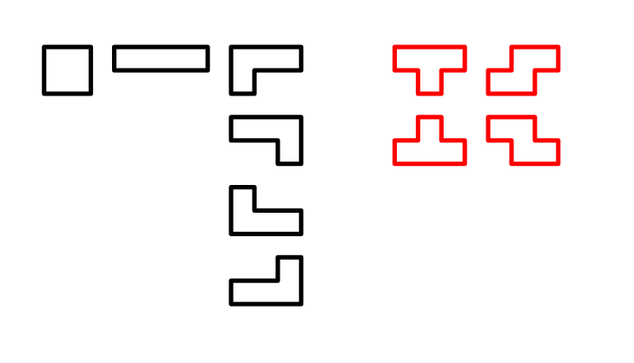
Now, L/J can be thought of as the same piece mirrored across one axis; we can't actually just treat it as the same at all times (more on that) but for organizational simplicity let's call it L. O, I, L are our three piece types.
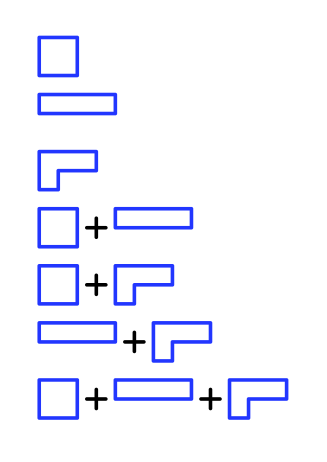
From there we can say that every possible tiling of a 2x2n rectangle is going to be made up of one of these seven subsets of O, I, and L:
{O}, {I}, {L}, {O,I}, {O,L}, {I,L}, {O,I,L}
So that might be as good a way as any to organize our specimens.
The first couple of values of n are very trivial:
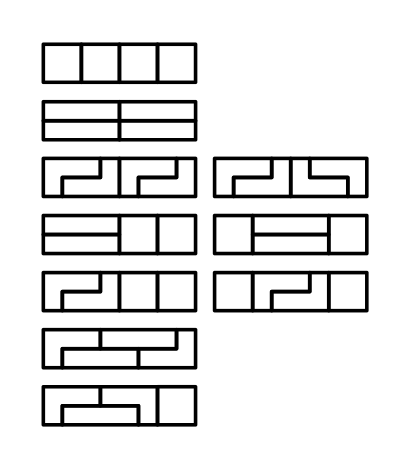
n = 1 (so 2x2n = 2x2) the only solution is a single O.
n = 2 (so 2x4) has four solutions: a pair of O's, a pair of I's, and two different orientations of a pair of L's.
But me being me, I want to avoid repetitions across mirror/rotational symmetry, so I'm going to decide that second pair-of-L's isn't interestingly different from the first one. I'm only going to count that once. So really we have three n=2 solutions, controlling for symmetry.
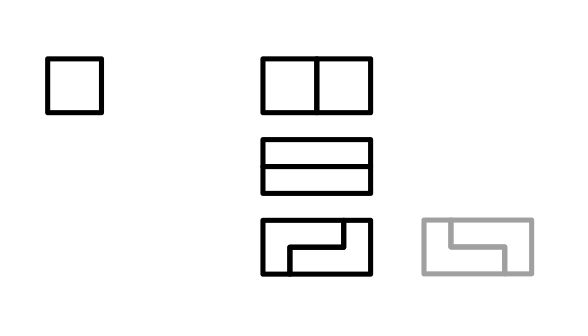
Does this mean we don't ever have to care about the mirroring of L pieces, tho? Nope! We just had to yet. That changes immediately with...
n = 3
For which we have four solutions, controlling for symmetry (several more that I've ignored if you don't, my set will keep diverging more and more from Mark's because of this). The bottom-most of which is a case where we have BOTH versions of L/J in play -- there are times when that WILL matter!
There's also no single-piece solutions except 3 O's.
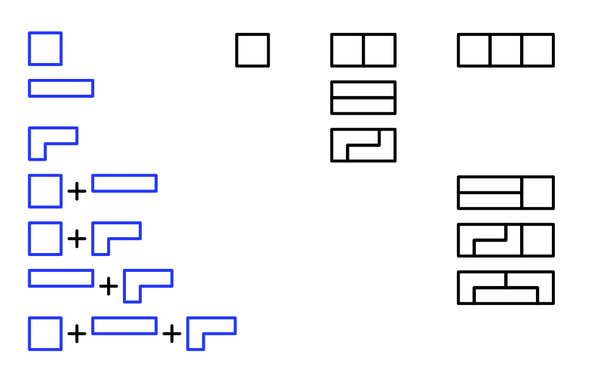
Once we hit n = 4, we're in full swing: there's finally specimens for all seven combinations of pieces, and ten total unique solutions controlling for symmetry.
I have to stop and pay attention to work for a bit, but one of the things I'm excited to fiddle with more is looking at where genuinely new non-decomposable patterns show up (like the sixth one down on the left in this image) where it's not just a concatenation of previously attested smaller specimens.
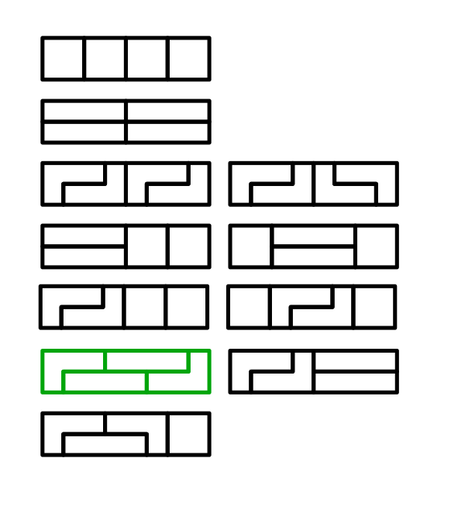
Coming back to this to look at some patterns and make a couple more notes.
First off: for odd n, there's never going to be a solution that uses ONLY L or ONLY I shapes. Which makes sense: for a 2x2n rectangle for odd n, you'd need to arrange n-1 I's or L's into most of the space (and the only way we know how to do that is 2x4 blocks) and then fit one extra one into...a 2x2 space. Oops! So for odd n, those specimens just will never exist.
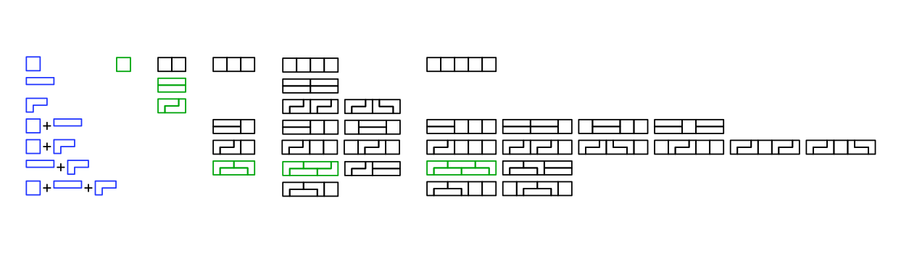
The other interesting thing is where totally new specimens show up -- that is, solutions that aren't a combination of two smaller solutions.
The answer seems to be "literally only in the I+L row", and only and exactly one for each successive value of n >= 3.
I've highlighted all brand-new specimens in green.
n=1 introduces the O as a 2x2 solution
n=2 has two I's and two L's respectively as new 2x4 solutions
n=3 has a new L+L+I 2x6 solution
n=4 has a new L+L+I+I
n=5 has a new L+L+I+I+I...
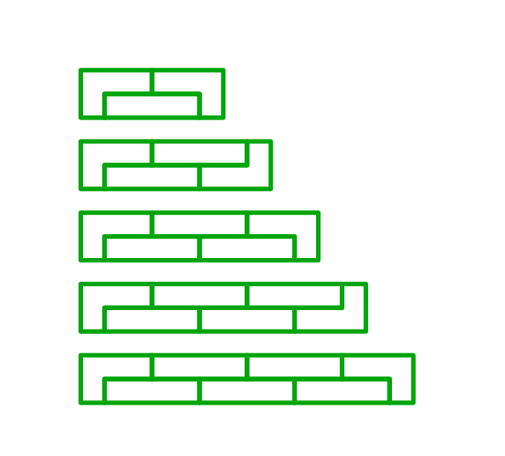
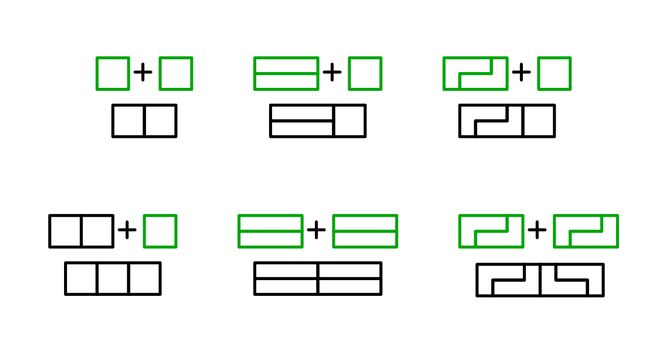
And once we're talking concatenation it starts to feel interesting and tingly to remember that this all started with an observation about the Fibonacci sequence, which is all ABOUT concatenating smaller values.
People capable of crunchy analysis can tackle the actual formal combinatorics here, I know better than to try and put myself and others through that. But it's neat!