 MTZ
MTZGood Advice
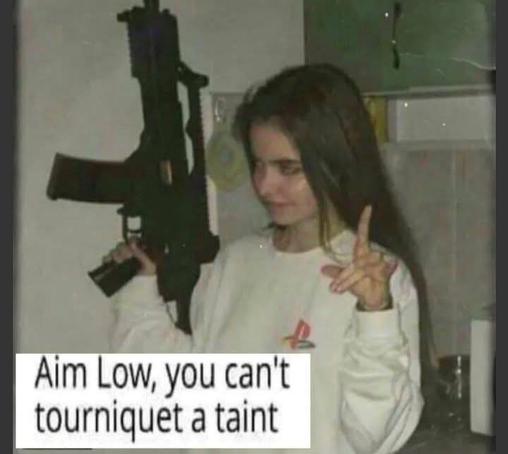
So I know this is a shitpost, but a pelvic shot is taught by some militaries as part of an alternative failure drill (two shots to the chest, followed by one to the head if they continue to be a threat). Its a larger target than a headshot requires, and is rarely protected by armor. Plus of you miss the shot is more likely to hit the ground instead of continuing flight well beyond whoever you were shooting at.
So shitpost or not, its not the worst place to shoot.
taught by some militaries
Also some police agencies.
More importantly, there are ‘junctional tourniquets’ now for armpits and groins. They’re obviously not as effective as a tourniquet around the limbs, but they’re around.
Who would win? Private healthcare or a Phillips screwbullet?
Jfc I hope you’re not serious lol. These are self-defense rounds, meant to break apart inside the attacker or intruder, so you’re not shooting through walls, potentially killing people on the other side.
Part of a defense training class includes, “know your target and what’s behind it” for a reason
Nope, actually the opposite. They’re supposed to overpenetrate. But they look like they’re supposed to expand and fragment, right?
Check it out: lehighdefense.com/…/xtreme-penetrator.html
They do really cool stuff inside ballistics gel because of the surface pressure on that flattened tip
Yes, it generates a larger cavity/hole than a JHP (jacketed hollow point) and the article continues comparing JHP to this new round.
A traditional HP is just that, the center is open, and it almost immediately breaks open on impact so shrapnel sort of goes all over the target. This is safer for everyone involved but might take several shots to stop someone because of the little actual penetration. Especially of a heavy canvas coat is worn out can severely degrade performance.
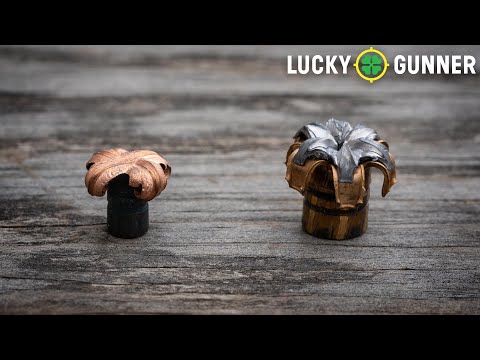
This round, is copper filled with a fluid from the sounds of it, but instead of the front opening up in impact, this his there target and spreads from the rear (the fluid moving forward causing cavitation part). This means the round had a chance to penetrate while also expanding and puting pressure on surrounding tissue which causes more damage. Still though, as it expands, it should greatly reduce velocity and not go through the entire target. A JHP might go on 2-5 inches or more based on design and caliber. Maybe this could go 6-10 inches. If it did exit, there’s likely too little force to do extreme damage to whatever else it hits.
I’ve got some in my safe, but never shot this particular round to experience it myself. I’ve shot all sorts of standard ball, FMJ, JHP, and composite or lead-free rounds of numerous caliber and form factor.
Oh shit for real? I’m stupid and sent you the ones I’m not familiar with because I didn’t actually read it before sending. They also make them without fluid, just a solid bit of copper. Does the same thing but doesn’t expand
I looked up “fluted penetrator” and just linked the first thing I saw, so thanks for the correction and actually reading the article that I was being too much of a tool to read.
This is the bullet I should have used in the image and original comment.
All good man!! There’s a ton of different ammo aimed at different things, so no doubt too many overlap in names and specs, etc.
Holy shit that guy chose “defensive” ammo of .357 magnum lmao! Is there a .357 that wouldn’t destroy the target? Haha that’s awesome. The 9mm for the 2nd test is far more common, but interesting they’re going for penetration while still expanding. You’d think they contradict each other.
All I know is, I don’t want to be on the receiving end of any bullets!
Okay, so that’s the wierd part of them. The author says expansion but it’s not the bullet itself expanding on those. The idea is the bullet stays rigid but those fluted channels and flat nose push matter outward away from the bullet.
Yeah though, bad wound to try and do any kind of first response on
These aren’t really that effective compared to a hollow point. They create a big visual in ballistic gel, but in a more realistic medium they act more like an improved FMJ, but still over penetrate badly (which isn’t a good thing in most cases).
They tend to be recommend as a bear round, where over-penetration is actually valuable and desired.
The same manufacturer actually makes a deeper cut version that doesn’t over penetrate called the xtreme defender, which is generally still worse than a good hollow point in standard calibers, but can be a good option for weaker calibers like .380, where hollow point under-penetrate.
however, for 9mm and above, you’re better off with a standard hollow point, which is more effective and far more affordable than the all-copper xtreme rounds.

Oh, good to know. But how do you assess value? I know we like hp for transferring force but my personal attraction to these was exit wounds.
Also according to a article I linked later, they break bones?
When it comes to pistol calibers, raw kinetic energy isn’t really a factor, they’re just too weak to actually induce any sort of hydro-static shock that could cause a permanent rupturing of nearby tissues, you need much higher velocities or energy to do that that, which only rifle rounds or shotgun slugs can reliably induce.
For pistols, the only mechanism of action they can rely on is the mechanical size of the bullet itself, as the bigger the bullet, the larger the hole, and thus the faster the blood loss. Hollow points are the best method to cause bigger holes.
Ballistic gel is a somewhat deceptive testing media, as it can show a big permanent wound cavity beyond the size of the bullet itself, which isn’t actually how it would perform in real tissue, which is able to stretch much more than ballistic gel due to it being more elastic. What really matters for pistol rounds is being able to expand as much as possible while also maintaining adequate penetration (12" in gel), so that you can reliably penetrate bone and muscle to reach critical organs from any angle. You also want to ensure that the specific hollow point chosen isn’t prone to being plugged by heavy clothing if you live in colder environments.
LuckyGunner provides the best comparison of bullets that I’ve personally seen for every pistol caliber, allowing you to avoid bullets that don’t adequately penetrate, expand, or over-penetrate. Take note of the actual size of the expanded bullet they show, which is what the actual size of the wound itself would be.
All defensive pistol calibers break bone when struck, the xtreme penetrators will simply penetrate further and through more bone than a hollow point. This makes it act similarly to a hardcast (ultra hard lead that doesn’t deform) flatnose bullet, which are also usually only recommended for bear protection.
Over-penetration is an extremely negative trait in personal defense against humans, as it means that the bullet will pass through the target into anything behind them, including innocents who you do not intent to hurt. In self defense rounds you want the bullet to stop inside the first target to avoid endangering anything behind them.
But how do you assess value?
Xtreme Defenders are a good value for bear protection, but are extremely poor value for self-defense, as they are more expensive than a good hollow point while providing less effective wounding characteristics and increased danger to bystanders.
Wow that is really disappointing. Is that why that Paul Harrel guy was using food items? And is 357 too slow to cause tearing like that then? Hydrostatic. I was lead to believe this would work like that because of the speed of that round.
I’ll look up lucky gunner, too. Thanks for breaking all this down for me. It’s looking like bullets have gotten a lot cheaper recently so I might as well get some hp.
Yes, the meat analog he uses, though not perfect, is the closest to a real-world test that a regular person could reasonably perform themselves.
357 out of a revolver is indeed still too slow, even with lighter bullets. Only in a lever action carbine does 357 start to reach the required power to perform some hydrostatic tearing, since 357 is really able to take advantage of that extra barrel length to increase velocity fairly dramatically.
There was an extremely comprehensive video done on real-world wound ballistics that I was struggling to find for my last comment, but I found it just now, once again thanks to Luckygunner.
He gives a summary of it here, and also made this video as a supplement, but if you’d like to see the absolute last word on firearm wound ballistics, I’d suggest this full documentary featuring Dr. Martin Fackler (but be warned, it has some quite gory NSFW images as examples).
Rifle looks like a Galil, so she’s probably got some relation to the Israeli military.
I probably just caused you to have more questions…
Looks like she is standing in a kitchen, actually.
I see a tiled kitchen backsplash, above head cabinets, and utentils like salt shakers and the white box looks like a microwave or a toaster oven, or maybe its a coffee machine.
You got any stats on that? Because I feel like gender-myths shouldn’t be propagated one way or the other when they’re not true.
Because I can’t find stuff to support your statement.
What I do find is Men are more accurate than women in aiming at targets in both near space and extrapersonal space
Men outperformed women on both the extrapersonal aiming tasks, and women outperformed men on the task of fine motor skill. However, a male advantage was observed for one of the aiming tasks performed in near space, suggesting that the male advantage for aiming accuracy does not result from proximity
But then again also
The mid-points of a series of lines which were positioned both within hand-reach (near space) and beyond hand-reach (far space) were estimated by 24 women and 24 men. When using a laser pointer to perform estimations, women were more accurate in the near condition than the far, whereas men were more accurate in the far condition than the near. When using a stick pointer for the far condition, women were more accurate than when using the laser, whereas men were more accurate using the laser pointer than the stick for the far condition. There was no difference between near and far accuracy scores for either sex using the stick. These results suggest that use of a tool which provides proprioceptive feedback causes the brain to remap far-space stimuli as if situated in near space.
Being amazing at shooting is more an individual trait than anything tied strictly to sex.
I’m not saying women aren’t better marksmen, I’ve heard that as well. But I served with a bunch and none of them were especially crack shots. They weren’t especially bad either. I never thought it’s got that much to do with genes or hormones, really. So I’d be interested to see if there is science showing women really are better on average.

Men excel at motor tasks requiring aiming accuracy whereas women excel at different tasks requiring fine motor skill. However, these tasks are confounded with proximity to the body, as fine motor tasks are performed proximally and aiming tasks are directed at distal targets. As such, it is not known …
You didn’t ask me, but I’ve got something: pubmed.ncbi.nlm.nih.gov/21390957/
I’ve understood that Women make better surgeons as well; for the exact same reason. Steadier hand.

To examine gender differences in hand stability, finger position and force holding tasks at low force levels were conducted with 30 male and 30 female young adults. Total fluctuation was defined as the standard deviation of measured data and fluctuation and the 10-Hz component of the physiological t …
No, I didn’t ask you specifically, but I asked the internet in general and you’re a part of it, so technically yeah I sort of asked you as well. The wider audience.
Thanks for the link.
“At low force levels” could be further specified, because I’d like to note that most weapons actually weigh a bit. Ofc if you’re a sniper, you’re looking for a spot where you can use something to hold your weapon instead of using muscles for a static hold.
My point is that while that’s a difference, yeah, I don’t think it’s enough to conclude women are better marksmen, as are neither of the studies I linked. Thanks anyway.
Yet I’ve shot with a lot of women. Like a literal army’s worth. There was no difference, except perhaps one leaning to men having the advantage, but I don’t see a causation other than Finnish dad’s preferring to teach their sons over their daughters.
However the differences I did see weren’t accounted for by any gender difference and the women certainly weren’t that much worse. I’d say the larger difference was city-folk vs people’s who grew up rural. Rural people’s could shoot, whatever they happened to have between their legs, (as well as use axes without putting their own ears at risk,) and city-folk were, well, less-able. Less trained would probably be the correct choice of words.
As I grew up rural, my dad made me shoot my first shotgun and .308 and an officer’s side-arm (which for my great-grandpa was a tiiiiiiny little pistol you couldn’t hit jack shit with from >10 yards) at the ripe age of 12 and my I shot my first AR at 13, I was fair bit more trained than most of the people I went to the army with.
But of those I did shoot with, I just wouldn’t say women are better marksmen. I know it’s a common myth, because the Soviets had female snipers. But that’s just it. It’s myth. Much like “carrots make you able to see in the dark.” It’s not straight up untrue, it’s just not true either.
 ShinkanTrain
 MinnesotaGoddam
 Widdershins
 ProdigalFrog
 Sundray
 RidderSport
 ebolapie
 Dasus
Dasus