 Kris
KrisSolar mit Batterie – was kostet der Speicher?
Kommerzielle große Solaranlagen werden heute oft mit angeschlossenem Batteriespeicher gebaut. Das liegt daran, daß der Energiebedarf abends, nach Sonnenuntergang, oft am größten ist.
Die Speicherdauer, "hours of storage" oder "E/P Ratio" (Energy-to-Power Ratio) bezeichnet dabei das Verhältnis von Energiespeicher-Kapazität zu Nennanschlußleistung, also MWh/MW. Das ist die Anzahl Stunden, die die Batterie Energie liefert, wenn man mit maximaler Last ausspeichert. Wenn das nicht der Fall ist, hält der Speicher entsprechend länger durch.
Der Capex der Installation ist dabei proportional zur Speicher-Kapazität, kann also in USD/kWh angegeben werden.
https://ember-energy.org/latest-insights/how-cheap-is-battery-storage/
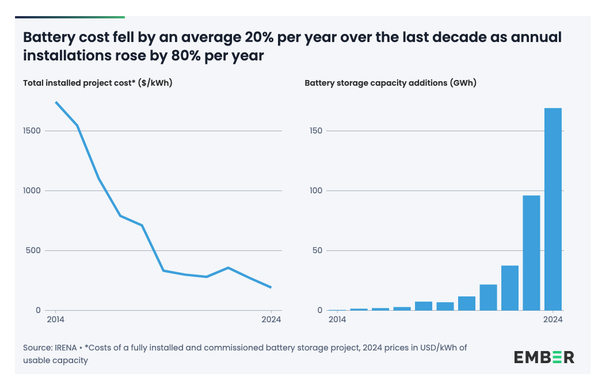
EMBER Energy liefert Zahlen und zeigt, daß der kWh-Capex in 2024 unter $100 pro kWh gefallen ist.
Ember:
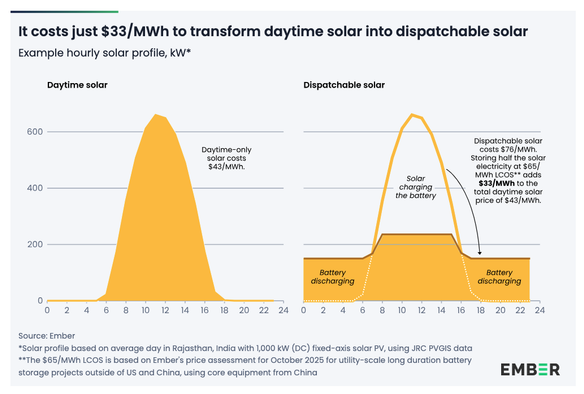
Capex of $125/kWh means a levelised cost of storage of $65/MWh
und rechnet dann die Wirtschaftlichkeitsrechnung durch.
Dabei geht man von reiner Solarnutzung durch die angeschlossene Solaranlage aus. Nimmt man weitere Swing-Energie aus dem Netz auf, sinkt der LCOS weiter ab. Die Zahlen sind für Europa, für China und USA ergeben sich weit bessere Zahlen.
Und:
With a $65/MWh LCOS, shifting half of daily solar generation overnight adds just $33/MWh to the cost of solar
weiter:
This is not the same as baseload solar. Delivering constant power every hour of the year, including cloudy weeks and seasonal lows, requires solar overbuild and more battery storage. But shifting half of daytime solar is a major step. It aligns solar generation more closely with a typical demand profile, meaning solar can meet a much larger share of the evening and night-time demand and significantly increase its contribution to the power mix.
Und können wir so viel Batterie bauen?
Battery manufacturing capacity is already scaling far ahead of demand,, with supply exceeding demand by a factor of three in 2024. While China currently dominates global battery production, this has triggered a wave of investment in new manufacturing capacity across Asia, Europe, the Middle East and the US as countries seek to diversify supply chains and enhance energy security.
Dabei ist Lithium auch keine kritische Resource mehr. Insbesondere bei stationären Speichern hat eine Natrium-Batterie enorme Vorteile (unter anderem ist die komplett Durchgangssicher und zyklenstabiler).

 Markus Sugarhill
 eazysprech
 Tanglahat