 lumpenproletariat
Over the past few weeks, several US banks have pulled off from lending to Oracle for expanding its AI data centres, as per a report.

 NutWrench
Freaking finally. Maybe RAM prices will finally start coming down.
 brucethemoose
Too late, I’m afraid. The supply for DRAM basically can’t adjust, and already-manufactured chips can’t be repurposed, so even if Oracle, Meta, and OpenAI went bankrupt tomorrow, it would take some time to build up inventory again.
Look at it from the bright side. Manufacturers are building massive new capacity for demand that will never come. Already produced chips can’t be repurposed but machinery can, easily. In a few years RAM will be dirt cheap.
That’s not true, from what I’ve read:
www.trendforce.com/…/20251113-12780.html
despite higher ASPs boosting profitability across the memory industry, capital spending on DRAM and NAND Flash is only anticipated to increase modestly in 2026. This limited investment growth is unlikely to significantly affect bit output.
Memory makers seem skeptical, hence aren’t planning to spend on more capacity in 2026.
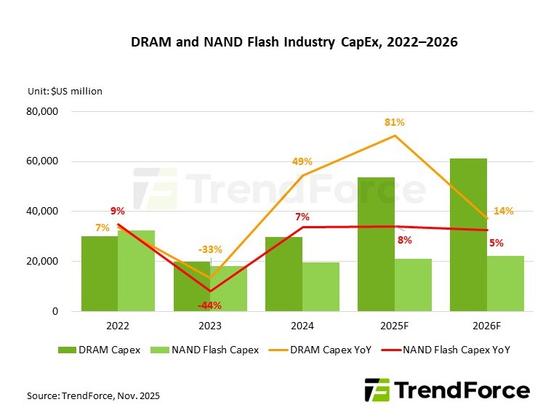
Memory Industry to Maintain Cautious CapEx in 2026, with Limited Impact on Bit Supply Growth, Says TrendForce
TrendForce’s latest investigations reveal that despite higher ASPs boosting profitability across the memory industry, capital spending on DRAM and NAND Flash is only anticipated to increase modestly in 2026. This limited investment growth is unlikely to significantly affect bit output. Instead, the emphasis is shifting from capacity expansion to advancements such as process technology upgrades, higher-layer stacking, hybrid bonding, and high-value products such as HBM.
 xep
xepI don’t actually buy it. It won’t fit on memory modules as they are today, but in the end, it’s just faster, higher density, prob has some extra features, but nothing you can’t rework a motherboard or modules to support. of course, min quantity will be like 128GB :)
That’s not true, unfortunately. It’s not economical to transplant RAM ICs once they’re packaged and soldered onto something.
And if they’re produced as, say, HBM modules, they absolutely cannot be repurposed for, say, DDR5 or LPDDR5 CPUs, or GDDR GPUs. There’s no reworking, the memory buses on processors simply do not support them electrically, and altering those processors would have a massive development cost with years of lead time.
Some of the RAM (like the LPDDR5X for the Nvidia Grace Hopper ARM CPUs) can be re-used, but it seems most is being made as HBM.
 dan1101
I was pleasantly surprised to find my laptop is two generations behind so new RAM only cost $20 for an upgrade. One of the few times it pays to be poor.
They can just keep prices same and pocket the profif, no?
Only if they can still find buyers at the inflated price. I’m not aware of any consumers buying RAM right now, so I doubt they would be able to.