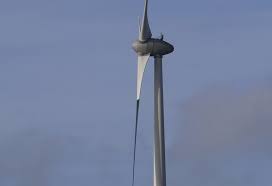
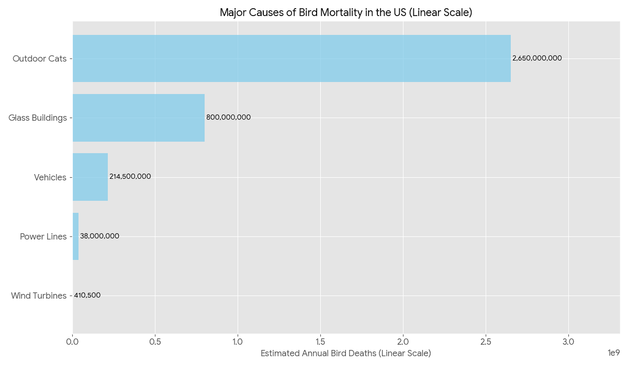
"The biggest bird killer in the US (and likely, the world) is #Cats. Outdoor cats kill somewhere between 1.3 billion and 4 billion birds a year in the US alone. Let’s put it this way: for every one bird that dies in the blades of a turbine, domestic cats are dragging roughly 4,000 back to the porch."

Article: The harm caused by wind turbines isn't nearly as bad as you think...
https://www.zmescience.com/feature-post/technology-articles/sustainability/renewable-energy/birds-and-wind-turbines/

#Birds #Windmills

@nickrauchen Wind turbines could even stop within 10 seconds when birds are around. Marginally bad for energy production, but goodwill is guaranteed. Wonder why that feature is not mandatory yet.

@PeterBlok Because it is very expensive and it can only detect big birds.

@nickrauchen

@vlindervriendje @nickrauchen Relative to the costs of a whole turbine, it's peanuts.

@PeterBlok maybe but one can ask oneself the question if it is really necessary because of such few accidents and because the system doesn't work for small birds. Birds and other wildlife also adapt being around wind turbines. About 15km from my home there are geese breeding directly underneath them. The road makes more victimes. As do powerlines.

@nickrauchen

@vlindervriendje @nickrauchen Smaller birds can also be detected, provided they travel in flocks. Even bats can be detected. And when there's an incentive, even smaller, single birds could be detected.
I would argue that any death that can be prevented should be prevented. The availability of energy hardly suffers from this, neither does the price of energy. It is currently mostly left out because it is not required. Making it mandatory would help in general acceptance of wind power.

@PeterBlok Here and there, there will always be victims, no matter what we do or how much we invest. Just as people will continue to be killed in traffic accidents despite mandatory systems. Don't get me wrong, I'm on your side. Still, we have to be realistic. The number of victims per mill per year is often only one to four. I think that's roughly the number of birds that fly to their deaths into a window of a building block.

@nickrauchen

@PeterBlok Should we therefore ban windows? Moreover, we're seeing birds and other animals, adapt to wind turbines. They're clever. What if birds fly through the Netherlands where the systems work, but not abroad? They then assume the turbine is shutting down, while those abroad might not. That also results in casualties. So it's not so black and white.

@nickrauchen

@PeterBlok Dyeing one wing, which has also been suggested, could be a solution, but technically it's not so easy because the mill could become unbalanced, which is undesirable. Repeatedly informing people, thus debunking the persistent myths about "butcher" mills, is probably the best approach.

@nickrauchen

@vlindervriendje @PeterBlok

The article said something like "power loss was minimal," maybe 2%?

I assume that they balance those big "wings" in a similar way to the wheels on your car.

Next gen blades could have the color "baked in" at time of manufacture and would not have the power penalty, maybe?

Worth pursuing, researching, & deploying if it has significant positive effects.

@nickrauchen @vlindervriendje I don't see the wind industry picking up on having one dark blade. Weight shouldn't be a problem, it's just a different colour. Probably logistical costs prevent this development, along with people also being more aware of each turbine then.
Furthermore, a recent study found that it does not affect bird fatalities significantly, at least not everywhere. So the jury's still out on this one.
https://windpowernl.com/2025/07/03/pilot-with-black-wind-turbine-blades-in-eemshaven-shows-no-impact-on-bird-collisions/
Pilot with Black Wind Turbine Blades in Eemshaven Shows No Impact on Bird Collisions | Windpowernl

A pilot project in Eemshaven, the Netherlands, has found that painting one blade of a wind turbine black does not reduce bird collisions

Windpowernl

@PeterBlok The weight sure is a problem. Different paints have different weight, consistancy and different resistance to air so it has to be ballanced perfectly. Way different than a wheel of a car. It has to be evenly on the whole blade or the effect will cause disaster, I learned from experts in windmill technology. I'm a certified advisor for including wildlife in solarfields and windparcs. We still take regulair fieldtrips long after the study because of rapid changing techn.

@nickrauchen

@vlindervriendje @nickrauchen Lots of people are not bothered by facts, you know? They believe all kinds of bullshit, are susceptible to fossil propaganda. So countering the 'wind mills kill birds' myth with bird detection on all of them will hush the argument. And actually save some bird lives at the same time. Which we should.

@vlindervriendje @PeterBlok

Again there is effective #mitigation going on in the building trade.

My non-expert understanding is a series of parallel lines either etched into or applied to #windows helps #birds identify the solid barrier, but has little effect on inside out viewing. 🙂

@vlindervriendje @nickrauchen We normally do what we reasonably can. Like seat belts and air bags in cars, helmets on bikes. Stopping a turbine when there are big birds or flocks of small ones around sounds reasonable, right?
And it's true that wind mills hardly affect bird populations compared to other human activities, like climate change. So in a sense, they save more birds than they cause harm.
Still does not mean to keep things as they are, just make them better.
@vlindervriendje @nickrauchen Whether to keep things as they are or not depends on the risk and cost of improvement. The investment is really not that high for the 25 year span of a turbine. Even less when it would become mandatory.
Top predators getting killed is more important to the eco-system than smaller birds, they can even damage the turbine. So sheer numbers are not telling everything. Also, migratory bird routes coincide with wind mill locations, it can also be helpful there.