
"A cursory glance at the economic and social development of service-oriented economies dampens any such optimism. There is a reason why manufacturing jobs occupy such a central place in contemporary populist rhetoric. As a rule, they generate significantly higher value added per employee and per hour than jobs in the service sector. In countries such as Germany and the UK, this difference is typically 15 to 40 percent. In addition, around 70 percent of all private investment in research and development in Germany comes from the production sector. An economy that allows an uncontrolled decline in its industrial production willingly accepts a future of stagnating productivity growth and declining real wage growth. This would be no different in Germany.

Britain is the prime example of a country that, despite a large service sector with highly productive services (such as IT, consulting, and finance), is trapped in a vicious cycle of low investment, productivity, and real wage growth as well as high inequality. This reflects that the so-called “productive” services are accompanied by high exploitative rents (from capital income) that inhibit economic activity in other areas while driving up asset prices.

The UK economy is paradigmatic of the “dual” or permanently “K-shaped” type of economy, in which income gains benefit the top 20 to 30 percent (but especially the top 10 percent) while the rest stagnate or shrink in the face of rising living costs. While Germany has not been exempt from these trends (inequality has been increasing and wealth disparities are anomalously high), a UK-ification of its economy would worsen them.

The relative indifference to deindustrialization from the liberal center can hardly be justified."

https://jacobin.com/2026/03/germany-deindustrialization-trade-green-elite
#Germany #Deindustrialization #Manufacturing #Economy #EU

German Deindustrialization Is Self-Inflicted

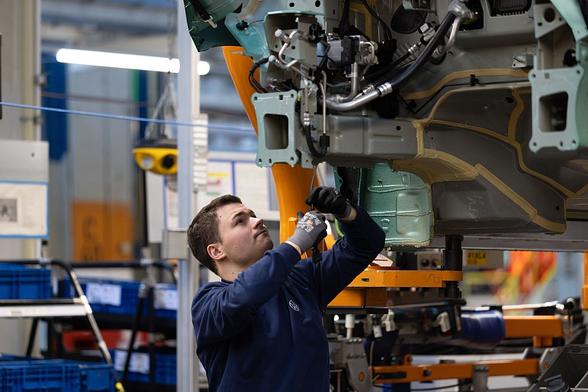
Germany is in the midst of an industrial job loss wave worse than the one during COVID. The Right blames the green transition, and parts of the Left blame the Ukraine war. But the real cause is the shortsightedness of Germany’s political elite.

"To the extent that higher energy prices did hurt industrial production in previous years — the energy costs of competing industrial firms abroad have fallen in recent years — was largely due to the broader shocks in gas and oil during the pandemic and war. However, the decisive factor in this context was not renewable energies but the blatant German and European general dependence on imports of fossil fuels. The implication is that renewable energy capacity has not been expanded enough.

The argument that the energy transition is to blame is also self-serving. It shields Germany’s political and economic elite from accountability for deliberately damaging the country’s economic prospects. The political class bears collective responsibility for the enormous investment backlog that accumulated during the fiscal consolidation of the 2010s, when they pursued debt reduction through budget balancing despite the fact that interest rates on German government borrowing were very low or even negative. Key infrastructure projects are stagnating, as are private capital investment and capacity utilization, which are further depressed by weak domestic demand in the context of ongoing efforts to reduce debt."

@remixtures whether „austerity policy“ or allocating budget (which was/is still quite big for Germany) wrongly (subsidizing eg large companies during the pandemic via „Kurzarbeitergeld“) shielding old industries instead driving future ones (like infrastructure for renewables) as the failure of the political elite might still be worth discussing.
In any case, the economic „elite“ (i.e. DAX execs) relies way too much on federal subsidies. That‘s where I‘d see the bigger failure.