 Adrianna Tan
For all the Proton fans
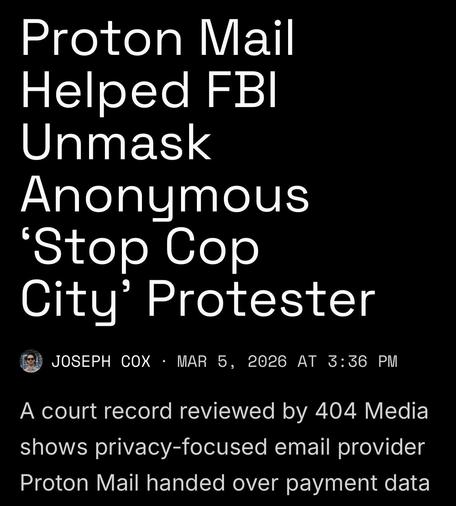
@skinnylatte This headline is incredibly biased. Did Proton help the FBI? Or did they hand over data to the Swiss government that the Swiss government ordered them to, and then the Swiss helped the FBI unmask an anonymous protester?
I keep seeing this post pop up in my feed with permutations of "WHY PROTON DO THIS!?" -- Because they were legally ordered to.
We're doing a disservice to ourselves for not recognizing the bounds of the privacy that Proton, or Tuta, or any other "private" email service provides, and looking at this moment as a failure by the provider - when really it's the failure of a user to recognize the technical & legal bounds of of their comms services to keep them anonymous.
The lesson here, i think, is about opsec, and knowing the bounds of the tools we're employing for whatever our goals are.
@r3dr3clus3 @skinnylatte If you don't have the data, you can be ordered to give it up by whomever, and you can't. Proton mail claims privacy, but it in fact saves enough data to identify a single individual.
The headline is not biased. Proton claims things they actually can't uphold. This is not the fault of the customer. Stop blaming the victim.
If you pay by credit card they, by definition, have the data and can be compelled to give it up. Just like any company will be. The headline is sensational FUD.
I don't use Proton, but the misinformation flying around about this now will lead people to very simplistic "Proton bad! No use Proton!" instead of "I want to be anonymous, so I need to rethink my opsec in ways that avoid obviously traceable things like credit cards."
This is the problem. People need to learn the difference between security, privacy, anonymity and secrecy and where those things overlap and how to balance them against living as a hermit in a cave somewhere. Simplistic "Proton(etc.) bad! No use Proton(etc.)" hijack what needs to be a calm, fact-based discussion.
 Red
Red warning low flying owls
 My camera shoots fascists