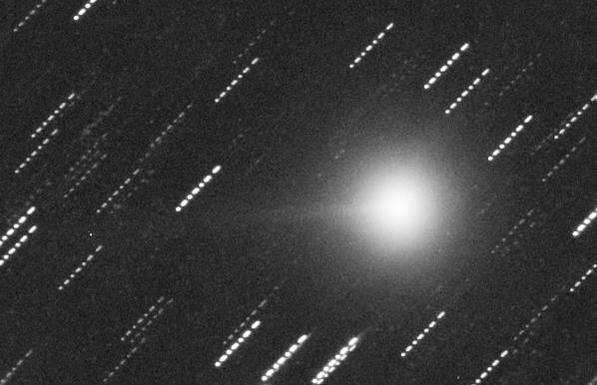
Will THIS become the comet of the year if not decade? "6AC4721" doesn't even have a proper number or name but it is on a #Kreutz orbit that will bring it very close to the Sun in April - and was discovered already farther from the Sun than even Ikeya-Seki, whatever that means: https://www.facebook.com/groups/227002358661288/posts/1665380981490078/ and https://astronomynow.com/2026/01/16/potentially-bright-sungrazing-comet-discovered/ and https://x.com/JAtanackov/status/2012283238807482804 discuss the uncertain outcome of the adventure. In any case here is the comet last night: "Kreutz Comet 6AC4721 is currently brighter than expected,." write G. Rhemann and M. Jäger: "A deeper image from Namibia (Jan 16.91, 12“/3.6 12x120sec with Asi 6200) already shows a 2' coma and 85” coma in Pa 41. The total brightness measured with the Tycho Tracker was 16m5."
The new #Kreutz #comet discovered unusually early has been named C/2026 A1 (MAPS): https://www.minorplanetcenter.net/mpec/K26/K26BC9.html - see https://www.spaceobs.com/en/Alain-Maury-s-Blog/The-discovery-of-comet-C-2026-A1-MAPS for the discovery story and http://www.cbat.eps.harvard.edu/iau/cbet/005600/CBET005658.txt and https://www.facebook.com/groups/227002358661288/posts/1670699484291561 (!) and https://groups.io/g/comets-ml/topic/117373975#msg34667 for diverging views about its chance of survival when it races a mere 160,000 km over the #photosphere on 4 April and becoming a bright comet.
The new #Kreutz #comet is now C/2026 A1 (MAPS): http://www.cbat.eps.harvard.edu/iau/cbet/005600/CBET005658.txt and https://www.spaceobs.com/en/Alain-Maury-s-Blog/The-discovery-of-comet-C-2026-A1-MAPS and https://www.minorplanetcenter.net/mpec/K26/K26BC9.html - whether it will reach and survive #perihelion is highly uncertain but there is hope as https://www.facebook.com/groups/227002358661288/posts/1670699484291561 and https://groups.io/g/comets-ml/topic/117373975#msg34667 explain. And if MAPS makes it to perihelion and is (very) bright then coronagraphs on the ground might be able to catch it against the inner corona as the following table - calculated with https://ssd.jpl.nasa.gov/horizons/app.html#/ - shows.
When checking the brightness development of the fascinating #Kreutz #comet #MAPS with https://cobs.si one sees that the observations so far all nicely sit on a standard comet curve with a high n of ~6.7 i.e. the nucleus responds vividly but also calmly to the increasing solar heat. While the extrapolation with three different models is quite something, with peak magnitudes - directly next to the Sun in the sky, of course - of either -5 mag., -20 mag. or -40 mag. Scary stuff ... ;-) But seriously, some special math for sungrazer brightness trends will kick in at some point before perihelion is reached.
Prospects for #Comet C/2026 A1 MAPS - a comet with a narrow tail in the evening twilight, with uncertain but potentially high brightness? https://hdr-astrophotography.com -> Tail simulations for comet MAPS: https://groups.io/g/comets-ml/message/34888 - in order not to depend on a single prediction, i have simulated different scenarii.

So the new #Kreutz #comet #MAPS is *still* following the constant rapid rise in brightness it has shown since discovery: a dumb extrapolation - https://cobs.si/analysis/?comet=2688&from_date=2026-01-15+00%3A00&to_date=2026-04-30+00%3A00&observation_type=V&observation_type=C&plot_x_value=1&plot_y_value=1&fit_option=1&exclude_faint=on&exclude_issue=on&observer=&association=&country=&compare_values=compare - has it get 10,000-times brighter than the Sun at its extremely close perihelion which makes so sense at all, of course, physically.

"It must therefore be assumed that this increase in activity will level off significantly in the near future," writes https://fg-kometen.vdsastro.de/koj_2026/c2026a1/26a1eaus.htm: "More likely are parameters m m0=12.0 mag / n=4 (or even lower), which would still result in a (very short-term) maximum brightness of about –9 mag (but this would probably still be significantly too bright) – always assuming that the comet survives its perihelion passage unscathed."

For other views see http://www.cbat.eps.harvard.edu/iau/cbet/005600/CBET005663.txt and https://arxiv.org/abs/2602.17626 and https://www.facebook.com/photo?fbid=10236580364221799 and https://cometografia.es/cometa-kreutz-2026-a1-maps-analisis/ - and the actual brightness is tracked at https://cobs.si/obs_list?id=2688 where it has reached ~11.5 mag. now.

The #Kreutz #comet #MAPS "has become more than 1 mag brighter between March 6 and 9" and stands at 10.5 mag. right now: https://groups.io/g/comets-ml/message/35019 and https://www.facebook.com/photo/?fbid=2374472359736249 with the latest picture by Jäger & Rhemann here - less than 4 weeks til perihelion, and the brightness continues to rise with a strong n~8 ...
@cosmos4u The apparently rapid brightening seems to be an artifact of observers who previously weren't able to detect the outer gas coma suddenly being able to see it and only now including it in their photometry as it brightens and contracts. The true total brightness of the full coma has been rising with n ~ 3.5 since at least early February.
@qicheng If I force fits through the COBS data cloud from Feb. 10 or 15 onwards I still get n~7.5 (while a fit from discovery to early February gave n~6) - what data specifically do you base your n only half as big on? Green in http://www.cbat.eps.harvard.edu/iau/cbet/005600/CBET005663.txt and Sekanina in https://arxiv.org/pdf/2602.17626 (fig. 3) also saw a high n though there may have been some downturn recently, also noted by Lefaudeux in https://www.facebook.com/photo?fbid=10236580364221799
@cosmos4u That's derived from my own, uniformly processed large aperture photometry. But as an example, Michael Jager's near-discovery photometry (https://www.facebook.com/groups/227002358661288/posts/1666582504703259/) covering the inner 2' of the coma was already ~2 mag brighter than the points on COBS at the same time. Meanwhile, the characteristic diameter of a green ball / C2 gas coma (i.e., containing 1 - exp(-1) ~ 63% of the total emission) was ~8', and the brightness inside an 8' circle would've been ~1.5 mag brighter, with the full coma another ~0.5 mag brighter than that. The telltale sign that the apparently rapid brightening is an observational artifact is that the coma size estimates associated with the reporting magnitudes have been expanding, whereas the physics of photodissociation means the gas coma contracts as the comet approaches the Sun. The latest coma size estimates have been starting to exceed the now ~2' characteristic size, so (provided you exclude all the magnitudes associated with smaller coma estimates) you should soon start seeing the reported magnitudes converge onto the n ~ 3.5 trend of the total brightness if the comet maintains its recent behavior.
ICQ Comet Observations | Kreutz Comet 6AC4721 is currently brighter than expected | Facebook

Kreutz Comet 6AC4721 is currently brighter than expected. A deeper image from Namibia (Jan 16.91, 12“/3.6 12x120sec with Asi 6200) already shows a 2' coma and 85” coma in Pa 41. The total brightness...