Hey @jpm, what kind of fibre and optics do I want? going to do 2-4 ~10m runs.

I am currently getting in way over my head with a 25 gigabit Mikrotik switch but this started as point to point runs.

Think future-proof, not necessarily cheap but of course some of this shit is going to come #StraightOuttaShenzen

Looks like I might have painted myself into a bit of a corner with some "cheap" SFP28 gear, too, but I'm not too attached

@voltagex remind me tomorrow, but in a nutshell go for 10km 1310nm or 1550nm single-mode if it’s not too much more expensive than 850nm multi-mode. You’ll be able to find everything you need on FS.com
@voltagex right, brain engaged, i think, so let's talk high-speed ethernet and the SFP family of optics.
@voltagex (after picking up Little Miss 7 from school early because she fell on her face)
@voltagex Ok, SFPs. Little rectangles, about THAT big, one end goes into network-related thingo, other end goes into cable
@voltagex and that's about it. There's no magic to them, they just translate one signal to another. On the host-side (switch or NIC), it's a high-speed serial connection, and on the cable side it could be anything, limited only by the imagination of a SFP vendor and market demand.
@voltagex In general, you'll only really need to know about SFP, SFP+, and SFP28, and only really need to know about them in the context of Ethernet. QSFP+ and QSFP28 are just 4 SFP+ or SFP28 in a trenchcoat.
@voltagex so, what's up with the cable end? That's where things get deep into "it depends" territory. Luckily, it boils down to 3 different cable families.
@voltagex namely, single-mode fibre, multi-mode fibre, and twin-axial copper (think, coaxial cable, but with 2 cores instead of 1). Even better, the OG 1Gbit/sec Ethernet SFP doesn't even really have the twin-ax option, it only really started appearing from 10GbE.
@voltagex The twin-ax option is the simplest, but the most limited. It literally just electrically connects the high-speed serial links on the host equipment together. Given how fragile these high-speed serial signals are, the cable length is extremely limited to about 10M at most, and anything over about 5M is going to have active signal conditioning and amplification onboard. It works great for anything inside the same rack or the immediately-adjacent rack, but don't go too much further than that.

@voltagex the second option is "multi-mode" fibre optic cables and optics. Traditionally, they were cheaper than "single-mode" but this is no longer true, because cheap VCSEL lasers are now capable of single-mode emission. They operate in the 850nm near-IR light band, and cables are generally constructed from 50um diameter plastic or glass cores. Because of the loose tolerance of the optics and fibre cores, their range is usually limited to 300M, and there's multiple grades of multi-mode fibre available with corresponding limitations on distance vs speed similar to copper ethernet cables. If you're buying new now, just go with OM4. OM1 cables use 62.5um diameter cores, and are only usually found in up to 1Gbit/sec applications. OM2 and later are all 50um diameter cores, but the optical transmission properties vary between generations which will limit transmission length.

You definitely don't need the fancy hybrid single-mode optics that use multi-mode cables unless you're trying to run 10GbE up the side of a building with ancient OM2 multi-mode cable plant.

@voltagex the third option is "single-mode" fibre optic cables and optics. This is where Shit Gets Real, and you do not look at energised optics with remaining good eye. Luckily, the actual cables are already so good and cheap that you just buy whatever from a reputable vendor and it'll work with any new single-mode optical devices you ever want to attach in future.

The optical devices on each end, however, are another matter entirely.

The basic consideration is the range class - typically either 10km, 20km, 40km, 80km, or 120km. Direct correlation to how much power the laser uses, and how expensive the modules is. Faster speeds may not get the 120km range class. Yes, you can have a single piece of glass 120km long to carry your signals.

And then comes the "oh wow holy shit my mind is blown" consideration of WAVELENGTH DIVISION MULTIPLEXING

@voltagex unlike electrical signals where only a single signal can be present on a conductor at the one time, you can send MULTIPLE DIFFERENT SIGNALS, IN DIFFERENT DIRECTIONS, AT THE SAME TIME, ON THE ONE FIBRE CORE
@voltagex you don't NEED to, of course, but you CAN, just by replacing the optical components on both ends.
@voltagex the "basic" single-mode SFPs run at either 1310nm or 1550nm far-IR wavelength, and use a single dedicated fibre core for each transmission direction. Not really any different than a multi-mode fibre connection, except the distance is now at least 10-20km
@voltagex the "bi-directional" single-mode SFPs come in pairs, where one of the pair transmits on 1310nm, the other in the pair transmits on 1550nm, and both transmit on a single fibre core at the same time. The receive path uses a wavelength-selective prism to direct the received wavelength to the receiver inside the SFP module while passing the transmitted wavelength through with little attenuation. This is the basic theory of how GPON networks work over a single fibre core as well.

@voltagex and finally the "wavelength division multiplexing" single-mode SFPs specify their wavelength, which is then optically combined into a single fibre core and transmitted to the other end, where the multiplexer uses wavelength-selective optics to split the signals back out into separate wavelengths on multiple fibres again.

Oh yeah, and there's 2 kinds of WDM, "coarse" and "fine", but they both work the same way, the only difference is how closely the wavelengths are packed together.

Almost certainly you don't need this, but you can just attach WDM MUXes to the single-mode fibres you already have whenever you want!

@voltagex and for extra lols, you can combine CWDM optics and muxes and BiDi operation, so you end up with 8 x 25Gbit/sec full-duplex links running across a single fibre core.
@voltagex and finally, 10GbaseT SFP+ modules are an abomination and should never be used if you can help it, because they generate so much heat and eat so much power it's not funny.
@jpm yes, although I've had to literally burn myself on them a couple of times to learn this
@voltagex As for where to buy this stuff, just go to https://fs.com/ I run their stuff in production environments, and they're just as good as the vendor-blessed optics at 1/10th the price. They also have a bunch of exotic optics that vendors don't even offer, but work perfectly well because SFPs are just an abstraction layer between layer 2 and layer 1
FS.com Deutschland - Rechenzentrum, Technologie-Lösungen für Unternehmen und Internetdienstanbieter

Bereitstellung skalierbarer Netzwerktechnologie-Lösungen für Rechenzentren, Unternehmen und Internetdienstanbieter. Entdecken Sie Hochgeschwindigkeits-Netzwerklösungen zum Aufbau einer zuverlässigen und skalierbaren Verbindungsinfrastruktur. Weltweite Lieferung, professioneller Support.

FS.com

@jpm @voltagex important to note though that they work by spoofing the manufacturer codes that switches check for because vendor optic lock-in is where they make cash money. So you can’t just throw any old FS optic in a Cisco and expect it to work — you have to get one with the Cisco coding.

Oh yeah and the Linux drivers for intel 10G cards default to enforcing this “vendor supported SFP” shit unless you explicitly set a kernel parameter because open source capture by corporations lol

@jpm @voltagex oh hey Joel want to see my favourite things that render your last sentence hilariously inaccurate when it comes to weird edge cases in broadcast/AV industry?

  • DirectOut USB.MADI operates a high channel count USB sound card converter on FPGA in the SFP
  • Riedel MuoN HDMI/SDI to/from lossless broadcast Video-over-IP converter
  • @jpm @voltagex we’re over here on layer 2+4i of the OSI model
    @s0 @voltagex I’ll just stay squarely inside the OSI model with these perfectly spherical cows
    @s0 @voltagex but that’s the neat* thing about SFPs, they can mangle any data stream to/from a high speed serial data stream
    @jpm @s0 @voltagex or low speed - I’ve recently been testing out little SFP pluggables that are actually single-port terminal servers for OOB management.
    @jpm @voltagex there's another variant you haven't mentioned - the SFP serial port ... https://www.youtube.com/watch?v=XgmQ-qBrqxY
    The SMALLEST Serial Console Server

    YouTube
    @mherbert @jpm I'm an idiot so I have the SFP VDSL modem somewhere
    @voltagex @jpm hahah ... using SFP for anything other than fibre feels ... Wrong
    @jpm @voltagex aha! So the promise of SPF+ for 10Gbe in a home setup is bs. Good to know.

    @arichtman @jpm @voltagex SFP+ DACs here and very happy.

    Edit: but this is probably the turning point where I decide to run 25gbs when I move my NAS et al out of the livingroom.

    @arichtman No?

    I will disagree with @jpm here - only because I've tried some different gear. The Aquantia AQC113 NICs are fine, haven't tried the new Realtek 10 gig NICs but they are also reasonably low power.

    SFP+ DACs are fine, 10 gig copper SFP+ is fine* if you have enough space around them for cooling.

    https://www.aliexpress.com/item/1005009139011834.html

    https://www.omadanetworks.com/au/business-networking/omada-accessory-media-converter/mc420l/ - this one in particular is great and doesn't get hot. @jpm happy to send you one to check out.

    KeepLiNK 10-Port Netzwerk-Switch | 8 x 2,5 GB Ethernet + 2 x 10 GB SFP+ | Unmanaged | Plug & Play | Hochgeschwindigkeitskonnektivität - AliExpress 7

    Smarter Shopping, Better Living! Aliexpress.com

    aliexpress.
    @jpm @voltagex there's an optical networking 101 talk that gets run at NANOG every few years, it's worth watching (or at least reading the slides)
    @jpm @voltagex what the fuck lmao
    @arichtman @voltagex they’re just different coloured lights
    @jpm @voltagex THATS THE POINT - is this not witchcraft to you? Yes they vibrate at juuuust the right period so they don't interfere.
    @arichtman @voltagex not really. It’s the same as 2.4GHz and 5GHz WiFi sharing the same air
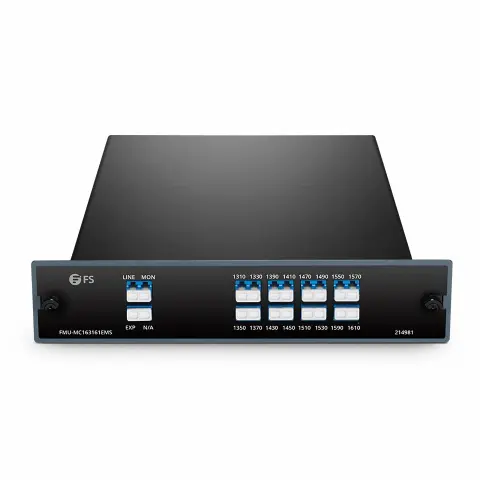
    16 Channels CWDM Mux or Demux, 1310-1610nm, with Monitor and Expansion Port, 4.5dB Typical IL, LC/UPC, Single Fiber, FMU Plug-in Module - FS.com Australia

    16 Channels CWDM Mux or Demux, 1310-1610nm, with Monitor and Expansion Port, 4.5dB Typical IL, LC/UPC, Single Fiber, FMU Plug-in Module, Product Specification:Channel - 16 Channels , Wavelength - 1310-1610nm, Special Port - Monitor, Expansion Port, Technology - TFF (Thin Film Filter), Insertion Loss - ≤5.0dB, 4.5dB Typical, Channel Spacing - 20nm

    FS.com
    @uep @arichtman @voltagex yep I did touch on those later in the thread. The wildest ones are BiDi CWDM with 8 bi-directional channels on a single fibre core

    @jpm @arichtman @voltagex the perils of seeing the thread via a reply and not the main line, and not a tree view.

    Also, "dense" rather that "fine", but yes.

    The cool thing with these is that because they're a purely optical device, each wl can be a completely different L2. we used to do a bunch of Ethernet and FC over different colours between failover sites.

    @jpm @voltagex 40GigE does exist, not just 4x 10GigE but we aren’t talking about backbones here - and in the context of backbones, 40GigE is a bit of a throwback as 100GigE is the go these days

    @ThermiteBeGiants @voltagex nope, 40GbE is quite literally 4 x 10GbE in a trenchcoat that all transmit/receive at the same time. Most QSFP switch ports can be configured either as 40G (all 4 transmit the same frame at once) or 4 x 10G (all 4 transmit different frames at the same time). If you use the 4 x 10G mode, you can use a quad-breakout cable to send the 4 independent 10G signals to different devices. Now, the cool thing about some QSFP* optics is that they use CWDM inside the module, so all 4 channels are optically muxed into a single single-mode fibre core!

    There is, however, a 50GbE SFP56 which is indeed a single 50G channel.

    @jpm @voltagex if you want a fun fact, 10GigE WAN (which is slightly slower than 10GigE LAN) is the same bitrate as the old OC-192/STM-64 SDH spec, to allow for equipment reuse
    @jpm @voltagex Some (all?) are full-blown computers inside those little plugs. One reason the faster ones generate so much heat. And also the way some bastard vendors restrict you to their SFPx kit, rejecting (or worse, slowing!) other vendors'. I'm looking at you, Dell.
    @kauer @voltagex i am seriously thinking about putting a literal RasPi class ARM system inside a SFP, eg for light branch-office network services like NTP, DHCP, DNS, or for sticking 48 of them in 1RU...
    @jpm @voltagex 48? You're going to need a bigger power supply...
    @kauer @voltagex depends how little power i can get the SFP to draw. A full RasPi? Nope. But maybe a single ARM core, 512MB of RAM, and only the RGMII peripheral and SGMII to RGMII PHY active? Maybe...
    @jpm I am good up to 10 gig, above 10 gig appears to be pain, suffering and potential hazards to my eyesight
    @voltagex @jpm ow ow ow brb gonna need a microscope to find these perforations