Tire pressure "transmissions are sent without any encryption or secure mechanisms and include a unique identifier. This allows anyone with affordable equipment like a low-cost spectrum receiver and a standard off-the-shelf antenna to capture and track them throughout time and space."

https://www.securityweek.com/researchers-uncover-method-to-track-cars-via-tire-sensors/

Researchers Uncover Method to Track Cars via Tire Sensors

Academic researchers have shown that low-cost receivers can be used to capture transmissions from tire pressure sensors and track drivers.

SecurityWeek
@dangoodin easy as buying something and navigating a menu

@ghostsarespooky

Please say more. What does one buy? How easy is it for people with only intermediate tech skills to do? Are there any tutorials explaining all of this?

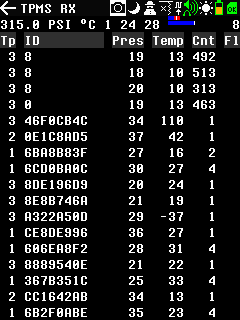
@dangoodin @ghostsarespooky This is a screenshot from a HackRF with PortaPack. TPMS decoding has been a feature since the introduction of PortaPack H1 by Jared Boone in 2014, and he gave some talks about TPMS at hacker cons around that time.

@mossmann @ghostsarespooky

Interesting. So is the idea to regularly change the TPMS?

@dangoodin @ghostsarespooky I'm not sure what you mean by "the idea". Here are slides and video from Jared's talk at ToorCon 2013 (which actually predates PortaPack): https://www.sharebrained.com/2015/01/31/tire-pressure-monitoring-system-tpms-talk/
Tire Pressure Monitoring System (TPMS) Talk

I demonstrate exploring automotive Tire Pressure Monitoring Systems using a software-defined radio at ToorCon San Diego 2013.

@mossmann @ghostsarespooky

I'll rephrase: To prevent TPMS from identifying my vehicle, do I use this kit to regularly change my TPMS? If not, how does this mitigation work?

@dangoodin @ghostsarespooky Ah, thank you. These tools (HackRF, PortaPack, Kismet) can monitor transmissions from sensors but do not provide any mitigation for privacy concerns.

@mossmann @ghostsarespooky

OK, so it's just for tracking people's TPMS? It's not for changing your own?

@dangoodin @ghostsarespooky Correct. As far as I know, the only mitigation is to physically remove sensors from your tires or to replace them with new sensors with different IDs. Each sensor (one in each tire) has a unique ID. When they are replaced, there is a process to register those IDs with the vehicle. This programs the vehicle to recognize new sensors; it does not program the sensors themselves.

@mossmann @ghostsarespooky

Sigh. removing the sensors may be viable. Do the sensors come with the tires (and hence change each time they're replaced)? Sounds like swapping out the sensors would be a lot of work for the average vehicle owner.

@dangoodin @ghostsarespooky I've never done it myself, but sensor installation, removal, and replacement are commonly done by tire shops. If you want to investigate how hard it is, you could call a shop and ask them how much they would charge for removal of all your TPMS sensors. Note that the vehicle would complain about the lack of sensor input after they are gone. This may be a permanent dashboard alert unless the vehicle has a way to disable it.
@mossmann @dangoodin @ghostsarespooky TPMS failure is also an advisory notice on a UK MOT. not critical, but will be on every MOT report in your service history which can affect resale value.
@gsuberland @dangoodin @ghostsarespooky Yeah, and I think in Canada, missing TPMS sensors would result in a failure of mandatory safety inspection, not because TPMS is strictly required of the auto manufacturers but because any safety feature provided by the manufacturer must be working. Similarly I believe that in some jurisdictions tire shops are not permitted to disable safety features on customer vehicles.
@mossmann @gsuberland @dangoodin as a Canadian, can confirm. Also probably auto-defaults you in the event of an accident if your TPMS sensors are missing "on purpose". I'd also hazard a guess that most shops won't remove them since that's a liability.