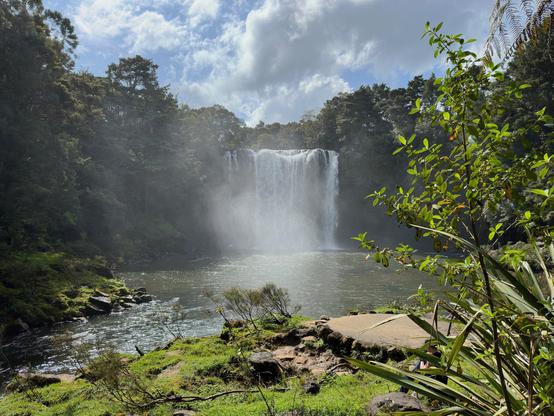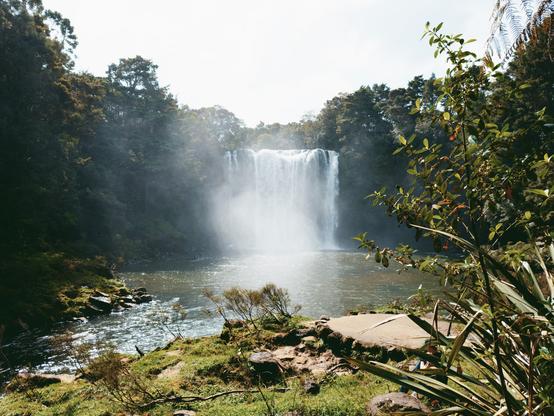
@claus @quister The "blown out clouds" is what gives the picture depth. The trees next to the waterfall are clearly a "shadow" area, which would be ridiculous if it would the same energy levels as the sky and the clouds. (And it is ridiculous in the first picture).
You're immediately discarding authorship. If the author's intent was to bring all focus to the waterfall, without losing depth, it only makes sense that "the sky" gets attenuated. It is of non-importance.
@claus https://unsplash.com/photos/a-green-plant-in-the-dark-on-a-black-background-8Zj1wywkEhQ
The black background here, for example, isn't created by restriction of the tool either.
And I can bet that there was more information captured than that.
@claus Notice how your focus shifts from "the sky" to "the cliff".
All this ties well into why the HDR technology as a whole doesn't work.
If we bundle up the ideas into a broader “integration theory”, I think we can see some hints.
For example, try to parse the air material of the waterfall mist. Notice how there can only be one continuum of energy in the totality of the pictorial depiction? If we increase the gradients of the “sky”, we are always implicitly *losing* the depiction of the air material.
I *suspect* this is the ineffable quality of depictions of clouds, too.