
I love love love love (in a sarcastic, dark humour sort of way) the title of the article Dr. Laura Revell, Dr. @astrokiwi.bsky.social and I wrote last week https://theconversation.com/a-new-space-race-could-turn-our-atmosphere-into-a-crematorium-for-satellites-276366.

But one thing got cut in the final edit: simulations of the night sky with 1 million satellites. I just tried to pitch a separate article on that, I'll see if that gets picked up this coming week or not.

A new space race could turn our atmosphere into a ‘crematorium for satellites’

Planned ‘megaconstellations’ of satellites could cause unforeseen harm to the ozone layer and climate systems. Global regulation is needed before it’s too late.

The Conversation

Ready for a horror show that is different than the current news cycle?

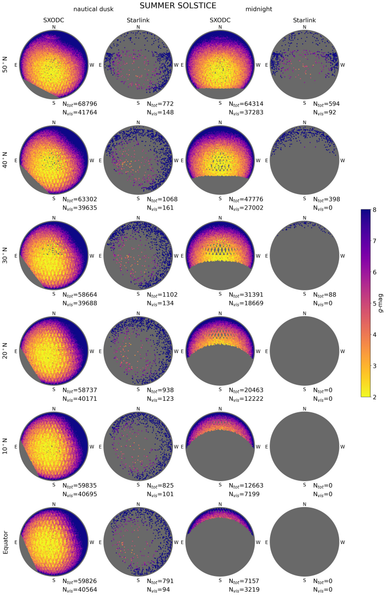
This is code that @hannorein, Aaron Boley, and I put together for modelling Starlinks. We scaled up the brightness based on what we think could be the size of these stupid new "AI datacenters" that SpaceX says they will launch a million of, and used the orbits posted on @planet4589.bsky.social's website

I'll walk you through this plot in the following posts.

Each of the grey circles is an all-sky plot, your zenith is the center of the circle. The rows are different latitudes, from 50N to the equator (it is mirrored in the southern hemisphere). The date is the Summer Solstice (N hemisphere). The first 2 columns show nautical dusk, the last 2 columns show midnight. Columns 1 and 3 show the SpaceX Orbital Data Centre, while Columns 2 and 4 show Starlink's 42,000 planned sats.

The dots in each grey circle are sunlit satellites, and the colour tells you how bright they are. Anything pink, orange, or yellow is naked-eye visible.

Below each circle is "Nvis" which tells you the number of satellites bright enough to be visible with the naked eye, and "Ntot" which is the total number of sunlit satellites above the horizon.

There are only ~4,500 stars that are naked eye visible.

A million sats this big would be more visible satellites than stars.

Of course, there's no way in hell we'll ever get to 1 million satellites in orbit. We'll be in Kessler Syndrome long before that (many experts say we're already in Kessler Syndrome now, and the timescale between collisions will continue to get shorter).

I"ll also note we're making huge assumptions here on size and orbits, because SpaceX hasn't actually said what they're going to do. And that's fine with the FCC, they're going to approve it anyway. Fuckers.

Want to tell the FCC not to approve this hideous, stupid, short-sighted megaconstellation? Instructions are available here: https://aas.org/posts/advocacy/2026/02/how-submit-comments-satellite-applications-fcc
Just for "fun", for the next few minutes if you tell me your latitude, I'll put up a plot showing how many satellites would be visible in your night sky with 42,000 Starlink satellites and 1 million SpaceX AI datacenters, at midnight on the summer solstice.
@sundogplanets Very roughly: 65°N