Paper day!

The latest article led by Yours Truly is live on Astronomy & Astrophysics @[email protected] today.

Buckle up, it's ๐Ÿงต time! 1/

#astronomy #astrophysics #science

https://www.aanda.org/articles/aa/full_html/2026/03/aa58750-25/aa58750-25.html
Lyman continuum escaping from in situ formed stars in a tidal bridge at z = 3 | Astronomy & Astrophysics (A&A)

Astronomy & Astrophysics (A&A) is an international journal which publishes papers on all aspects of astronomy and astrophysics

In short: We have used JWST to spy a young cluster of stars that has formed
between two galaxies, in a large strand of gas drawn out between them by their mutual gravitational pull. From there, the star cluster pours out high-energy UV light called *Lyman continuum* (LyC) into intergalactic Space.

This LyC light is important, because somehow it once changed the
fundamental properties of **ALMOST THE ENTIRE UNIVERSE**, and we aren't even sure *how* it can get out of a galaxy. 2/

Usually, this ionizing light does not escape easily. Most galaxies are wrapped in a thick blanket of hydrogen gas which is completely transparent to visible light, but catches and absorbs this ionizing light with very high efficiency. 3/
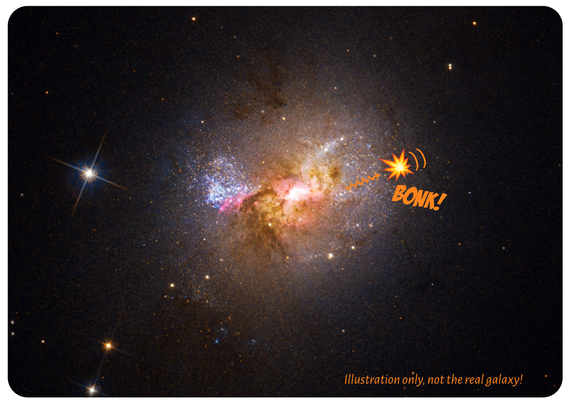
But sometimes, something makes holes in the surrounding hydrogen gas so the ionizing UV-light can escape. 4/
Because this LyC light has been so important for the Universe, of course astronomers are very eager to find out what it is that regulates whether it can escape or not. Why can it get out of some galaxies, but not others? And why does it seem to get more and more difficult with time? 5/
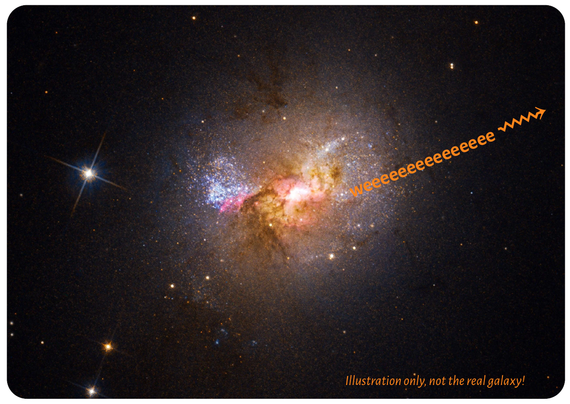
Most research has focused on how stars can punch holes in the surrounding hydrogen from within. Either by having a lot of very bright young stars that pour out more ionizing light than the gas can absorb; or if stellar winds or supernovae push the gas outward and makes cracks in it. /6

And that can certainly work! In the not-so-distant Universe, most galaxies that leak ionizing light do seem to work exactly this way.

Here is a nice illustration that I have stolen and modified from a 2022 article byBingjie Wang about this. 7/

But there's a hitch: Further away, farther back in time (remember that light takes time to travel! The further away we look, the further back in time), this escape of ionizing light seems to depend less and less on the specifics of the galaxy that it escapes from. This suggests that something else, from the outside, helps it along. 8/
So what can come from the outside and help ionizing light to escape? Something that was more common in the early Universe? We don't know for sure, but one thing that could be the explanation is galaxy interactions --- when galaxies either collide or fly by each other and tug at each other with their gravity. 9/

Galaxy interactions can cause ionizing light to leak in a few different ways.

**First** by sparking very stong star formation, which in turn leads to all the stuff I mentioned above: strong stellar emission, stellar winds, and so on.

But these are exactly the internal properties that we just found out cannot be the whole story, so this effect is less interesting in our context. We need something that doesn't look like your typical strong-starburst galaxy in the local Universe. 10/

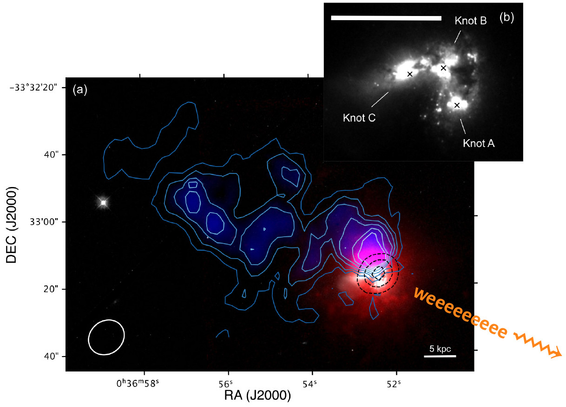
A **second** way that galaxy interactions can cause LyC escape is by peeling the gas away from where the stars are by the pull of gravity. The stars produce the ionizing light, and if (most of) the absorbing gas is removed from the stars, the ionizing light has a much easier time getting out. 11/

This effect was first observed a couple of years ago by my collaborator, Alexandra Le Reste, who pulled off what no one had done before and observed the neutral hydrogen in a LyC leaker using the MeerKAT radio telescope array.

The contours on the image below show where the neutral hydrogen is, the red stuff is hydrogen that is already mostly ionized, and the bright star clusters are where the ionizing light escapes from. It should be clear how the gravitational peel helped it along! 12/

But! What we found in the newly published paper was neither of those, but instead a **third** effect.

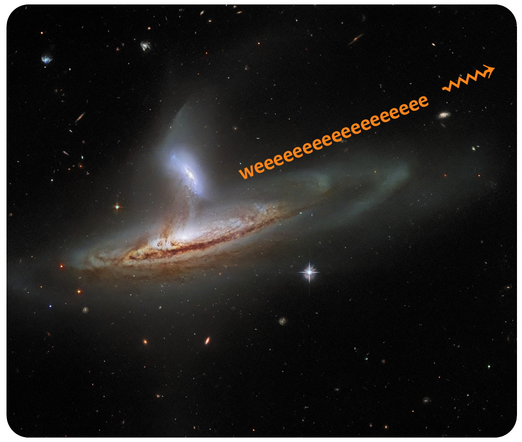
When galaxies interact, they can draw out long strands of gas between them, called a "tidal bridge". And sometimes, new stars can form in such a tidal bridge - this is all something that has been observed many times before.

(Here's a nearby galaxy pair with a tidal bridge for illustration) 13/

...but if a large clump of young and powerful stars happen to form in such a bridge, they are already removed from most of the neutral gas in the galaxy, and can easily blow or burn the rest away, and their ionizing light get out!

That is exactly what we found!
Here's two Hubble telescope images of the galaxy, the left shows normal starlight, the right shows the ionizing light. Notice how the core of the galaxy is much brighter, but its hydrogen gas completely blocks the ionizing light! 14/

To be clear, what we found wasn't the escaping ionizing light - others had already found that. But they had flagged it as "shaky", because it didn't come from the central part of the galaxy as expected. That made them suspicious it might be a foreground object masquerading as ionizing light.

A link to the paper that discovered the ionizing escape is here (free access):

https://iopscience.iop.org/article/10.3847/1538-4357/ab2045

15/

The Lyman Continuum Escape Survey: Ionizing Radiation from [O iii]-strong Sources at a Redshift of 3.1

The Lyman Continuum Escape Survey: Ionizing Radiation from [O iii]-strong Sources at a Redshift of 3.1, Fletcher, Thomas J., Tang, Mengtao, Robertson, Brant E., Nakajima, Kimihiko, Ellis, Richard S., Stark, Daniel P., Inoue, Akio

This suspicion was fully reasonable, by the way!

Foreground galaxies do masquerade as escaping LyC all the time.

But we found that in that case, the escape was legit, and more interesting than usual. 16/

What we found was that the smaller galaxy in the bottom of the green square is not just a chance aligned galaxy, but is physically very close to and actually interacting gravitationally with the main one, and the two are probably going to merge later.

(Which means they already merged long ago, because the light we look at here is 11 **billion** years old!) 17/

We used publicly available data from the JWST archives to study how warm ionized is arranged and moves around in these galaxies.

In the picture below, the left panel shows how the gas moves - the difference in redshift means the two galaxies move about 500 km/s relative to each other, which is very typical for galaxies in the early stages of merging.

The right panel shows the brightness of a spectral line shining from warm ionized gas. The circle shows where the ionizing light escapes. 18/

If we look at gas and stars side by side, we can see that there isn't a lot of gas by the "spike" of stars where the ionizing gas escapes.

We can also see a bridge of gas as a vague green strand between the two galaxies. The strand of starlight, from which the ionizing light escapes, is not at the same place as the gas! That is normal for galaxy interactions and is exactly **why** the ionizing light can escape so easily from there. 19/

What can we learn from this?

We can learn that in this galaxy, most of the ionized light is produced in the bright center of the galaxy, but it cannot get out from there.

The smaller amount which is produced in the tidal bridge has a much easier time getting out. 20/

If galaxy interactions are really as important as we think for this ionizing escape, that could help explain how so much more LyC light escaped in the early times of the Universe then does today - galaxy mergers and interactions were much more common in those times than they are now. 21/

And if tidal stripping + star formation in tidal bridges is as important as we think for this escape of ionizing light, it would have another consequence:

When we look for these LyC leaking galaxies in the early Universe, we shouldn't only look for galaxies that look like ionizing leakers do today - we could miss a lot of them that way! 22/

That's it! Thank you for seeing me through to the end of this journey.

This work was done together with a crew of brilliant and talented people, including but not limited to,
@Kerens and @janerigby
plus a number of folks not present in the Fediverse.

Bye for now! ๐Ÿ‘‹

23/23