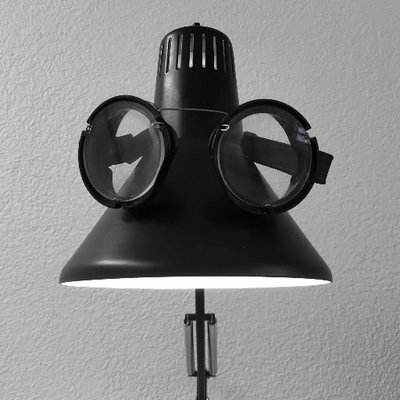
The Moon is, err, a comet & therefore an interstellar alien spaceship 👽🛸

Am I doing social media astronomy right? 🤨

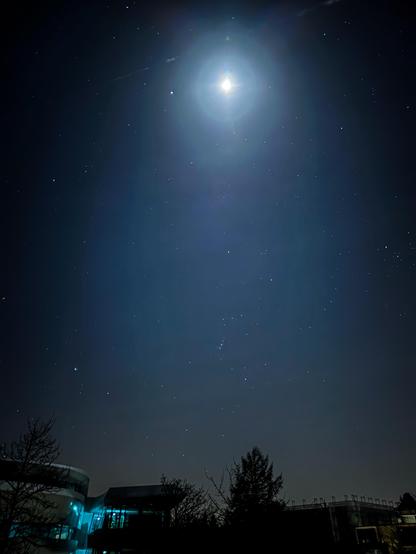
In the real universe, a clear night atop the Königstuhl, with Orion, Sirius, Aldebaran & the Hyades, Jupiter, & that bright cheesy object all putting on a show. Plus the very orange giant star Epsilon Leporis down in the trees 🍊

And as for Apple’s always entertaining night mode image processing … 🙄
#Space #SpaceScience #Astronomy #Photography #Heidelberg

@markmccaughrean Sirius was crazy yesterday. It was glittering (scintillation) super bright and changing colours in a way that I haven't noticed before. And this was from my balcony in my small town.

@felix I spotted the same this evening – it’s a real characteristic of Sirius, as it’s one of the few stars bright enough to activate your cones (& planets don’t do it as they’re extended).

I enjoy spending an evening at this time of the year playing around with my defocussed binoculars & my phone held to an eyepiece, capturing the rapidly changing colours.

Here’s a collage from a few years ago that I included for the chapter about Sirius in my book 🙂👍

https://flic.kr/p/2qX9g7N

The Colours of Sirius

Flickr
@markmccaughrean is it just our atmosphere or is the star varying its light intensity this much?

@felix 100% our atmosphere: the white starlight arriving at Earth is not changing at all on these timescales.

It’s due to turbulence in our atmosphere linked to temperature differences, leading to rapid small-scale changes in air density. That changes the refractive index, essentially moving the star around in the sky. And as the refractive index is wavelength dependent, different wavelengths get differentially more ‘focussed’ or ‘dispersed’, making the star appear to change colour.

@felix Sirius is famous for it, as it’s very bright, thus activating our colour sensitive cones, and it’s typically close to the horizon when seen from Europe, meaning its light passes through a lot of atmosphere, leading to more turbulence.

Planets don’t show the effect because they’re not quite point sources, meaning that their light comes through different bits of atmosphere, thus smearing out the twinkling.

@markmccaughrean I am glad I asked. Learnt a lot, thanks.