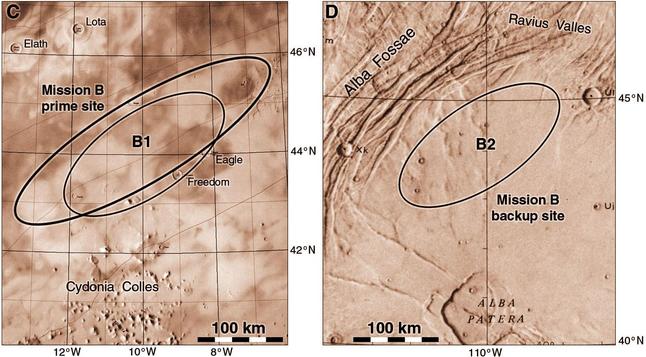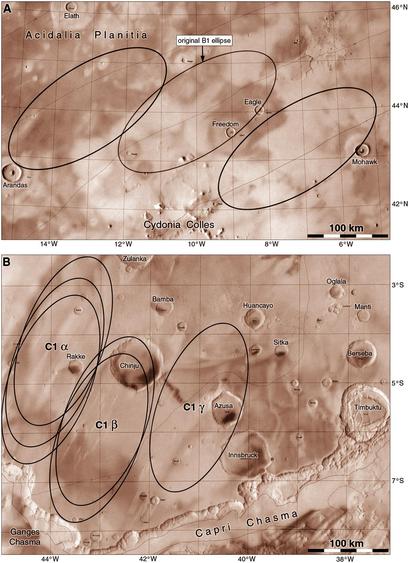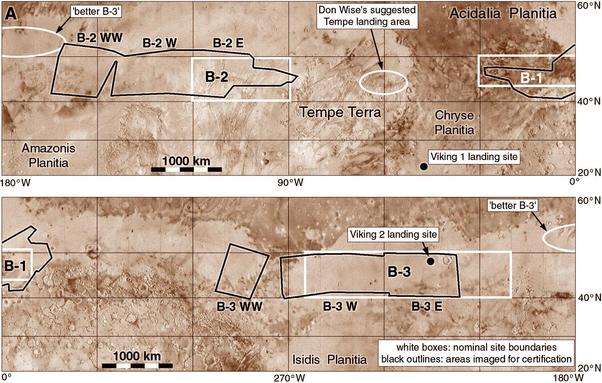
Last September I started a thread on Viking 1 which began with the Viking site selection process. Here we will pick up the story for Viking 2. Viking sites were chosen initially using Mariner 9 images and elevation data, and the final stage of that process produced these two sites for Viking 2, a prime site (B1) and a backup (B2). B1 is Cydonia and its most famous inhabitant lives in those hills (Cydonia Colles). B2 is a low volcanic rise now called Alba Mons.
#mars #maps #viking2
Viking Orbiter 1 took images to certify its potential landing sites, and then to look for a better one. After VL1 landed the orbiter could spend a bit of time looking at Viking 2 sites. B1 and B2 were at 44 north, hoping for more water than the VL1 latitude, but it was too far north for Earth-based radar to estimate surface roughness. At this stage new ellipses were already being considered for Viking 2 as we will see next.
#mars #viking2
Here we see sites considered by the Landing Site Staff on 17 July 1976, just before Viking 1 landed. C ellipses on the plateau above Capri Chasma had radar data and might be safe, but were they interesting?. New B ellipses might be smoother than B1 but more imaging would be needed. The landing site team were already tired after intensive work on Viking 1, but there was still much to do. The V2 latitude had to be decided before the second orbiter reached Mars on 7 August.
#maps #mars #viking2
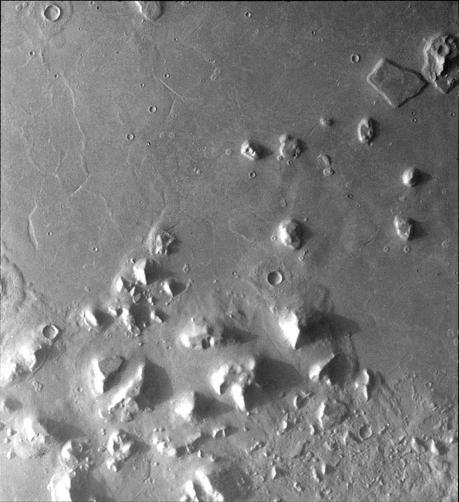
The images forming the background of those maps are USGS shaded relief drawings based on Mariner 9 images. Drawings made by supremely skilled artists using airbrushes. Viking gave much better pictures, so what did those Viking images look like? Here is a Viking Orbiter 1 image of Cydonia covering part of Cydonia Colles, south of the B1 ellipse. Above centre is a little hill with a face. Let the fun begin! Otherwise the area is interesting but with too many hazards.
#mars #viking2
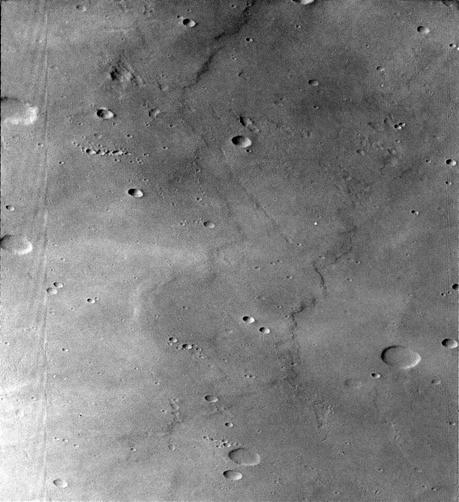
Is Capri any better? Here is another Orbiter 1 image in the C1 Beta (middle) ellipse on the map posted yesterday. This is a safer landing site but too boring to excite the mission scientists. The driving factor in choosing a site was evidence of water - there is no evidence here. At Cydonia the plains were thought to be sediments deposited by water flowing from huge channels further south. This early survey was not encouraging.
#mars #viking2
Viking 2 needed much more data to help find a good site. The northern latitudes were seen less well by Mariner 9 so new Viking images were essential. The 44 degrees north region was chosen over the southern latitude band and the images started to pour in. Much of the latitude band all around the planet was searched as shown here. This map shows broad landing areas, any one of which might hold many potential ellipses. They all needed analysis...
#mars #maps #viking2
Geological interpretations and hazard mapping were essential to find a safe site. This put an enormous strain on the landing site team who worked under pressure of having to land no later than early September 1976 so a 'primary mission' of reasonable length could be completed before conjunction in late November. Around conjunction Mars is behind or very close to the Sun and communication is curtailed. The stakes were very high and time was short.
#mars #viking2
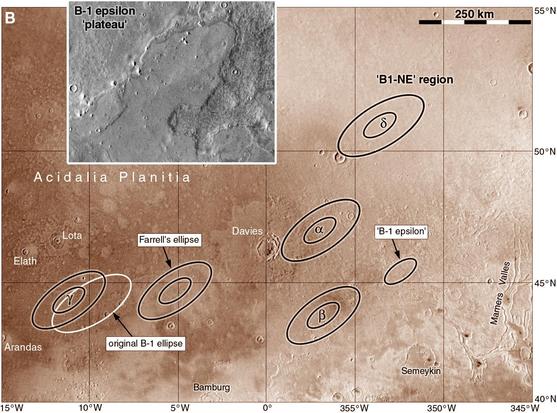
Let's take a look at some Viking 2 candidate sites after all this imaging. Here is the B1 region. New ellipses are shown with an outer ellipse (99% chance of landing within it) and a smaller inner ellipse (50% chance of landing within it). The outer ellipse was 130 by 50 km, the inner one 52 by 20 km. None of them were safe enough. The only possible site in B1 was that little Epsilon ellipse, a 50% ellipse which just about fits on a smooth plateau shown in an inset image.
#mars #maps #viking2
At a meeting on 16 August 1976 (a few days before the Viking 1 landing) Hal Masursky said the B1 site was 'semi-catastrophic'. Next we will check out the B2 region. But it's not going to be good news.

EDIT: What??? Nobody picked me up on that mistake - VL1 landed on 20 July 1976, so that meeting was well after the landing. Let's pretend I didn't say it.
#mars #viking2

Here is a picture from ellipse B2 W beta (2 versions of that ellipse were shown in the last post). This is an interesting-looking site. Way too interesting, in fact. Lots of hills and other features, every one of which is a hazard to a lander. The geology was not understood well enough. See the 'thumbprint terrain' at bottom left, looking a bit like a moraine if you are so minded. I'd like to go here but Viking 2 would not be risked at this site.
#mars #viking2
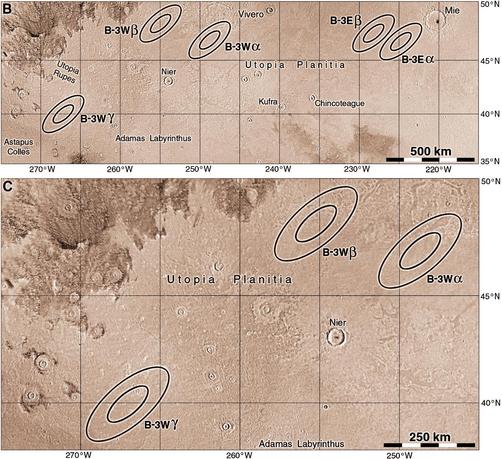
Pictures of the B3 area began to come in. Remember this is 1976. The downlink was timed so the big Goldstone antenna would get most of the images. They were recorded on big tapes and flown to Flagstaff for the site mapping. This map shows ellipses in the east and west parts of B3. Would any of them work for Viking? A new idea made it seem feasible. Geologist Henry Moore noticed something in the B3 East region...
#mars #maps #viking2

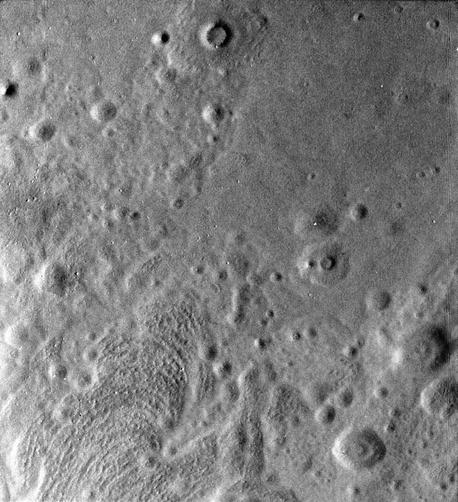
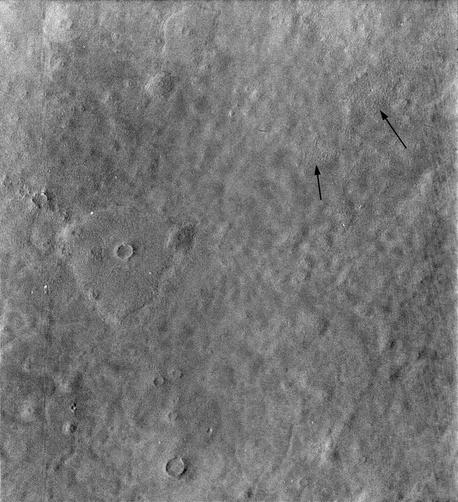
This image from Viking Orbiter 2's orbit 9 shows part of the B3 east region. I had to crank up the contrast to pull out detail - these were very low contrast images. It's still quite bumpy, but Moore's idea seemed to make it acceptable. Some small patches in this image have a wrinkly texture - see the arrows - and he interpreted them as sand dunes. They could cover boulders and small craters and render the site safe.
#mars #viking2
This image has a resolution of about 40 m/pixel, meaning a boulder would have to be about 100 m across to show up even minimally. It's no surprise we don't see any. This image covers about half the final landing ellipse and the spacecraft ended up in the top right corner near those 'dunes'. Viking 1 had about 20 m/pixel images to work with. Compared with Apollo, they were landing with very limited understanding of the surface conditions.
#mars #viking2
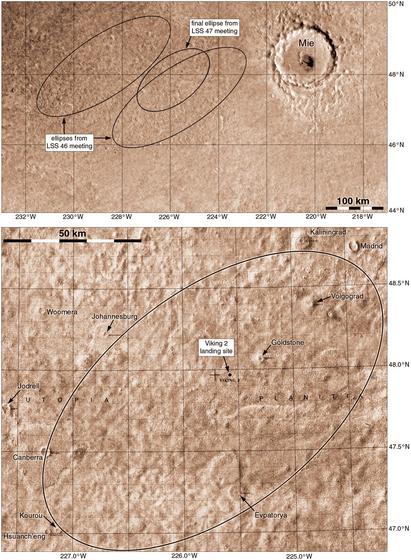
Here is the final landing ellipse for Viking 2. The top map shows a large crater, Mie, with 2 ellipses from yesterday's post, and the final site in a smaller ellipse between them (shown enlarged below). The landing site should be in the ejecta of that crater, which we would expect to be very rocky. Luckily for us, those sand dunes are going to cover up the rocks! Isn't that right, Hank? Hank? ... has anyone seen him?
#mars #maps #viking2
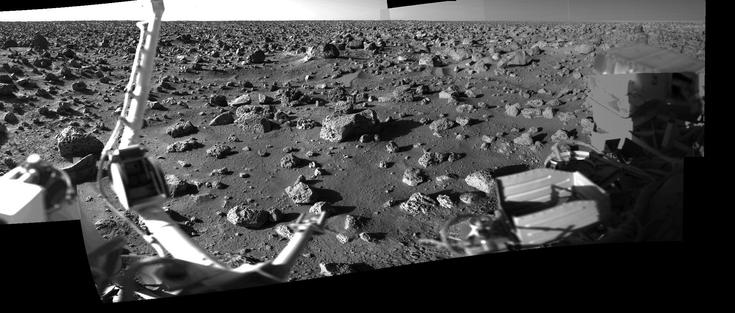
Let's take a look at Hank Moore's sand dunes. Here they are - oops, no, it's a forest of rocks. Needless to say this site would never have been chosen if it had really been understood. Viking Project Scientist Gerry Soffen said he was "amazed we really got two landers down safely". It was a stupendous achievement. We have so much more information now for planning landings... when will the next one be? Presumably Europe''s Rosalind Franklin rover. Fingers crossed.
#mars #viking2

That image came from this page at Malin Space Science Systems (builders of many cameras for science missions, but not the Viking cameras):

https://www.msss.com/mars/pictures/viking_lander/viking_lander.html

The Wikipedia page for Viking 2 has nice images as well:

https://upload.wikimedia.org/wikipedia/commons/4/42/Viking_Lander_2_Camera_1_NOON_HIGH_RESOLUTION_COLOR_MOSAIC.jpg

https://upload.wikimedia.org/wikipedia/commons/b/b9/22i103-104-105-109_FROST.jpg

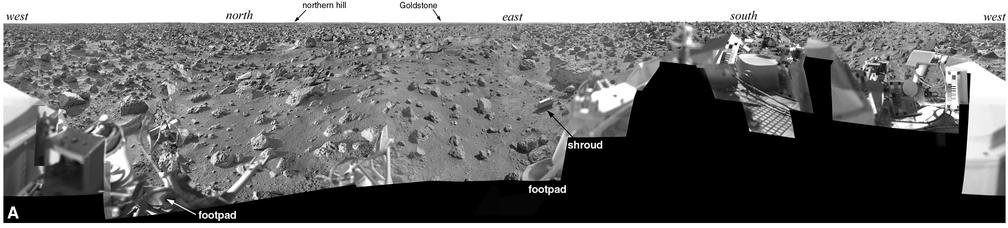
It really is rocks everywhere. Two cameras each gave c. 300 degree panoramas, overlapping for stereo in the arm work area. Here I have combined them for mapping purposes.
#mars #viking2

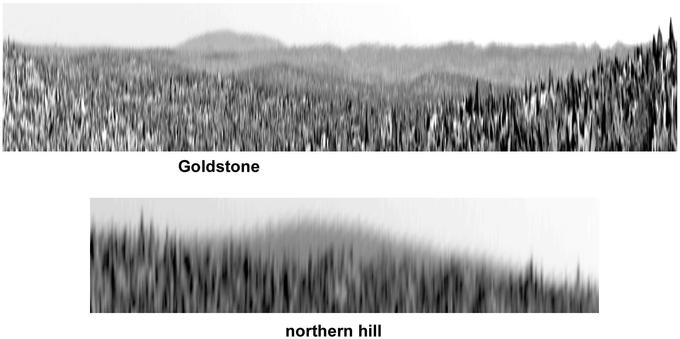
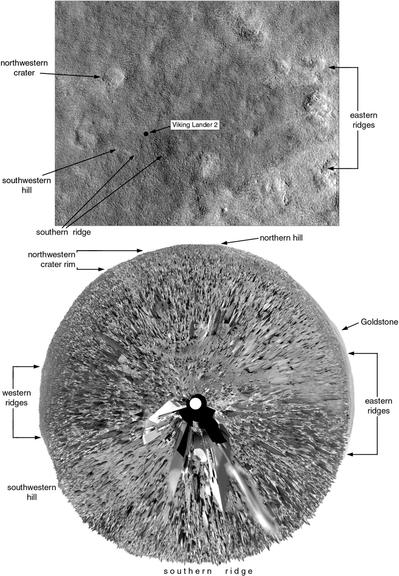
The feature called Goldstone noted on the horizon is visible on the final landing ellipse map, but it's hard to see here. The 'northern hill' is even more difficult to see - my pan is not full resolution which doesn't help, but what we really need is a bit of vertical exaggeration to clarify what's happening on the horizon. We will check that out tomorrow.
#mare #viking2

Here are the faint horizon features from the Viking 2 panorama in Phil-o-vision: a vertical stretch by a factor of 5. I find this is the only way to see very topographically subtle features clearly. These are from full resolution data - just stretching yesterday's panorama will not help.

I always want to know where a lander is, and before MRO and its HiRISE camera it was not easy to know. The Viking 1 and 2 sites were not located very precisely at the time. This could help!
#mars #viking2

Imagine taking a map and drawing a vector from Goldstone in the direction towards the lander, and then doing the same from the northern hill. Where they cross is your lander location. Easy! Well, no, not easy. First - it that really Goldstone? It seemed likely but you always have to consider it might not be. Second - what feature is the northern hill? That was difficult to discern in VIking orbital images. This was my first crack at the problem:

https://www.lpi.usra.edu/meetings/LPSC98/pdf/1024.pdf
#mars #viking2

When I wrote that up fully, I thought there might be 3 candidates for the northern hill, not just one. I hope you can get this file:

https://link.springer.com/content/pdf/10.1023/A:1006041227129.pdf

(if not, let me know and I will deal with it another way).

Figure 9 is the important one - it has 3 vectors, so 3 potential sites. L1 was the one I preferred. Sadly, L3 is the correct one. There were other attempts, but none of us got it until HiRISE found the lander later, as we will see.
#mars #viking2

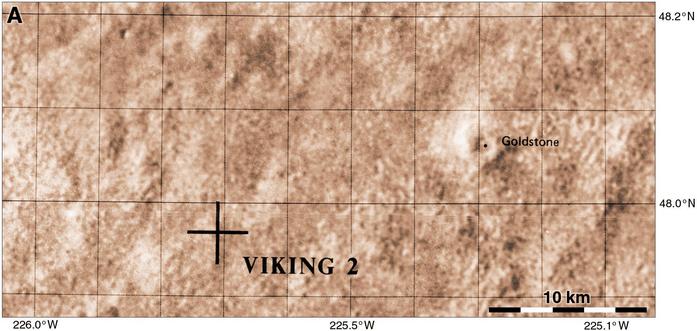
The U.S. Geological Survey mapped the Viking 2 landing site soon after the landing, and this image is part of their map. It shows the estimated landing site, but it is only an estimate and there was still a lot of uncertainty. Yes, that is indeed the best image available at the time, so you can see why this is difficult. So let's look at other estimates, having already seen mine and this one.
#mars #maps #viking2
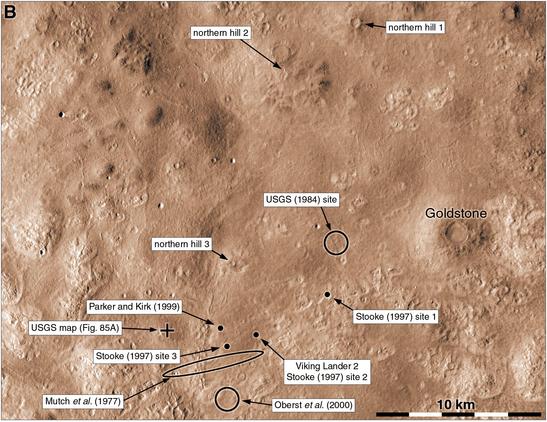
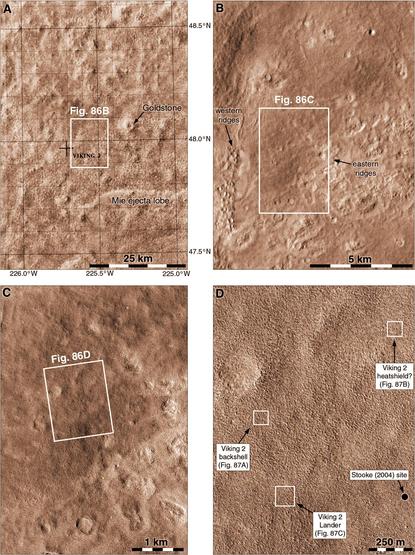
This map shows several other estimates in the years after the landing. The background image is a LOT better - this is from the Mars Odyssey spacecraft's THEMIS visible light camera, which was the most useful before HiRISE. The USGS site is shown as well as other attempts, and they are clustering quite nicely in the lower left corner. But let's face it, none of us knew exactly where we should be in this area. Ultimately, only the HiRISE camera could solve the puzzle.
#maps #maps #viking2
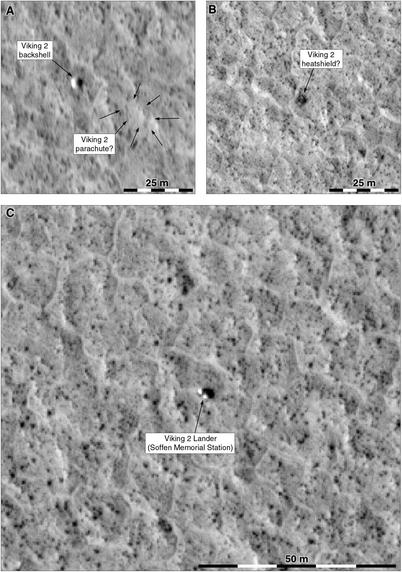
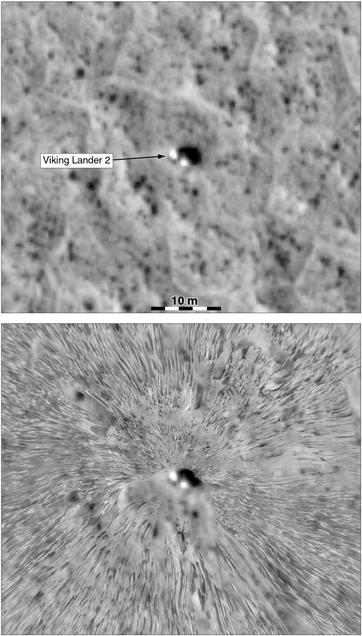
Here is what HiRISE showed at the Viking 2 site - just little cutouts from a big image here. We will see them in context tomorrow. Every little black spot is a rock (or the shadow of a rock). A pattern of polygonal rises separated by shallow troughs forms a background to the image - What Henry Moore saw as dunes were the larger of the 'rises' (larger than any right here) making a mottled pattern in some areas. The rocks were invisible.
#mars #viking2

The 'rises' and troughs form patterned ground, which forms in arctic regions over many years of seasonal freezing and thawing of ice in the ground. Thousands of years - but here on Mars we may have tens of millions of years of the process. Viking 2 didn't see that ice but we know it's there because HiRISE saw new craters form nearby, exposing ice which then slowly melts away - see this free access paper:

https://agupubs.onlinelibrary.wiley.com/doi/full/10.1002/2013JE004482

#mars #viking2

So the lander was found by HiRISE - where is it exactly? This set of maps zooms in on the site. The parachute is not very visible, and maybe this identification is wrong. But the lander is certainly correct because rocks and other features around it can be identified in the panorama and the HiRISE image.
#mars #maps #viking2
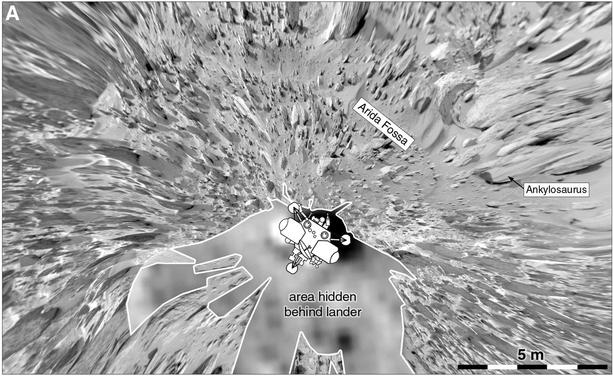
The panorama can be projected into a circular projection - a polar projection, except that I like to modify the radial scale in a way that more closely resembles a stereographic projection. It's easier to compare with a map if you do that. Here it is for Viking 2, with a HiRISE image to help locate a few features. Other features like the western ridges are shown on the previous post.
#mars #Viking2
Here's an interesting perspective on what we are looking at in this area. The Moon's surface would look like this if we gave it a bit of an atmosphere so the finer dust could be blown away by the wind. Strip away the finer dust, let it accumulate in other places, and what is left is all the rocks buried in the regolith, and gravel between them. I know it might not be exactly true, but it's not too far off.
#mars #viking2
Here is the HiRISE image of Viking 2 with an attempt to project the surface panorama onto it. It's not really very successful. Over the years I got better at this and by the time we got to InSight I think it worked very well (you can judge yourselves if we get that far in this story). The rocks are stretched into pillars by the projection, and later I worked to shrink the height of each rock individually. But not here. Still, it gives an idea of the nature of the site.
#mars #viking2
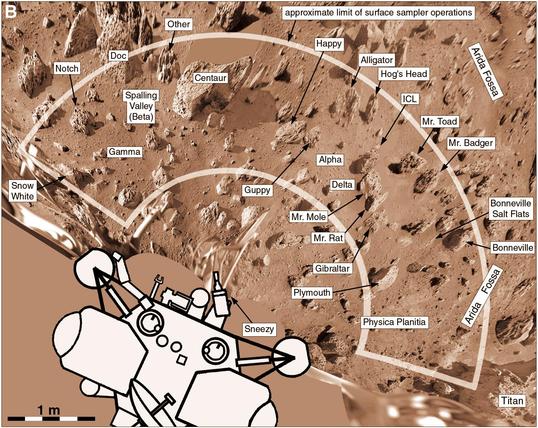
Let's zoom in closer to Viking 2. Again we have a surface panorama projected onto a HiRISE image to show the character of the site. At this scale, closer to the lander, it works better, but note one problem. Rocks get elongated by the process but they should all extend radially out from the camera. Where they seem to swirl a bit I got my control points wrong. But you can only do so many iterations! Arida Fossa is 'dry ditch'.
#maps #mars #viking2
Now we zoom in really close to the lander, and here the process works pretty well. Only one rock was so tall that it looked badly distorted so I shrank it down leaving a blank area behind it. I could have done more but didn't here. For InSight I did this for hundreds of rocks, hence my white hair. Lots of features have names here in the sampling area where we will see a lot of activity.
#maps #mars #viking2
@PhilStooke
The paper gives me strong Jules Verne vibes :-)