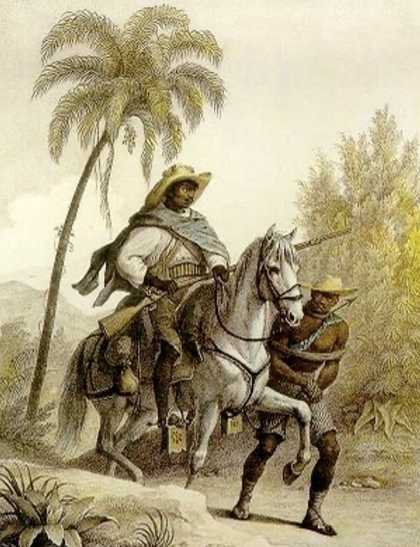
To understand the modern American state, you have to look at what it learned to do at night. In the slave South, violence didn’t arrive as spectacle. It arrived on schedule. Names checked. Horses assigned. Lanterns lit. By law, patrols could stop, search, whip, detain—without warrant or cause. Suspicion was enough. This wasn’t chaos. It was governance.

1/7

Image: 1823 illustration by Johann Moritz Rugendas. https://commons.wikimedia.org/wiki/File:Capitao-mato.jpg
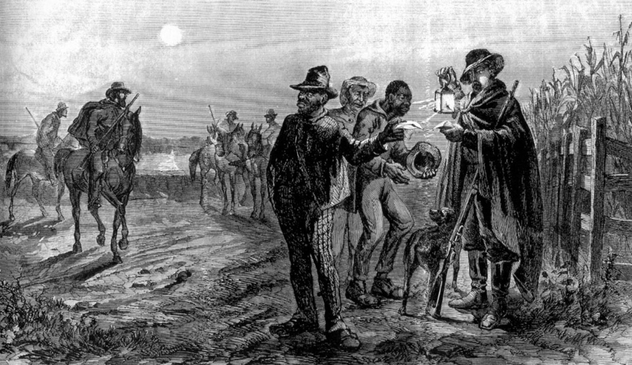
Slave patrols weren’t marginal or reactive. They were the state’s most regular point of contact with white men. Patrol duty crossed class lines. Men without office or wealth exercised sovereign, bodily power—backed by statute. This wasn’t vigilantism. It was the state stripped to essentials.

2/7

Image: Mississippi slave patrol illustration. 1863. Author unknown. Source: https://en.wikipedia.org/wiki/Slave_patrol#/media/File%3ASlave_Patrol.jpg

Patrols trained perception. Who walked too fast. Who hesitated. Which woods hid movement. How much pain controlled without killing. Violence wasn’t meant to be precise—it was meant to be ambient. White equality was rehearsed through Black unfreedom. Citizenship wasn’t just voted. It was practiced—at night, in motion, under color of law.

3/7

Image: 1851 Boston broadside warning Black residents to avoid police conversation (Library of Congress).n, 1851. Pdf. https://www.loc.gov/item/2021771790/.

Patrols also disciplined whites. Poor, itinerant, noncompliant men were watched too. As Keri Leigh Merritt later shows, whiteness conferred privilege conditionally. Participation in coercion was one condition. By the 1830s, patrol laws expanded. Crisis didn’t invent repression—it exposed how foundational it already was. When secession came, the habits were ready.

4/7

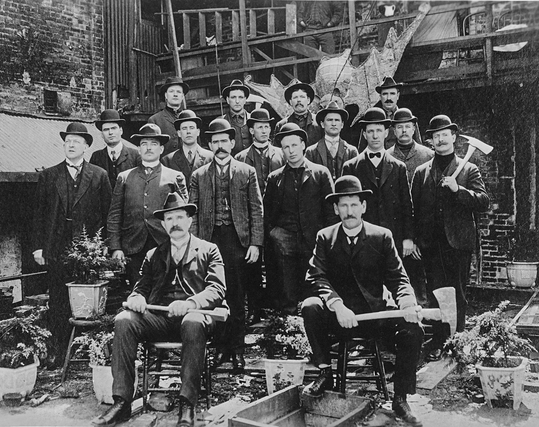
Image: The Chinatown Squad in 1905.Photograph courtesy Bancroft Library, University of California, Berkeley.

Intellectual Map

Davis, David Brion. The Problem of Slavery in the Age of Revolution, 1770–1823. Ithaca, NY: Cornell University Press, 1975.

Fischer, David Hackett. Albion’s Seed: Four British Folkways in America. New York: Oxford University Press, 1989.

Franklin, John Hope. The Militant South, 1800–1861. Cambridge, MA: Harvard University Press, 1956.

5/7

More sources

Genovese, Eugene D. Roll, Jordan, Roll: The World the Slaves Made. New York: Pantheon Books, 1974.

Hadden, Sally E. Slave Patrols: Law and Violence in Virginia and the Carolinas. Cambridge, MA: Harvard University Press, 2001.

Merritt, Keri Leigh. Masterless Men: Poor Whites and Slavery in the Antebellum South. Cambridge: Cambridge University Press, 2017.

6/7

Final Sources

Morgan, Edmund S. American Slavery, American Freedom: The Ordeal of Colonial Virginia. New York: W. W. Norton & Company, 1975.

Woodard, Colin. American Nations: A History of the Eleven Rival Regional Cultures of North America. New York: Viking, 2011.

Wyatt-Brown, Bertram. Honor and Violence in the Old South. New York: Oxford University Press, 1986.

7/7

@Deglassco

Great thread. ⤴️

“Violence wasn’t meant to be precise—it was meant to be ambient.”

“…whiteness conferred privilege conditionally. Participation in coercion was one condition.”

And Black women aren’t even mentioned yet.

@nellie_m You’re absolutely right. Black women were living under the same violence as Black men with the added component of sexual coercion and constant surveillance that the law barely named but fully enabled. White women, meanwhile, were cast as people to be “protected,” something that helped justify patrol violence. Gender wasn’t separate from the system. It shaped how control worked and who it claimed to defend.

@Deglassco @nellie_m

the patrols did to black women what they claimed black men would do to white women.

@Deglassco @nellie_m White women might have been classed as people to be protected, but white women weren't actually protected any more than ducks are protected at a duck club/hunting preserve.
@Deglassco I saw a post somewhere by a woman saying that Good and Pretti were murdered because they "surrendered their proximity to whiteness."

@jcriecke

whiteness conferred privilege conditionally. Participation in coercion was one condition.

@Deglassco

@Deglassco ⬆️👎
@Deixis9 I’m not sure what you are trying to do here, because you’re boosting this thread, but it also looks like you are downvoting Dr. Glassco’s efforts to educate others and I’m hoping that isn’t your intention

@Deglassco

I published this last week also addressing the topic from a historical approach, focusing on the first slave patrols in South Carolina. They pre-date the founding of the country by 80+ years.

https://buttondown.com/natebowling/archive/slave-patrols-and-ice-a-shared-history/

Slave Patrols and ICE: A Shared History

America's authoritarian approach to immigration enforcement is an echo of its past

Takes & Typos
@natebowling Your point about Nazi Germany and slave patrols is very prescient. The instinct for people to reach for 1930s Germany obscures more than it clarifies. As you wrote in your piece, the racial legal structure of the United States was not a late aberration but was an early, durable system that others studied. The Nazis openly examined U.S. race law, segregation, and immigration restriction because America had already solved the problem of how to formalize hierarchy.
@natebowling That matters because it reframes the present. The issue isn’t whether the U.S. is “becoming” fascist, but how a country long practiced in conditional belonging periodically reactivates those tools. Slave patrols weren’t just about slavery.
@natebowling As you know, America normalized internal surveillance, preemptive enforcement, and the idea that legitimacy must be constantly proven in public space. That inheritance didn’t disappear. It migrated. Your argument makes clear that today’s fears aren’t hyperbole. They’re historical recognition.
@Deglassco
So they didn't learn anything in about 200 years. Sorry, I don't want to understand modern America,

@Deglassco Excellent reminder of how governance has been used to justify targeted and deliberate
atrocities. And we must never forget that the abolition of slavery in America did not stop the atrocities. The Nazis took their lessons from the Jim Crow south.

https://www.history.com/articles/how-the-nazis-were-inspired-by-jim-crow

HISTORY

The HISTORY Channel - Geschichte erleben! The HISTORY Channel ist der deutschsprachige Pay-TV-Sender für spannende Dokumentationen und macht die Faszination von Menschen und Ereignissen täglich greifbar!

HISTORY

@Deglassco

And it looks very much like the Trump administration and their thugs are reinstating exactly this.

Racist and fascist MAGA as they are...

Enough is enough... there will be a day of reckoning, and it might be soon...

@Deglassco

I'm not sure about the meaning of "what it learned to do at night."

I guess it is a metaphor for something nobody talks about (guessed by the context - as nobody talks about these parallels).

As this was happening at plain sight and "everybody" was involved or concerned, but it is (or should be) a shameful part of US history it stays hidden/untold?

Or is it purposely vague prose you just liked to use?

You see, I'm guessing around like a lost non-English speaker in the night 😅

@stekopf Well, the word, night, isn’t really a metaphor for secrecy or shame. It’s literal. Slave patrols overwhelmingly operated after dark because night was when movement, gathering, escape, and autonomy became possible for enslaved people. The state learned how to govern mobility —-how to stop people, demand papers, enter homes, use suspicion instead of evidence, and normalize preemptive force.
@stekopf Those practices were then turned into a routine optimized for daytime, and naturalized into modern policing.
@Deglassco This is an educational and important thread.
@Deglassco
At first I thought it was a new DHS recruiting poster.
@Deglassco - how history evolves.