
Enter the Dragon 🐉🥋

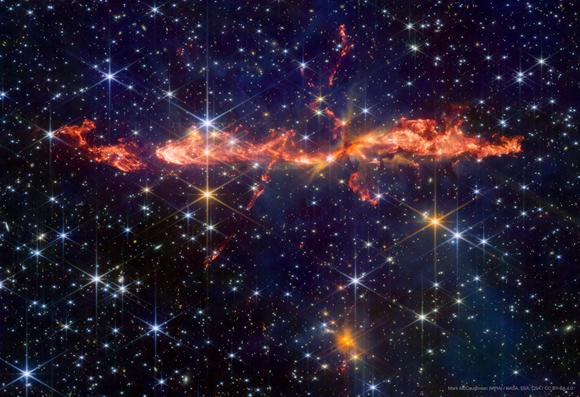
Here it is – my new JWST image of the young protostellar outflow system in Cassiopeia called HH288, aka The Dragon Jet.

We discovered it in the 1990s & the NASA/ESA/CSA JWST reveals stunning new detail, including several new jets crossing the main dragon 🙂👍

This is a 4K version – you can view & download the full 12K image here: https://www.flickr.com/gp/markmccaughrean/944q5814f8

For more coverage, see this by @DrCarpineti at: https://www.iflscience.com/dragon-jet-erupts-from-baby-stars-in-stunning-new-jwst-image-82374
#Space #SpaceScience #Astronomy #Photography

Some additional technical & scientific information in the thread that follows, mostly cut & paste from the image caption on my Flickr account.

But first, a gratuitous video, doing the Ken Burns thing across the scene. No music here, but on my Instagram post, I've used Lalo Schifrin's theme from Bruce Lee's "Enter the Dragon". Super cheesy, but definitely appropriate 🙂

Take a listen there, if you're still on that hellsite 😬 https://www.instagram.com/reel/DUGFNWQDBzT/

The image is a near-IR colour composite of the protostellar outflow system HH288, aka The Dragon Jet, made using the NIRCam instrument on NASA/ESA/CSA James Webb Space Telescope.

The composite comprises five individual mosaics in the F150W, F200W, F356W, F444W, & F470N filters, spanning the wavelength range 1.3 to 5 microns. Bluer colours are shorter wavelengths; redder are longer. The image is rotated by approximately 50º clockwise from North up, East left, & covers 378 x 259 arcseconds.

HH288 lies in galactic plane in the constellation of Cassiopeia at a distance of roughly 2 kiloparsecs or 6500 light years from Earth.

The nickname comes from the hopefully-obvious resemblance to a Chinese dragon, or loong / 龍 / 龙 / 🐉.

The main horizontal flow comprising "the dragon", with its head & flames to the left & tail to the right, spans roughly 3 parsecs or 9.8 light years.

The red, orange, & yellow emission is mostly due to emission lines of shock-heated molecular hydrogen, although there is some additional emission from carbon monoxide.

The more diffuse yellow-orange glow around the waist of "the dragon" is likely reflection nebulosity from the central protostars driving the main flow.

The wider blue & green glow in the image is likely a mixture of reflection nebulosity & emission from polycyclic aromatic hydrocarbons associated with dust in the region.

The gas in the main flow is moving at speeds of 100-200 km/sec from its protostar, which is thought to be significantly more massive than the Sun, & likely less than a million years old.

However, there are at least two other outflows seen associated with "the dragon", one linear running from lower left to upper right, & another more chaotic from lower right to upper right.

Close inspection shows perhaps another two or three newly-discovered small flows as well.

Also obvious is the small cluster of young embedded stars towards the bottom edge of the image, which also appear to be ejecting jets of molecular hydrogen gas. For obvious reasons, I'm calling this "the dragon's egg" 🐲🐣🙂

For more information on our original discovery of HH288 & millimetre wavelength studies of it, see this 2001 paper I wrote with Frédéric Gueth & Peter Schilke: https://scixplorer.org/abs/2001A&A...375.1018G/abstract

An interferometric study of the HH 288 molecular outflow

We present an interferometric study of the CO line emission in the HH 288 molecular outflow. The IRAM Plateau de Bure interferometer was used to obtain an 11-field mosaic covering the whole flow ( ~ 2 pc) with an angular resolution of about 3.5'' (7000 AU at a distance of 2 kpc). The data were complemented with short-spacings derived from IRAM 30-m observations. The exciting source of HH 288, IRAS 00342+6347, is a young (dynamical age of the outflow =~ a few 10<SUP>4</SUP> years) intermediate-mass (bolometric luminosity =~ 500lsun , envelope mass =~ 6 to 30msun ) embedded protostar. This source is likely to be an intermediate-mass counterpart of a classical Class 0 low-mass protostar. HH 288 is actually a quadrupolar outflow, and the angular resolution provided by the interferometric observations allows us to rule out models involving limb-brightened walls of a wide-angle single flow to explain such a morphology. The presence of two protostars in the central condensation is the most appealing explanation to account for the presence of the two flows. While the small East-West flow has a quite simple morphology and kinematics, the large North-South flow includes several overlapping structures, created by successive ejection events. Large collimated limb-brightened cavities are observed, with high-velocity material located along or near the flow axis. The internal structure of HH 288, including morphological coincidence between the CO and H<SUB>2</SUB> emission, supports prompt entrainment at the head of large bow-shocks as the main formation process of molecular outflows from intermediate-mass protostars. Based on observations carried out with the IRAM Plateau de Bure Interferometer. IRAM is supported by INSU/CNRS (France), MPG (Germany), and IGN (Spain).

NASA/ADS

The original data making up this image were taken by JWST between 26 & 30 January 2025 as part of the Guaranteed Time Observation programme #4548, PI Mark McCaughrean, JWST Interdisciplinary Scientist for star formation.

Image credit & copyright:
Mark McCaughrean (MPIA) / NASA, ESA, CSA / CC BY-SA 4.0

And there's more to come: we're currently writing up these JWST data for publication, but we also have new follow-up millimetre & radio observations coming up, using the IRAM 30m dish, the NOEMA interferometer, & the eVLA.

That's work being done in collaboration with Peter Schilke, Beth Jones, & Tatiana Rodríguez at the University of Cologne, & will be a great help in disentangling this very complex set of jets & outflows coming from several embedded protostars.

Oh, & as a brief coda, what looks like a "simple colour image" is, in fact, anything but. There's a lot of noise in the original data, partly due to the NIRCam electronics which struggle when the sky background is very low, & partly due to cosmic rays hitting the detectors.

Processing, aligning, & cleaning the five separate large mosaics, plus aligning them accurately, compressing the dynamic range, & colour compositing took about a month of manual work over Christmas.

But worthwhile.

@markmccaughrean very interesting!

Just a question as a physicist working also on data analysis: I assume that all these corrections include systematic uncertainties. Is that a problem only for precision analysis of JWST data or does that even affect more statistically limited/counting things style results?

@freyablekman Thanks, Freya. Interesting question.

Some of the pipeline flow is strictly quantitative, removing instrumental imprints, flux calibrating, & astrometric registration on the sky. It's those data that we use for the scientific analysis.

But they often have many non-astronomical features still in them, including electronic glitches & ripples. Removing them to make a colour image like this is much more like art than science, & you always need to check details against the originals.

@freyablekman I'm not quite sure what you mean though when you juxtapose "precision analysis of JWST data" with "more statistically-limited counting things style results"?

The aim is to be photon-noise limited in our astronomical data, albeit those photons may be background rather than the source under study. But we definitely have other sources of noise in the electronics & detectors, plus some pipeline induced, which often means we fall short.

@markmccaughrean I mean you must have measurements where the assumptions on that noise make the measurement worse? And measurements where that doesn’t matter so much? How is that assessed?

@freyablekman Ah, ok – yes. There are both stochastic & systematic errors in things like the flux calibration & astrometric registration, but one of the biggest systematics we usually have to deal with in such regions is our poor knowledge of the distance, which then affects our conversions from measured angles to sizes, & measured flux to intrinsic emission.

Both get folded into our errors, but astronomers are usually happy when we get things right to half an order of magnitude, so 😉

@markmccaughrean yeah I’m sure you are aware of the astronomy order of magnitude jokes.

(I work on LHC physics) We have both studies/results where systematic uncertainties are the most important and studies where they don’t matter, and of course the case in between.

That’s why I was wondering if that was true in JWST world as well, as you were talking about all these corrections. When we correct we never correct perfectly. And knowing those imperfections is super important and has a huge effect on how much science can be extracted

@freyablekman Probably less of an issue the kind of astronomy I do – if I can see it in a series of separate data sets, it must be real. Quite how far / bright etc. is secondary 🙂

But there are many fields (e.g. dark matter & energy surveys, exoplanet spectroscopy) where systematics & an understanding how well they're known are absolutely crucial, very much as it is for you.

@markmccaughrean 🙏 thanks for the explanation, I learned something new today

@freyablekman My pleasure – I always find it interesting & instructive to talk with scientists in other fields, as it helps hone my understanding.

I gave a talk about JWST at EMBL here in Heidelberg last year, & one of the questions was "why do you put subtended angles & not a physical scale bar on all your images?"

Took me a second before I realised that they, as microscopists, know the exact distance to their object of interest & thus scale, while it's often a lot less certain for us.

@markmccaughrean Fantastic processing, Mark! This time was indeed well spent.
Since I've been playing with the JWST pipeline lately, did you apply any modifications over to the default products that would appear on MAST?
@stim3on Thanks, Simeon 🙂 Usually we apply a modified pipeline to our JWST data, extending dynamic range & tweaking astrometry. It wasn’t needed in this case though, so I started from the default latest MAST products. That said, I ended up leaving out a couple of wavelengths from the composite as they had bad background matching, something we’d need to fix manually. But there was a huge amount of post-pipeline processing needed, especially to clean various noise terms up 😬✌️
@markmccaughrean I can only imagine, those badly matched backgrounds were the reason I didn't finish my last JWST processing attempt.
Later this year I hope to dig into the jwst pipeline (thankfully a lot of it is python) to see if I can improve things there. Probably not in a way that will be accurate enough for science products, but at least as an improved starting point for image processing.