PFAS — “forever chemicals” — contaminate water, soil & food, harming ecosystems & posing serious risks to human health. Our report with @[email protected], @[email protected], Opopa & @[email protected] asks a simple question: who should pay for the damage PFAS cause to people & the planet?🧵
👣 A step back: what are PFAS? They are a large class of thousands of synthetic chemicals, widely used in consumer and industrial products. They don’t break down, accumulating in water 💧, soil 🌱, human bodies 🩸, and wildlife 🐝 — earning the name #ForeverChemicals.
#PFAS pollution is a growing crisis. Solving it requires coordinated action — & serious funding. The costs are massive, yet communities & ecosystems are left paying the bill 💸. 👉 That’s where the #PolluterPaysPrinciple (PPP) comes in: those responsible must cover the damage 👈
The #PolluterPaysPrinciple is over 50 years old — but the #PFAS crisis shows how vital it still is, and how costly weak or missing enforcement can be. 🔴 Today, PFAS clean-up and health costs are staggering, rising, and largely paid by citizens — not polluters.
The global costs of removing #PFAS from the environment may exceed global GDP. If polluters paid the full bill, many would go bankrupt — clear proof that prevention is essential. Under envl. law, prevention comes first, followed by control & mitigation. www.sciencedirect.com/science/arti...
🇪🇺 #PPP is enshrined in European Union Treaties. That means EU policymakers have a duty to enforce it. This paper combines criteria, policy tools, and real-world case studies to show what effective PPP enforcement can look like in practice.
That means turning off the tap: ➡️ Apply a broad restriction on PFAS production and use, ➡️ Allow only minimal, time-limited exemptions ➡️ Protect the right to a #HealthyEnvironmentForAll. Read more: www.banpfasmanifesto.org/en/

Manifesto
Manifesto

BUT, applying PPP isn’t simple. It needs clear rules, strong enforcement. Policymakers must define: ❔ Who pays: polluters and contributors ❔For what: past, present, and future pollution, ❔How much: all direct and indirect costs, incl. harms to health and ecosystems.
👀 #PFAS are just one aspect of the crisis Like #Plastics — a long-lasting material that contaminates the world with waste & toxics — they are yet another symptom of unchecked corporations that continue exploiting pollution, despite decades of scientific warnings 😱.
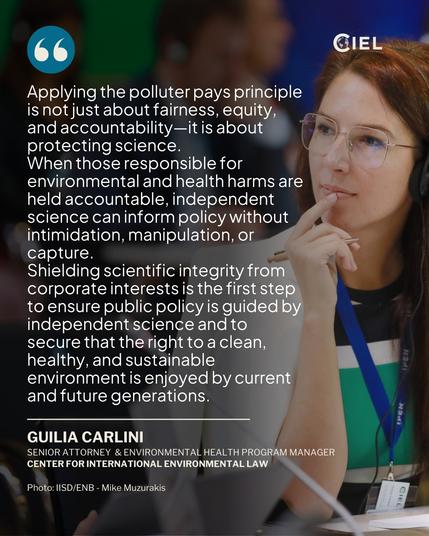
👨‍🔬 That’s why applying the #PolluterPaysPrinciple is also about protecting #Science. When polluters are held accountable, independent science can inform policy without intimidation, manipulation, or #CorporateCapture.
‼️ #PFAS contamination is not inevitable. With the right policies, accountability, and funding mechanisms, it can be tackled — and prevented.‼️
Bottomline: 🌀#PFAS pollution can be stopped— if accountability is at the core 🌀Paying after the damage is done is not enough 🌀 The #PollutersPaysPrinciple should be key across fora, incl. The ongoing #PlasticsTreaty talks. READ our report: www.ciel.org/reports/ppp-...