 LadyButterfly she/her
Eep

Vitangelo Moscarda discovers, by way of a completely irrelevant question that his wife poses to him, that everyone he knows, indeed everyone he has ever met, has constructed a Vitangelo persona in their own imagination and that none of these personas corresponds to the image of Vitangelo that he himself has constructed and believes himself to be.
Huh. To me that seems like it’s either trivially true or it’s nonsense, depending on definitions.
Of course nobody knows anybody 100% - especially not oneself. So each person gets a different view, with slightly different facts and assumptions about each other.
But on the other hand, strong or important personality traits tend to be noticeable after spending just a few minutes with a person.
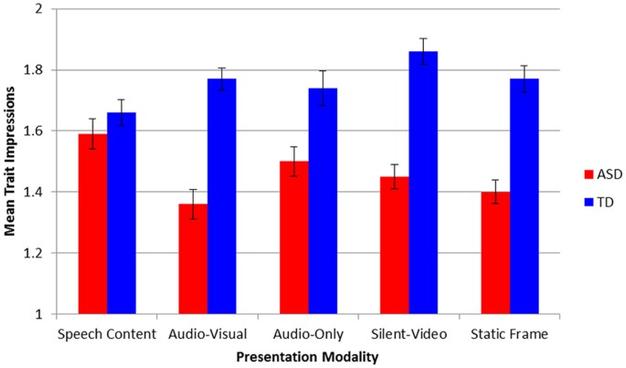
Individuals with autism spectrum disorder (ASD), including those who otherwise require less support, face severe difficulties in everyday social interactions. Research in this area has primarily focused on identifying the cognitive and neurological differences that contribute to these social impairments, but social interaction by definition involves more than one person and social difficulties may arise not just from people with ASD themselves, but also from the perceptions, judgments, and social decisions made by those around them. Here, across three studies, we find that first impressions of individuals with ASD made from thin slices of real-world social behavior by typically-developing observers are not only far less favorable across a range of trait judgments compared to controls, but also are associated with reduced intentions to pursue social interaction. These patterns are remarkably robust, occur within seconds, do not change with increased exposure, and persist across both child and adult age groups. However, these biases disappear when impressions are based on conversational content lacking audio-visual cues, suggesting that style, not substance, drives negative impressions of ASD. Collectively, these findings advocate for a broader perspective of social difficulties in ASD that considers both the individual’s impairments and the biases of potential social partners.
 thisisbutaname