 LadyButterfly she/her
Eep

Everyone wears different masks around different groups of people. Autism can amplify social problems, but everyone to some degree has experienced the image in the OP.
Trying to ascribe specific behaviors to autism might not be healthy, especially absent a formal diagnosis or a reason to think knowing whether it’s autism could help you deal with it in some way.
I feel sometimes like people treat autism as a pseudo-horoscope where just about anything can signify it. In reality, adult diagnosis of autism is very difficult for even professionals. Not only do autism symptoms tend to present less strongly in adulthood, but in addition to screening you, the neuropsychologist – as it’s a pervasive developmental disorder –will often ask to speak to someone like a family member who knew you when you were young. If it didn’t present in childhood, it’s definitionally not autism. Symptoms can get really fuzzy in adulthood in no small part because 18 years is a long time to learn how to act more neurotypical.
That’s not saying “ignore it and move on”. Introspecting like this can sometimes reveal broad behavioral patterns you didn’t notice or thought nothing of. Just keep in mind that autism is generally more complicated than something you can poll and ask “is this an autism?”
Everyone wears different masks around different groups of people.
Speak for yourself, that sounds like way too much effort for minimal payout, especially considering how many of them are transitory.
Mostly normal. There is some good research and theory about the topic out there. They refer to the trait as ‘self-monitoring’ and rank people as high or low in the trait. High self-monitors are “alert to social cues that suggest what they should do, and they are ready, willing, and able to tailor their behavior to fit in… low self-monitors are both less attentive to social norms and less flexible.”
High self monitors are activity specialists, who have friends for specific things, like a “ballet friend” or “tennis buddy,” and they avoid disputable topics.
There are a few trends that can be seen, with the high self-monitors having higher intimacy in relationships to start, but the relationships are less committed and shorter.
Some papers to look at: Nezlek & Leary, 2002; Fuglestad & Snyder, 2009; Leone & Hawkins, 2006; Snyder & Simpson, 1984; Wright et al., 2007). Quotes from Miller, 2012
Pick the most professional one and the weirdos will either get it, or notice you’re acting quite different and you can explain the others aren’t nearly as cool later.
Or pick the strangest and see whose really worth hanging out with
Vitangelo Moscarda discovers, by way of a completely irrelevant question that his wife poses to him, that everyone he knows, indeed everyone he has ever met, has constructed a Vitangelo persona in their own imagination and that none of these personas corresponds to the image of Vitangelo that he himself has constructed and believes himself to be.
Oh most of his work seems to be in public domain.
I can see many old translations to many languages, however the only place I can find them is Anna’s archive. For example they have editions made by epublibre, but epublibre itself is down.
Alright I started reading it this morning. Very entertaining.
Super thx, I’m always interested in authors from Latin countries since they’re closer to my culture.
Huh. To me that seems like it’s either trivially true or it’s nonsense, depending on definitions.
Of course nobody knows anybody 100% - especially not oneself. So each person gets a different view, with slightly different facts and assumptions about each other.
But on the other hand, strong or important personality traits tend to be noticeable after spending just a few minutes with a person.
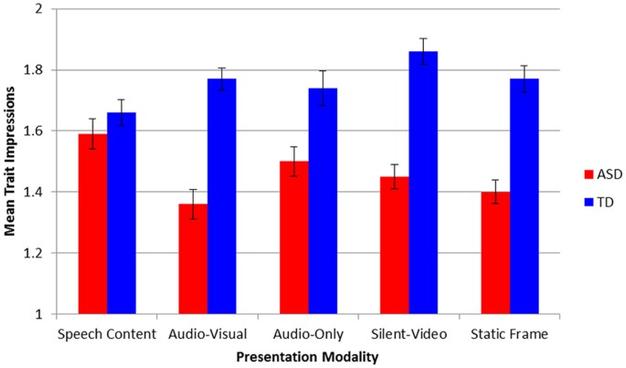
Individuals with autism spectrum disorder (ASD), including those who otherwise require less support, face severe difficulties in everyday social interactions. Research in this area has primarily focused on identifying the cognitive and neurological differences that contribute to these social impairments, but social interaction by definition involves more than one person and social difficulties may arise not just from people with ASD themselves, but also from the perceptions, judgments, and social decisions made by those around them. Here, across three studies, we find that first impressions of individuals with ASD made from thin slices of real-world social behavior by typically-developing observers are not only far less favorable across a range of trait judgments compared to controls, but also are associated with reduced intentions to pursue social interaction. These patterns are remarkably robust, occur within seconds, do not change with increased exposure, and persist across both child and adult age groups. However, these biases disappear when impressions are based on conversational content lacking audio-visual cues, suggesting that style, not substance, drives negative impressions of ASD. Collectively, these findings advocate for a broader perspective of social difficulties in ASD that considers both the individual’s impairments and the biases of potential social partners.
I negotiate boundaries with people individually.
Yeah, I think you nailed it there. I am perfectly happy talking about certain parts of my life with certain individuals, while completely walling off those parts with others.
 Earthman_Jim
 TheTechnician27
 sorrybookbroke
 Loaf
Loaf
 RVGamer06
 vaultdweller013
 muusemuuse