RE: https://fediscience.org/@Guillawme/111534984107819771

Something really cool happened to me this year!

@HRBridges re-processed a #cryoEM dataset from some previous work of mine and colleagues (publicly available as EMPIAR-10739; see quoted post below for a summary of this work). She significantly improved the results we had struggled to obtain at the time of the initial analysis, and wrote it up as a case study for the CryoSPARC Guide: https://guide.cryosparc.com/processing-data/tutorials-and-case-studies/case-study-end-to-end-and-exploratory-processing-of-a-motor-bound-nucleosome-empiar-10739

This is already super cool! Even cooler: she found a structure we had not found in this dataset. And it is a significant piece of result both to complete our understanding of ALC1 (the protein under study) and more broadly to understand one more way in which chromatin-binding factors can recognize the #nucleosome
We wrote an article about it, the preprint went online in November (now trying to get it peer-reviewed, but it might take some time; I can only work on this in my free time): https://doi.org/10.1101/2025.11.10.687450

I wrote some more about the back story here: https://www.gaullier.org/en/blog/2025/12/28/new-preprint-on-alc1
Long story short: this preprint would not have materialized, had we not both attended the CCP-EM Spring Symposium this year and discussed at the poster session.

I will write a summary thread about this new preprint in the near future (hopefully before the spring semester hits me; it's going to be busy...).

As promised, here is a summary of this new preprint on the ALC1-nucleosome complex. 🧵

https://doi.org/10.1101/2025.11.10.687450

First, a reminder of some structural features of the #nucleosome.

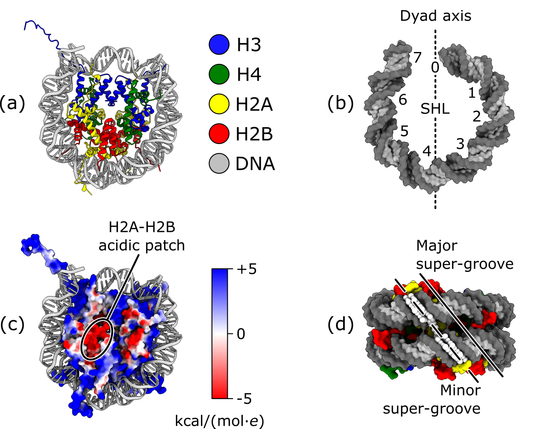
Histones H2A and H2B form a negatively charged cleft exposed on the surface of the histone octamer, called the "acidic patch". It is recognized by many chromatin-binding factors. If you have read on these proteins, you have most likely already read about the acidic patch too.

One feature much less commonly mentioned is the "super-groove". The DNA wraps around the histone octamer in such a way that the major and minor grooves perfectly align across the two gyres. In 2004, Dervan, Luger and colleagues synthesized short polyamides able to bind to specific sequences across the super-groove (https://doi.org/10.1073/pnas.0401743101). They hypothesized that some chromatin-binding factors may recognize the super-groove, among other nucleosomal epitopes. Until 2025, there was no direct evidence for this.

1/5

In 2021, I was involved in a study of the #chromatin remodeler ALC1, a protein involved in the early events of the DNA damage response. This led to a paper summarized in a previous thread: https://fediscience.org/@Guillawme/111534984107819771

We had deposited the raw #cryoEM data to #EMPIAR (dataset EMPIAR-10739), which is the primary reason this new preprint could come to exist at all.

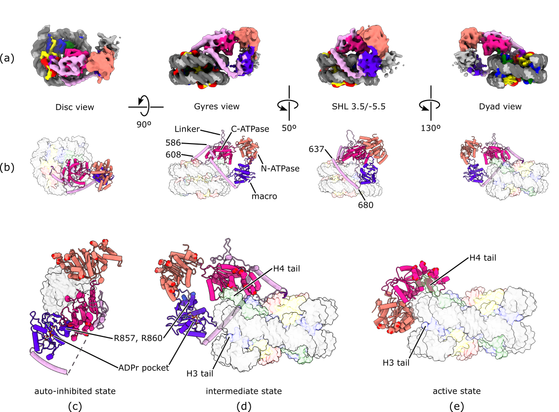
This figure shows the structural knowledge available on ALC1 up to the point of the new structure we report in the preprint. An AlphaFold2 prediction, a structure of the auto-inhibited conformation, and a few structures of ALC1-nucleosome complexes. Notably, none of the structures of nucleosome complexes resolved the macro domain. This is a significant gap, because the macro domain is key in regulating ALC1: it is responsible for auto-inhibition and recruitment to PARylated nucleosomes, and these two things are exclusive, which is why recruitment also causes release of the auto-inhibition. So at this point we know what the protein looks like when auto-inhibited and when active, but how it transitions from the former to the latter is unclear.

2/5

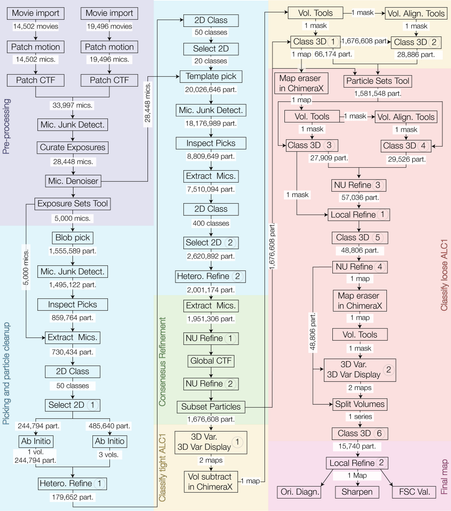
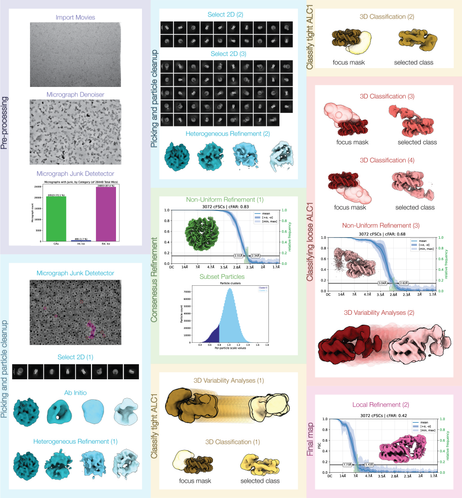
And here is @HRBridges 's magic explained in a flow chart. ✨

For more info, consult the preprint's methods section and the case study in the CryoSPARC Guide. This is a compact view of the process, showing what worked best. The map we deposited had job number J8039! 😵‍💫

3/5

So what does this new structure look like?

ALC1 is loosely bound to the #nucleosome, in a conformation that likely doesn't allow it to slide the nucleosome along the DNA, since the two ATPase lobes are not clamping the DNA. But we finally see the macro domain, for the first time in a nucleosome-bound structure! It interacts with the N-ATPase lobe, preventing the ATPase domain from fully clamping the DNA. So this looks a lot like an intermediate state in the transition from auto-inhibited to active ALC1.

Another striking observation from this structure is a long alpha-helix just upstream of the macro domain, that lines the nucleosome's minor super-groove.

4/5

A closer look at this helix indicates that it is rich in basic residues: Lys and Arg account for 34% of its sequence composition. This already suggests that its function is to interact with DNA. Looking at sequence conservation, it seems like the basic residues facing the DNA are conserved, further supporting this. Finally, in the 2021 paper we had found that a construct containing only this helix and the macro domain did bind to unmodified nucleosomes (the macro domain by itself only binds to poly-ADP-ribose).

So we propose that this helix is a super-groove recognition element, and we call it the super-groove recognition helix (SGRH).

So ALC1 is the second described example of a naturally occurring protein recognizing the super-groove. The first one is a kinase called Haspin, published earlier in 2025 by Cynthia Wolberger's group (https://doi.org/10.1038/s41594-025-01502-y). Interestingly, Haspin and ALC1 display quite distinct binding modes to the super-groove. This suggests that recognition of the super-groove could be widespread and use diverse structural elements in chromatin-binding proteins. I can't wait to see more examples uncovered!

5/5, fin.

Finished reading this preprint on the ALC1-#nucleosome complex? ⬆️

The methods section details what worked, but not everything that was tried: it would be way too long for the academic article format (this methods section is already quite long).

Well, if you are curious about the thought process and decision making during data analysis, rejoice! For @HRBridges has written it all up in Part 2 of the case study in the CryoSPARC Guide!

Find it here: https://guide.cryosparc.com/processing-data/tutorials-and-case-studies/case-study-processing-of-a-novel-motor-bound-nucleosome-state-empiar-10739-part-2

Discuss it on the forum here: https://discuss.cryosparc.com/t/case-study-exploratory-processing-of-a-motor-bound-nucleosome-empiar-10739-part-2/24438
Or directly here on the Fediverse.

Case Study: processing of a novel motor-bound nucleosome state (EMPIAR-10739) - part 2 | CryoSPARC Guide

Processing EMPIAR-10739 including using 3DVA to guide classification strategies, separating low population classes, and local refinement of a flexible region.