@Antti98
> "but on other hand how many normal Joe will ever experience that 3rd party will target your device specifically?"
> "Didn't claim that average Joe couldn't use GOS, just that it makes most sense for those that probably face direct 3rd party attacks"
> "Some alternatives are in my opinion good enough from privacy perspective to average Joe who's main privacy thread is Google/Meta/Microsoft"
You don't have to specifically target the device. Some time ago, the developer of the Smarttube app (a privacy-friendly YouTube client) was hacked, and malicious builds of the app were released and distributed. Since Android has a robust sandboxing and permissions model, the damage was largely minimized.
The incident is a good example of how important sandboxing and the OS security model are. Just imagine if the app had also been available for Linux (including SailfishOS) or Windows – the damage would have been enormous.
It is also a good example of how a trustworthy app became a threat. This can happen with other apps at any time.
> "I don't know how chatting about phone OS turns into speaking about neo-Nazis without relating at all to those OSs?"
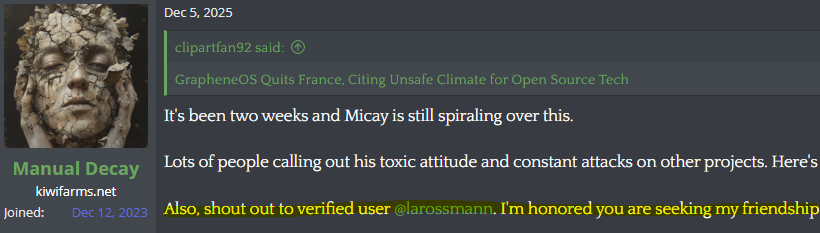
You were the one who linked Rossmann's video; I just pointed out that he is not a reputable source and that you shouldn't believe anything he says. If you want to know more, ask @GrapheneOS yourself.
Here's my take on it (my private Opinion):
I've been reading GrapheneOS posts (on X and Mastodon) almost daily for almost a year now, and I've never noticed any toxic communication on the part of GrapheneOS. All they do is publish technically accurate information (which often overlaps with other Android security researchers).
> "[...] with GOS (Google developed OS with different clothes and nicer seams) [...]"
This statement is incorrect. It is based on the AOSP (like LineageOS, IodeOS, etc.) but significantly improves the security of the AOSP. No GOS developer is affiliated with Google in any way.
> “doesn't contribute anything to the table if we are looking at European alternatives”
These so-called “European alternatives” all have far worse security than Pixels or iPhones. In the case of Fairphone, for example, GrapheneOS and Tavi (Android security researcher and former developer of DivestOS) have already written something:
https://discuss.grapheneos.org/d/24134-devices-lacking-standard-privacysecurity-patches-and-protections-arent-private
https://forum.fairphone.com/t/is-fairphone-really-interested-in-sustainability/99302/2
> “[...] but why bash every other alternative just to prove your superiority?”
It's not about showing that they are “superior.” It's about providing technically accurate information, refuting false claims made by various companies and organizations (some of which attack GrapheneOS), and defending themselves from those attacks.
If there were a smartphone OS with reasonable security (modern exploit mitigations, memory-safe languages, robust sandboxing and permissions systems, strict MAC policies) and timely security updates, they would recommend it.
 Voxelpower
 Antti
Antti