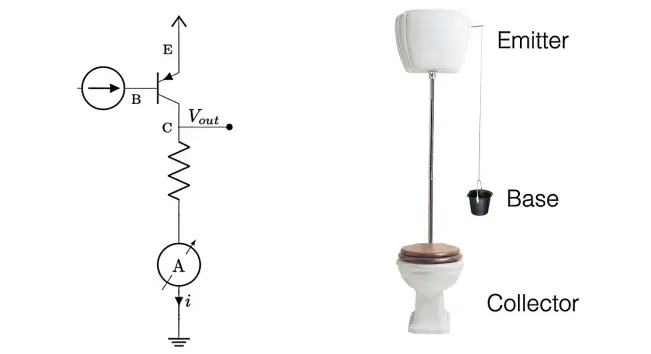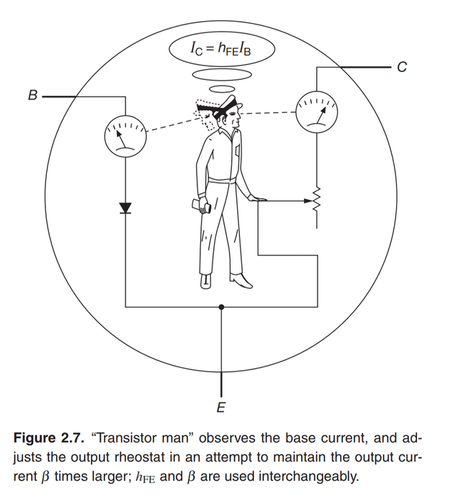

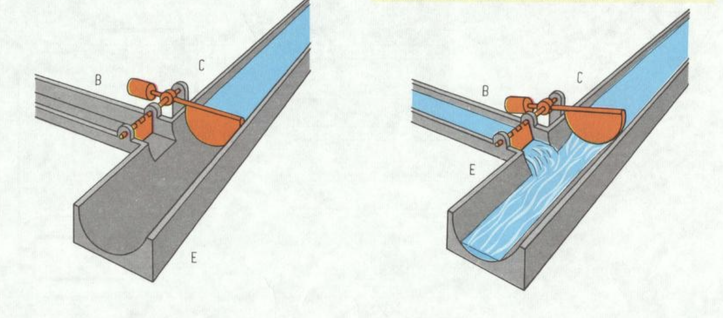
This is the biblically accurate way I learned how transistors work - copy taken from the original scripture.
@nblr I'd like to see the M.C. Escher version...
@nblr Me too, actually! I think we had the same Kosmos set.
@fell @nblr Make that three of us, I immediately recognised this one too and this is still how I think of transistors to this day 😅
@nblr Same.

@__michaelg @krono @nblr

This is the thyristor one.

You pull the gate, current flows without pulling further, until the current got close to zero and the thyristor is closed again.

But nice idea, i liked the noises of the water rushing down the downpipe on this old style toilets. There was lots of them in eastern germany until...1995.

@gafu @__michaelg @nblr I once broke one of these. around 1988
@nblr Definitely this one for me ...
@acsawdey @nblr what I'm getting from this is... Transistor man is a switch
@acsawdey @nblr I have "combinatorial network man", so I think that we believe in a slightly different religion.
@giomba @nblr That’s excellent! The truth is, that’s actually my religion too as I’ve never been great at analog and have spent my career working on processors .. which are an exercise in how many legions of combinatorial network men you can squeeze into a chip.
@acsawdey @nblr 'The Hitchhikers Guide to the Galaxy' written by Horowitz and Hill!
@acsawdey I have unironically called this book "The Bible" on many occasions.

@nblr

@aaron @nblr This is The Way.

It’s such good reference. I had a 2-semester “electronics for physicists” sequence that used it as a textbook and it really filled in gaps in my knowledge.

@nblr Viscerally remember this
@nblr oh wow have not seen it in 40 years but instantly remembered.

I've seen it about (slightly more than) fifty years ago, in a German experiment set "Radiomann" for kids.

@Nfoonf @nblr

@nblr Ahhh was it from some cosmos electronics kit? Accompanied by some space station lore comic?
@SadMonk Exactly! The funny professor and his robot friend who needed fixing every now and then ;)
@dreua I read that booklet over and over again. Simply because spaaaaace! XD
@nblr still waiting for someone to build a full computer like that
@DrLuke @nblr you're in luck, someone already has--quite a long time ago too
https://en.wikipedia.org/wiki/Phillips_Machine
-F
Phillips Machine - Wikipedia

@nblr
Explained by Heidi Kabel.

@OverBoing @nblr Wait, what? Bei mir war das Daniel Düsentrieb. Hattest Du zufällig die neuere X-Serie? Dann hätten die damals ja tatsächlich such schon aktiv versucht, Mädchen für Technik zu begeistern...

Und das wirft gerade für mich ein ganz anderes Licht auf das X! 😳
Kosmos Electronic X1000-X2000 : Kosmos : Free Download, Borrow, and Streaming : Internet Archive

Experimentieranleitung Kosmos Electronic X1000-X2000

Internet Archive
@nblr Von einem dieser Cosmos Lernsets... so zufällig?
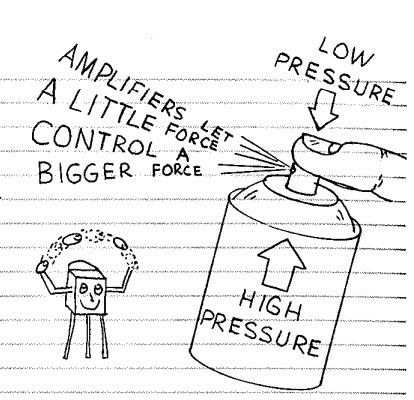
@nblr I genuinely have no idea what that's from. I grew up with the gospel of Forrest M. Mims III:
https://ia801009.us.archive.org/26/items/ittatp/Transistors.pdf
@markzero @nblr I grew up with a different Forrest M. Mims III book where electrons were depicted as having either happy faces on them when moving or with little sleepy faces when at rest. The whole thing was made to look like a hand-written notebook.

@encephalophone @nblr yeah! That's actually his more common style, afaik. Much more approachable. Sorry, I was on mobile when I searched.

Treasure your copy if you still have it.

@nblr Sadly the opportunity to show that C and E are kinda the same but not exactly wasn't taken. (In reality they differ mostly in size, and that or some other unknown to me difference makes amplification when you connect the transistor backwards much lower via a mechanism I don't understand.) I would try to draw a pair of channels with small flaps s.t. any of them raises the large one.

I would also quibble whether the large flap is correct (because we don't adjust resistance but limit the maximum current at first approximation), but I have no clue how to represent that better.
@nblr "The modern smartphone is a series of pipes..."
@nblr I remember that book. Even better than I remember the learning kit it came with.
@nblr True for BJT type. It is wrong for MOSFET transistors, though.
@alex @nblr
I agreee, this is very good analogy but it is only valid for bipolar transistors.
@rufio @alex @nblr npn-type in particular, iirc
@alex @nblr
Very true
this is how junction transistors behave but it’s not how field effect transistors behave
@nblr Saw it several decades ago, similar picture in a Kosmos electronics learner‘s kit for children. You could expand the kit with more components and build complex circuits like FM radios and basic computing circuits. And you knew your components.
It is a pity that there is nothing comparable for today’s children.

@dermb @nblr
Same here, instantly recognized the transistor picture.

But I never got the Radio working, did it work for any if you?
I think that was the Kosmos XN3000 and an AM Radio 🤔

Yes, working Radio 🎉
50%
No, just static :blobfoxsad:
50%
Never built it.
0%
Poll ended at .
@dreua @dermb XN2000 with AM radio, always wanted the XN3000(?) with the much cooler FM radio. Based on that trauma I made it my physics project at school, for graduation, to build an FM transmitter. -> 14 points 

@nblr @dreua @dermb My father built a radio that actually worked (well, he got some professional help) based on radio tubes. That was in the 1950s. This manual/textbook

https://veron.nl/nieuws/zoo-werkt-de-radio/

Zoo.... werkt de Radio! - Uit juni 1939 maar nog steeds zeer lezenswaardig

Juni 1939 kwam de eerste uitgave van "Zoo.... werkt de Radio!" op de Nederlandse markt. Toen een zeer goed boek en nu nog steeds zeer lezenswaardig.

VERON

@nblr @dreua @dermb Here is the actual text. Firefox reports an expired certificate, but it works. BTW the scanning person added manual annotations/corrections!

https://waij.com/oldbooks/radio_bestanden/Zoo_werkt_de_radio.pdf

@dreua @dermb @nblr Barely working IIRC, one very faint station, with the AM radio in Radio + Elektronik 1
@dreua @nblr I remember connecting some old speaker cable to the circuit to improvise a longer antenna

@nblr Erklärt von Daniel D. 😍

Ich hatte dann irgendwann die ganze Serie, 1000-4000, HighTech und Radio.

Und hatte die Kellertreppe mittels Laserschranke abgesichert, damit ich Spiele, die ich nicht spielen sollte, schnell genug beendet kriege, falls jemand runterkommt. 😁

@nblr Here us the Dutch version of the XN300 testament ;)

Is it legal to scan and upload these yet? I might know someone who might scan the German versions in case someone is interested...

https://archive.org/details/kosmos-xn-3000-experimenteerhandboek/mode/2up?q=Radio

Kosmos Xn 3000 Experimenteerhandboek : Franckh-Kosmos Verlags-GmbH & Co : Free Download, Borrow, and Streaming : Internet Archive

kosmos xn3000 experimenteerhandboek

Internet Archive
@nblr this is how I understand junction transistors to work as well. Water and electricity make great metaphors for teaching about one to someone who understands the other
Electric current is explained as number of charges passing a given point over time, voltage is analogous to the height of the watertower, etc.
@nblr lel, even without the original I had a family member draw the same exact scheme two days ago. for upcoming soldering workshops.

@nblr

So...are transistors just basically tiny relays? BC that's how those work too

@TeflonTrout To some extent and in some usage scenarios. They tend to be less “binary” though and that’s where the analogy slightly breaks. There usually is a proportional increase of current which makes them very useful for amplifying signals for example.
@nblr baller, thank you for taking the time!

@nblr @TeflonTrout

So the outflow should have more water -amplified- than input.

@SCALETHEORY @nblr

Edit: Am very sleepy. Forgot to mention that the first way I took your meaning, I considered the big source the primary focus and that made me think the graphic was wrong. But again, I never told you that in the first place!

k, then the graphic is still correct. The large trough would be the external power source that the transistor is metering. The LEFT current is the primary circuit... This would be easier if I knew electrical jargon.