Day 7 of my ‘getting through January vintage floral plates from books’, frontispiece to The ladies companion to the flower garden, 1860s. This is one of my ‘poison books’ from my collection with a bright green cover which may denote arsenic was used. Arsenic was used in Victorian products as a green dye in the 1860s to 80s.
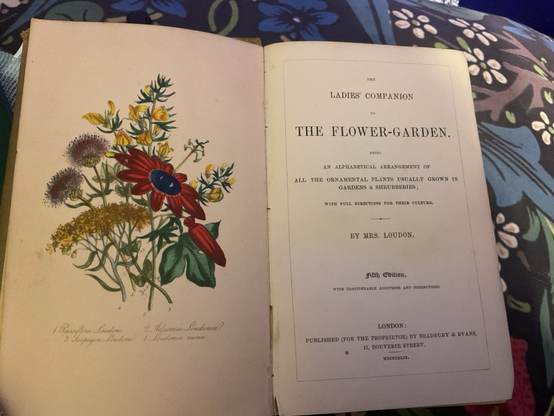
Arsenic was mined near my home at Devon great consols began refining arsenic in 1867 and was considered to be its largest producer in the 19th century. My suspected poison books are locked in a bag and I only handle them wearing specialist gloves.
#victorian #arsenic #poisonbooks
@Rachelburch thanks for letting us know you handle this safely. I had a moment of worry.
I loved Bitten By Witch Fever (https://www.lucindahawksley.com/books/bitten-by-witch-fever/) which wasn't just eye-opening about the use of arsenic in wallpaper but a lovely object in its own right.
Bitten by Witch Fever – Lucinda Hawksley

@sarble that Morris quote hasn’t aged well has it, but then he did have shares in the Devon consols mine.
"You might die from our wallpaper but it'll be a beautiful death"
@Rachelburch have you seen the Poison Book Project (https://sites.udel.edu/poisonbookproject/)? They have a database and list one book by Mrs Loudon but I'm not sure if it's yours... if it's different, they may like to know. Thanks for an interesting series and post. Take care.
Home | Poison Book Project

Learn why emerald green is our favorite color — at a cost. The Poison Book Project is an interdisciplinary research initiative at Winterthur...

@morgrugyn yes i know that project that’s where I got info from, I don’t definitely know my books poisonous im just being cautious. It’s not on that list but the colour and dates fit. The colour isn’t quite right but I’m just being cautious.