 Kara
Kara Alfie Kohn
A reminder during this holiday season, courtesy of the late Barbara Ehrenreich, about the "major philanthropists of our society."
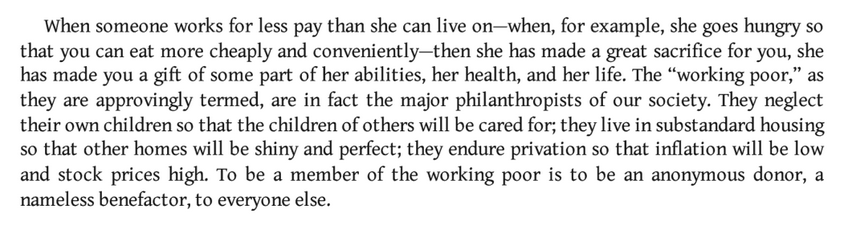
'Philanthropy', from the Greek 'philo-', "to love", implies a magnanimous intention to help, which would be lacking for most working poor people. It would be like equating taxpaying with philanthropy -- both might fund a public library, but the taxpayer's intentions are more ambivalent.
1 of 2
Less commonly a poor worker may so admire their nation, its laws, its wealth, its economic system, or their employers, that they come to feel themselves part of a greater body whose magnanimity is expressed by undercompensated labor. Such feelings are also promoted by corporations, religions, Nazis, and Thomas Carlyle.
Ironically or sardonically applying the term philanthropy to wage slavery seems unpleasantly close to the latter view.
2 of 2
@alfiekohn related: before eating a meal, people should consider expressing appreciation for the people who planted, harvested, transported, shelved, & prepared all the food.
this is better than giving thanks to an authoritarian god, which only serves to get people in the habit of going along with authoritarianism (and consequently human authority figures). The effect of that version of "grace" is not at all supernatural, but it is 100% political, and there are political stakes.
 Ari "Two Foxes" Jackson
 netop://ウィビ
 craignicol
 LR
LR Oof
Oof Oblomov