NCHS estimates of #LongCovid—based on Household Pulse Survey.

Census never published data for October and December of 2024, after posting that they were "transitioning" to longitudinal data collection. To be clear, that was under the prior administration.

On the other hand, Census has updated historical population estimates. (As of May this year, population for January 2024 was estimated at 332 million. In June that estimate jumped to 338½ million.) Chart below represents these updated Census population estimates.

Hospital capacity data collection and reporting was ended under prior administration. Only Federal Reserve disability data continues to update.

#ThisIsOurPolio #CountLongCovid #CovidIsNotOver #MassDisablingEvent

[This is first toot of periodically refreshed thread, providing various dataviz of ongoing #pandemic.]

Last period:
https://hcommons.social/@beadsland/114838338710485782

After missing last month's update for reason of government shutdown, #CDC's most recent dataset, updated Friday, finally breaks out estimates for multiple XFG subvariants.

Nowcast suggests three XFG strains have gained significant share in past four weeks, along with two recombinants, XFZ (child of PG.3.2 and XFC.3) and XFV (child of LP.8.1 and XFG.3.3.1).

Note that, in absence of robust data from states, CDC has given up modeling historical estimates, instead giving only shares of reported sequences.

Raj's dashboard, updated two weeks ago, shows Stratus wildly diversified, having spawned multiple third-generation pango aliases & descendant recombinants. Previous data had suggested XFG was stagnant.

GISAID data for the latter two-weeks-and-change of the most recent period is dominated by submissions from California (120 sequences), followed by New York (87), Minnesota (49), and Colorado (36)—paltry all round.

#ThisIsOurPolio #variants #CovidIsNotOver #dataviz #datavis

Raj's dashboard, updated this morning, shows Stratus dynasty with diversified XFG.3 family at plurality, accounting for quarter of all samples. Notably, GISAID submissions don't reflect CDC's estimated growth of XFZ & XFV recombinants.

GISAID data for the most recent four-week period is dominated by paltry submissions from New York (80 sequences), followed by Maryland (45), Colorado (41), Minnesota (33), and Illinois (26).

After missing last month's update for reason of government shutdown, #CDC's most recent dataset, updated Friday, finally breaks out estimates for multiple XFG subvariants.

Nowcast suggests three XFG strains have gained significant share in past four weeks, along with two recombinants, XFZ (child of PG.3.2 and XFC.3) and XFV (child of LP.8.1 and XFG.3.3.1).

Note that, in absence of robust data from states, CDC has given up modeling historical estimates, instead giving only shares of reported sequences.

#ThisIsOurPolio #variants #CovidIsNotOver #dataviz #datavis

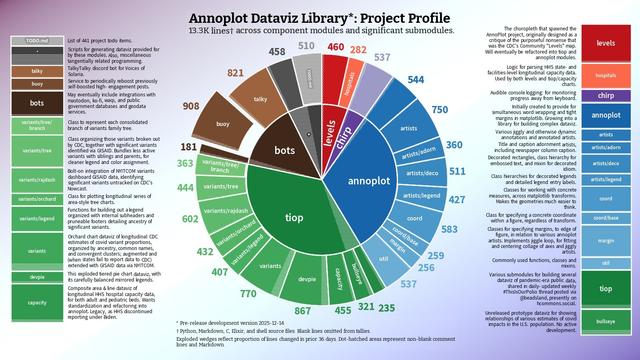
#Annoplot #dataviz development has been temporarily suspended as of October, but for maintenance:

https://hcommons.social/@beadsland/115295487903892225

November maintenance included: accommodating less frequently updated GISAID data; tweaking of etalicizing to parents; revising captions, footnotes, and alt-text generation for #datavis; and tweaking title wrapping in legend.

Buoy work continued until mid November, accounting for another 500 lines, when also put on hold. Hopefully will resume in January:

https://hcommons.social/@beadsland/115522549953210771

Work included: fleshing out pretty-printed logging; extensive refactoring; cleaning up derivative class mutations and pagination process; better handling of historical cutoffs, to allow for interruptions due to netbreaks; graceful shutdown and progress indicator behavior; debugging; refinement of refresh behavior; velocity-based scoring method for prioritizing what to reboost; redesign of parallel data-based pagination.

#CDC's most recent dataset, updated today, shows three XFG subvariants, broken out last month, outpacing growth of parent and remaining siblings.

Meanwhile, XFZ and XFV, both recombinants themselves descended from prior recombinants of LF.7 (XFC and XFG, respectively), are shown as quickly gaining in combined share.

Note that, in absence of robust data from states, CDC has given up modeling historical estimates, instead giving only shares of reported sequences.

Raj's dashboard, updated near a month ago, showed Stratus dynasty with diversified XFG.3 family at plurality, accounting for quarter of all samples. Notably, GISAID submissions didn't reflect CDC's estimated growth of XFZ & XFV recombinants.

GISAID data for the most recent four-week period was dominated by paltry submissions from New York (80 sequences), followed by Maryland (45), Colorado (41), Minnesota (33), and Illinois (26).

#ThisIsOurPolio #variants #CovidIsNotOver #dataviz #datavis

Raj's dashboard, updated Saturday, shows Stratus dynasty with diversified XFG.3 family at plurality, accounting for still over a fifth of all samples, with XFG.14 already over a tenth.

GISAID data for the most recent three-plus-week period was dominated by paltry submissions from New York (146 sequences), followed by Minnesota (129), California (39), Illinois (38), Massachusetts (33), and Nebraska (27).

#CDC's most recent dataset, updated near two weeks ago, showed three XFG subvariants, broken out last month, together outpacing growth of parent and remaining siblings.

Meanwhile, XFZ and XFV, both recombinants themselves descended from prior recombinants of LF.7 (XFC and XFG, respectively), were shown as quickly gaining in combined share.

Note that, in absence of robust data from states, CDC has given up modeling historical estimates, instead giving only shares of reported sequences.

#ThisIsOurPolio #variants #CovidIsNotOver #dataviz #datavis