Are you being tracked when you visit your government's websites?

Probably!

We (@sachindhke, Faisal Mahmud, Sandra Siby, and I) have a new paper appearing at PETS (the Privacy Enhancing Technologies Symposium) next July that looks at government websites from 61 countries over the last 29 years.

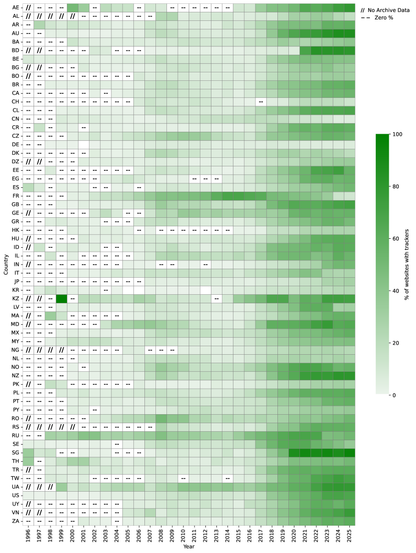
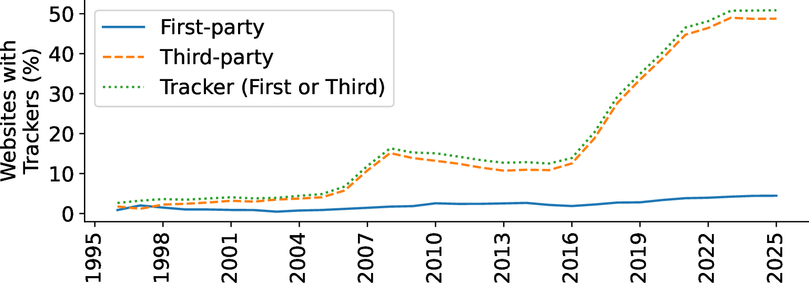
Today, about 50% of government websites in the countries we looked at contain web trackers, most of those third-party (ie. run by organizations other than the website itself). This number has been growing over the last few decades.
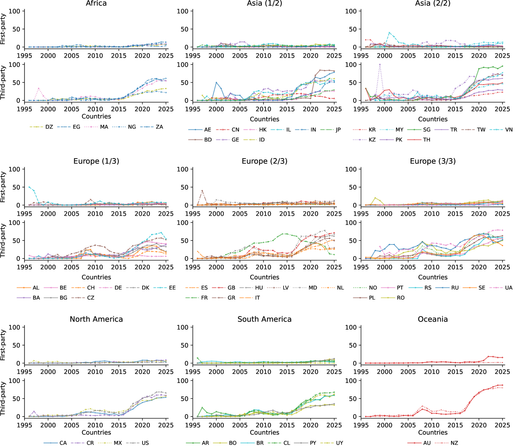
Using historical versions of government websites from the Internet Archive's Wayback machine, we can look back from 1996 to the present day, and we can see that different regions have adopted trackers at different rates.

Overall, the trend is towards increasing tracking, but not all regions are the same, and neither are all countries within a region. For example, the countries we studied in North America (US, Canada, Mexico, Costa Rica) have adopted trackers on their government websites in pretty similar patterns. So have Australia and New Zealand. In South America, though, the governments of some countries that we studied (Bolivia and Paraguay) have been less aggressive at tracking users than others (Argentina, Brazil, Chile, Uruguay). Similar clusterings between low-tracking countries (Algeria, Nigeria) and high-tracking countries (Egypt, Morocco, South Africa) appear in Africa too. Asia and Europe have more diverse ranges of tracking behaviors.

Google trackers are deployed on the largest set of government websites, appearing in all 61 countries we studied. Facebook, Automattic (wp.com), Cloudflare, and others - mostly US-based companies - are common across the world. Here, for example, is how Google's tracking footprint has evolved over the years on government websites.
Overall, this is what the history of web tracking on government websites looks like over the past 29 years. A few countries have backed off somewhat on tracking visitors to their websites, but overall, the trend is towards increased tracking.
If you want to learn more, we have a preprint of our paper up at https://www.flux.utah.edu/paper/singh-pets26 . And, @sachindhke is on the academic job market right now, so you could interview him and ask!

@ricci @sachindhke

This is quite interesting. I help run a govt focused CMS platform (focused on the US, AU, and NZ) and this definitely matches the trends I’ve seen. Especially in AU and NZ.