 Cleo Menezes Jr. 🌵
For fun: partially implementing the Moisac Windows concept by @tbernard.
https://blogs.gnome.org/tbernard/2023/07/26/rethinking-window-management/
For fun: partially implementing the Moisac Windows concept by @tbernard.
https://blogs.gnome.org/tbernard/2023/07/26/rethinking-window-management/
At the moment I am making a dynamic and intelligent tiling system that coexists with the mosaic as shown in the mockup and this has been a fairly wide road.
I have already achieved good results, but I think I will only have something that can be proved next year.

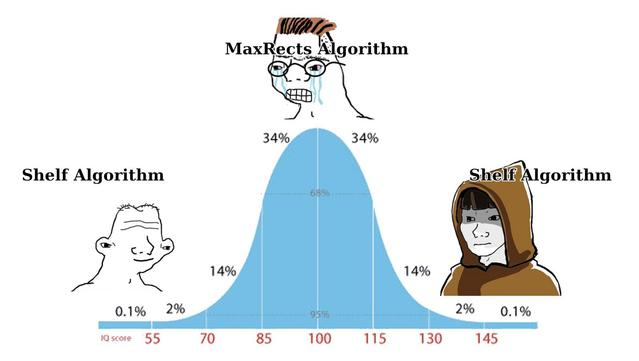
I initially used the Shelf algorithm to build the mosaic, but I ran into limitations I didn't like. I'm testing a hybrid approach: MaxRects algorithm augmented with some BSP algorithm features to improve space utilization and partitioning flexibility.
I need to weigh the pros and cons: a hybrid MaxRects with BSP improves space utilization and flexibility (fills gaps and eases reorganization) but increases computational complexity and processing cost.
Any thoughts?
Using the Shelf algorithm, I implemented an approach where windows are arranged with radial growth; exactly what I was looking for. This greatly improved space utilization and looks visually well-balanced.
Before the algorithm tried to complete the horizontal space of their "shelf" with windows before creating another "shelf". The look was very unbalanced and uncentric.
I was researching some articles about algorithms for collages and came across an interesting one: https://callistaenterprise.se/blogg/teknik/2025/06/11/genetic-algorithms-collage-creation/.
The proposal presented seems brilliant, as considering the concept of "collage" makes more sense than thinking about "mosaic" to solve this problem.
I tried everything: spiral packing, radial growth, bin packing... Each one promised to be "the definitive." The radial looked nice but had gaps. The spiral got stuck on edge cases. The bin packing ignored aspect ratios.
In the end, I went back to basics: horizontal rows with smart distribution. Windows arrange themselves in lines, respecting their original sizes. Simple, predictable, and it works.
Sometimes the elegant solution is the one that doesn't try to be brilliant. 🧘
Guys, MosaicWM is becoming more and more stable, so I would like to start having people testing it.
I have an issue reported by several users that, after the discussion in this thread¹, made me rethink how the Mosaic WM should behave:
#GNOME workflow is based on workspaces, and the most practical approach — as most people do — is one task per workspace.
+++
¹ https://github.com/CleoMenezesJr/MosaicWM/issues/7
also: https://github.com/CleoMenezesJr/MosaicWM/issues/13#issue-3713014865
- When an overflow occurs, should a new workspace be created at the end or adjacent to the affected workspace?
These are just the initial questions.
I heard "smart resize"?
The original idea for mosaic windows was that each window would open at its "ideal size," but that will take time to implement. Meanwhile, I propose a different approach to make tiling useful right away.
#GNOME's workflow encourages one workspace per task. I organize mine like this:
1. Terminal / Neovim
2. Browser
3. Messaging apps
4. Casual apps
+++
I already know where everything is and my windows usually open at the right size, so overflow is rare. But new users can find it frustrating to adjust windows until the layout is “perfect.”
Proposal: before checking whether a window fits the workspace, automatically try to resize it to fit. If a user opened an app in that workspace, they likely want it to fit there. Windows do have minimum sizes, so some overflow will still occur, but it would be less common for new users.
This is still experimental, no commits yet, just advanced tests.
What do you think?
@gnuntoo thank you for your feedback:
If you wanna try this new feature and talk about it, check it out:

Description This PR introduces the Smart Resize feature set, designed to dynamically adjust window sizes to optimize workspace utilization and significantly reduce unnecessary window overflows. It ...

 gnuntoo