I've got a new #KiCad plugin out in the KiCad plugin manager:

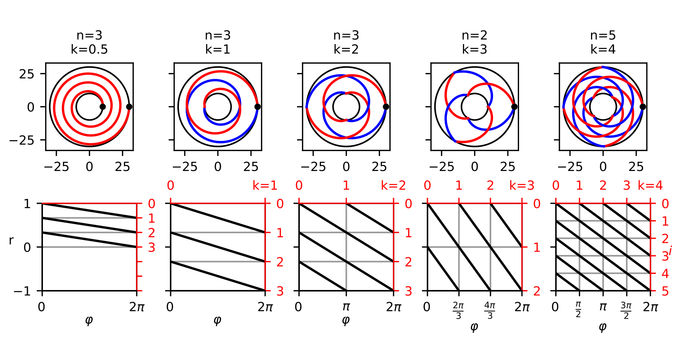
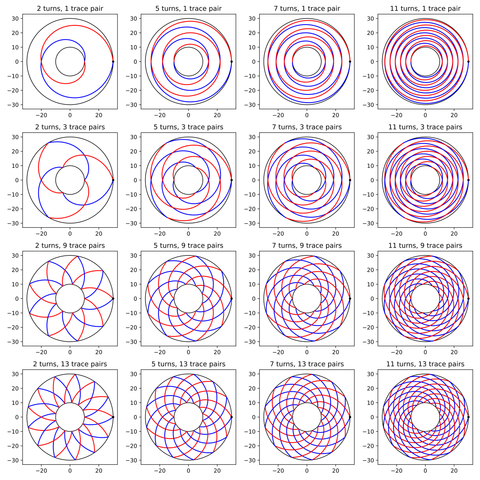
KiCoil generates "twisted" planar inductors. You can make it do one- or two-layer spiral inductors, toroid inductors, and many intermediate, hybrid variants in between spiral and toroid inductors.

These hybrid types have wider traces than a single-layer spiral, and have better high-frequency behavior (parasitic capacitance and self-resonant frequency) compared to two-layer spiral inductors. And they look really pretty!
#electronics

@jaseg this looks cool. as a software person, a couple of decades ago i worked on a project that used inductors like these (i think) to do distance sensors (e.g. is door shut or nearly shut? how high up the fuel tank is the floating sensor? axle rotation). They would have an active part on one PCB and a passive part on another (tiny) PCB, and use a microprocessor to estimate resonance (i think). Is that the sort of thing that these are used for? (their patents are all expired)
@drj Tbh, I have never seen anything quite like these used in the wild. There are some high-performance planar RF inductors that apply concepts similar to this or that are special cases of this, but AFAIK this is the first generalized implementation of the concept. I did some literature research back into the 1800s, and I didn't find any other explicit formulation of the general "any combination of co-prime turn count and 'twist' count" inductor idea.
@drj Some coreless motor winding types (e.g. classic Faulhaber) are quite similar in construction, but not in how they work.
@jaseg Here is one of the expired patents: https://www.search-for-intellectual-property.service.gov.uk/GB2417088 but i can't see the text, and all of this is voodoo to me, so i'm unable to tell how similar these things are. At the time i thought the basic idea of using a cheap but fairly precisely made inductor to estimate distance or rotation was actually kinda cool and more people ought to know about it. Maybe it is now a well-known thing; i don't know. (also, i kinda want to try it with hand-drawn spirals with conductive ink on paper)

@drj Oh, thank you, that's really interesting! google patents has a full PDF:

https://patentimages.storage.googleapis.com/ae/04/6f/e7ed0beb7de377/GB2417088A.pdf

I think this one is similar to the theft prevention things you see in stores. I think this is conceptually more similar to what I've seen referred to as "flux-neutral" coils, where you have an arrangement of multiple side-by-side coils of opposing polarity to either suppress or enhance far-field sensitivity.

@drj In aerospace, synchros are basically using inuctors configured as a two- or three-phase transformer for precise rotation sensing. They usually have cores, but there is no reason you wouldn't be able to do the same with a coreless inductor instead.
@jaseg Aha! i'm glad it's interesting. They had linear and rotational positional sensors to, so it might be worth digging around their other patents. They seem to have an annoyingly large number of similar patents.
@drj Yeah, lots of patent-focused companies do this. I know some areas within IBM do this as well. They file one patent, then every other year they file another patent re-using most of the images and a large fraction of the text of the original patent, tacking on only incremental "improvements" to keep the expiry deadline running.