 Claudius Clüver
 Information Is Beautiful
Guess what % of plastics have been #recycled? No prizes :(
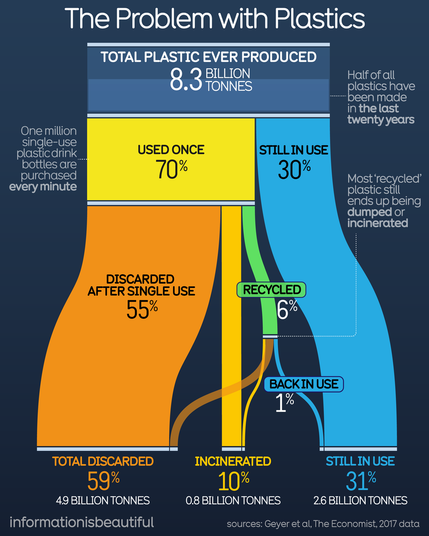
Recycling is futile. Message received. Thanks.
Recycling plastics is futile, so use something else. Anything else. Message received. Thanks.
@xylophilist @markd @hcf @infobeautiful
This is also a bit misleading: it's saying "all time", which means it doesn't account for the steady rise in the amount being sent to recycling, the amount actually being recycled, or the reduction in pure volume that comes from the recycling center processing before sending what it can't sell to a landfill. It also doesn't account for people trying to recycle plastics that can't be recycled, like wrappers and styrofoam boxes.
Even still, that at least 1/6th of what you throw in the bin is going to be recycled isn't "useless", it's just less than ideal. We need to take steps, politically, to make recycling more effective.
It should also be noted that this is not the case for paper: about 2/3 of recycled paper actually gets recycled, albeit into lower grade papers like what's used in brown paper bags, but it's a relatively effective way to reduce deforestation. I think part of that is buy-in on behalf of the paper industry.
@Raccoon @xylophilist @hcf @infobeautiful To my mind, the biggest problem with plastics is that the producers have offloaded the recycle costs to consumers and convinced the world that it's a consumer problem.
If producers were responsible for the full life-cycle costs of their products we would have a very different world.
As it stands, plastic producers have effectively privatised profits and socialised costs. Capitalism at its best.
@xylophilist @markd @hcf @infobeautiful Its value actually becomes negative after it's discarded. Plastic seepage (yum), microplastics, pollution, litter.
If we truly cannot find a solution for the plastic problem, it truly is better off burned in a blast furnace than becoming microplastics.
Let's just go back to glass. Infinitely reusable. A little sharp, but even thrown in the ocean it becomes beautiful.
@xylophilist @markd @hcf @infobeautiful Would it? Honest question. Because the heat and vibration of the ground will inevitably break that stuff down into microplastics.
I mean it's *centralized* microplastics, and I guess we could burn tons of soil later, but I'm unconvinced that burning our mistake now is not a better solution vs letting it inhabit our soil and our bodies.
Obviously *not* using plastic is the solution, but it appears we have weak representation on that front.
@shanie @markd @hcf @infobeautiful Well, looking at it one way, its value is its potential to be reused usefully. If it's gone up in smoke, that's physics. If it's merely sitting somewhere awaiting a more enlightened humanity, that's positive.
(Also, I was at a lecture a year or two ago on the subject of ways to dispose of plastic, and land-banking was the method that stood-out the most memorably.)
@hcf @infobeautiful Or, when given a choice between plastic/metal/glass packaging, avoid plastic.
I know things get complicated when you consider the carbon footprint for shipping heavier packaging... But we can work on greener shipping methods while we're at it.
Not a pretty picture…
"Luckily," the OECD projects a triple increase in plastic production by 2060, so Alzheimer's, cancer, and other diseases induced by microplastic pollution will become even more prevalent. What a nice world to live in.
@infobeautiful
I heard someone interviewed on NPR who said that recycling plastic is worse than useless, in that (a) processing plastic for recycling releases large amounts of microplastics and other harmful substances into the environment, and (b) such processing typically takes place in less developed countries, where environmental regulation is sparse or non-existent.
I haven't decided for sure yet, but I'm thinking I may start recycling only glass, paper and aluminum.
@EnigmaRotor @infobeautiful @ricardo That was my question as well. I think after 2017 a lot of one time plastic was banned in the EU for example.
Maybe this does make an impact, it might be small but every bit counts, right?
@infobeautiful Had the idea it was even less than 6%.....
Seen one plant being built, and also one specifically for recycling PET flascs. The latter went bankrupt.
Find out key facts about plastic in the ocean with our infographics, as well discover their impact and how the EU is acting to reduce plastic litter in the seas, Society. The results of today’s single-use, throw-away plastic culture can be seen on sea shores and in oceans everywhere. Plastic waste is increasingly polluting the […]
 Æ Sea F.
 MarkD
MarkD Tim ☑️ 🔭🌃📷🪨🚴🌳
 Raccoon🇺🇸🏳️🌈
 Jan Ainali
 Shanie MyrsTear
 Michael Porter
 *_jߍyrope
 xs4me2
 TobiWanKenobi
 Cognitive Dissidence
 Weird Socks
 Gabs
Gabs ohmrun
 Bo Jacobs
 EnigmaRotor
 Xanatos
 schrotthaufen
 Angela Scholder
 Julien W.
 mrjive
 X-Avy
X-Avy