
Brussels sprouts and Finnish lanttulaatikko feature in day 5 of #ChemAdvent. Their chemical connection is glucosinolates, bitter compounds in sprouts and swedes.

Genetic variations in people affect the perception of this bitterness – so if you're not a sprouts fan, that could be why!
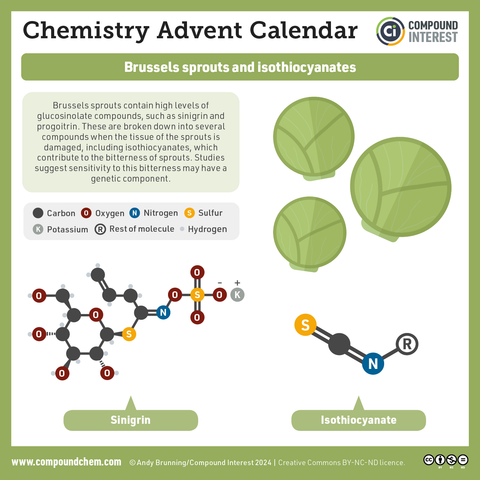
@compoundchem #AltText4You "Brussels sprouts and isothiocyanates" Illustration of Brussels sprouts as well as chemical structures of Sinigrin and Isothiocyanate showing C, O, N, K, and R groups.

"Brussels sprouts contain high levels of glucosinolate compounds, such as sinigrin and progoitrin. These are"

@compoundchem "broken down into several compounds when the tissue of the sprouts is damaged, including isothiocyanates, which contribute to the bitterness of sprouts. Studies suggest sensitivity to this bitterness may have a genetic component." #AltText4You
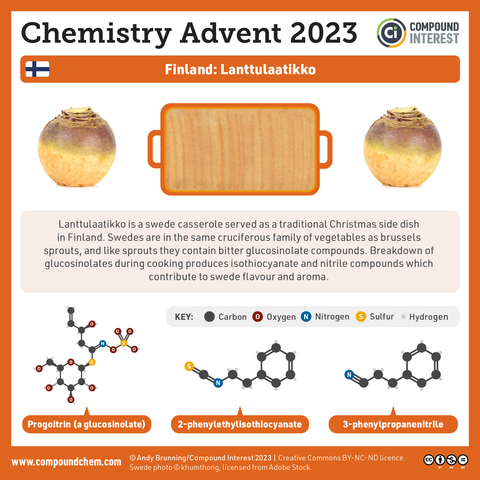
@compoundchem "Finland: Lanttulaatikko" Photos of swede (UK) (rutabega [US]) and an overhead view of a casserole dish between them. "Lanttulaatikko is a swede casserole served as a traditional Christmas side dish in Finland. Swedes are in the same cruciferous family of vegetables as brussels sprouts, and like sprouts they contain bitter glucosinolate compounds. Breakdown of glucosinolates during cooking produces isothiocyanate and nitrile compounds which contribute to swede flavour and aroma."
@compoundchem Depicted are the chemical structures of Progoltrin (a glucosinolate), 2-phenylethylisothiocyanate, and 3-phenylpropanenitrile, showing C, O, N, S and H. [This is where image description by the poster could be more helpful...I am not a chemist so I don't dare describe the structure for fear of error]. #alttext4You