 Kevin
Kevin Matt Blaze
AT&T Long Lines "Oak Hill" Tower, San Jose, CA. 2021.
All the pixels, delivered station-to-station, or, for a small additional charge, person-to-person, at https://www.flickr.com/photos/mattblaze/51261791084
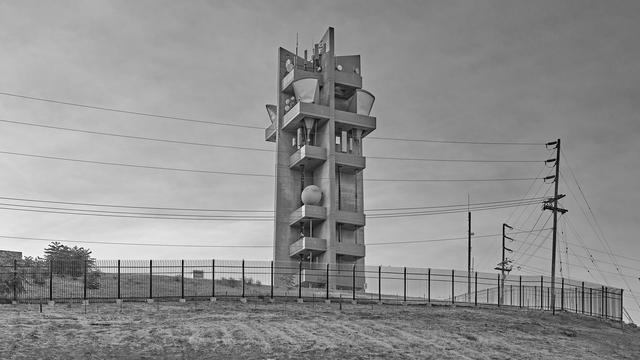
AT&T Long Lines "Oak Hill" Tower, San Jose, CA. 2021.
All the pixels, delivered station-to-station, or, for a small additional charge, person-to-person, at https://www.flickr.com/photos/mattblaze/51261791084
Captured with the Rodenstock 50mm/4.0 HR Digaron-W lens (@ f/4.5) on a Cambo WRS-1600 camera (with about 15mm of vertical shift to preserve the geometry), the Phase One IQ4-150 back (@ ISO 50) in dual exposure mode (which preserves a couple stops of additional dynamic range into the shadows).
The tower's shape is irregular; it tapers slightly.
The wide angle and panoramic orientation give a bit of context, alone on a hill (which is being rapidly encroached by adjacent residential development).
For much of the 20th century, the backbone of the AT&T "Long Lines" long distance telephone network consisted primarily of terrestrial microwave links (rather than copper or fiber cables). Towers with distinctive KS-15676 "horn" antennas could be seen on hilltops and atop switching center buildings across the US; they were simply part of the American landscape.
Most of the relay towers were simple steel structures. This brutalist concrete platform in San Jose was, I believe, of a unique design.
The San Jose Oak Hill Tower is unique in a number of ways. This particular concrete brutalist design appears not to have been exactly replicated elsewhere; it was site-specific. It sits atop an underground switching center (that was partly used for a military contract), which explains the relatively hardened design.
Today the underground switch is still there, owned by AT&T, but the tower space is leased to land mobile and cellular providers. The old horn antennas at top are disconnected
With a few exceptions (mostly towers atop downtown switching offices in populated areas), no one was trying to make any of this utilitarian communications infrastructure beautiful. It was form strictly following function, built to be reliable and rugged.
But there was, I think, quite a bit of beauty to find in it. Perhaps we'll look at our current neighborhood cellular towers, now often regarded as visual blight, the same way decades after they're (inevitably) gone.
Infrastructure is heroic.
@mattblaze In my mind one of the most interesting comparisons is that of the Golden Gate bridge as built versus what was originally proposed.
Both designs were "functional". But the original design by Strauss was a visual disaster while the as-built by Charles Ellis is a world-class gem. (Strauss was so jealous of Ellis that Ellis name was not to be found on the name plaque on the south tower - I don't know if his name was ever added later.)
Below is the original design, yuck. And we all know what was built.
https://www.goldengate.org/assets/1/6/ggb-exhibit3-1_2-2.jpg
@mattblaze Strauss had only designed short drawbridges before taking on the Golden Gate. There are a couple of Strauss designed drawbridges over China Basin near the SF. baseball park, such as the one below...
https://en.wikipedia.org/wiki/Lefty_O%27Doul_Bridge
https://en.wikipedia.org/wiki/Lefty_O%27Doul_Bridge#/media/File:Lefty_O'Doul_Bridge.jpg
 Karl Auerbach
 Tim Panton

 a HOT Rubie
  ~n
~n Recovered Expert