#catalinas #flying boat #aviation #aircraft #Newcastlensw #phototimetunnel #oldphotographs #oldphotos #vintagephotos
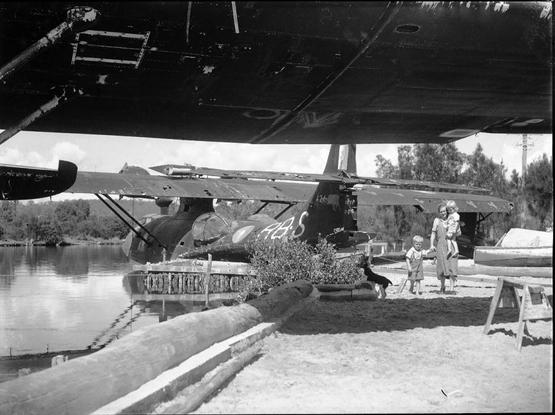
The following is an article written by Greg Ray in the Newcastle Herald in 2014 following an interview with John Cain Jnr in which he (John) describes how several Catalinas came to be moored in Stoney Creek near Toronto NSW. I've not been able to discern any serials although one is claimed to be A24-355. The squadron codes are RB (20 Sqn) and RK (42 Sqn).
"John Cain was with his father at Rathmines, not long after the end of World War II, when surplus Catalina flying boats were auctioned.
‘‘I think it was Newcastle auctioneer Don McHattie who was working his way along the rows of planes and calling the auction from the back of a T-Model truck,’’ he recalled.
John said his father, also named John, bought four of the planes with an idea in mind to turn them into floating accommodation on Stoney Creek, near Toronto. It was a photograph in a recent issue of the Newcastle Herald of those flying boats moored in the creek in 1947 that brought the story back for John.
‘‘At the time he bought them, people said he’d never get them across the lake and under the old Fennell Bay bridge without taking the wings off, but he did it, with the help of a bloke from the Royal Motor Yacht Club who owned a speedboat called ‘Pallsie’,’’ John said.
‘‘We used to play in the planes as kids. It was amazing what they left in them. They took out the engines and the armaments, but they left flare pistols, smoke bombs, maps of the Coral Sea and tins of rations that I used to take to school and share with other kids.’’
John Cain snr was a fiercely independent character who didn’t much like authorities trying to tell him what to do. Maybe that was because of what happened in the war, when the government confiscated the stock of his tyre business that once operated at the corner of Wood and Parry Streets, Newcastle.
‘‘Dad was so p---d off about that, he up and shifted us all out to Stoney Creek. That was about 1945.’’
.’’"
John acknowledges his memory of events in his very early life is prodigious, but he warns readers against skepticism. ‘‘I can remember things from when I was five as clear as day, but I’m not so good on what happened last week.’’
Out at Stoney Creek, John’s dad built a 23-cabin holiday park and a zoo. The cabins were all lit by electricity, supplied from army surplus equipment. Each had showers, toilets and iceboxes. They even had piped music and a PA system set up in every one, controlled from the ‘‘front office’’.
‘‘Actually, our house stayed half-built. The cabins were great, but we lived like paupers,’’ John laughed.
The holiday park had ex-army Nissen huts and old buses where people could stay, and there was an outdoor movie projector, a hand-cranked 35mm machine that screened reels of Felix the Cat and other cartoon favourites.
John Cain snr was extraordinarily resourceful, even by the standards of a time that obliged many to be that way. During wartime shortages, he was able to produce his own petrol from eucalyptus leaves, and from oil shale that he dug from somewhere down Lithgow way – until the authorities put a stop to it.
A flood tore through the holiday park in the early 1950s, ruining everything and washing the Catalinas away. Authorities complained that the wrecks were a hazard, and John and some friends had to go and cut them up with axes, selling the aluminium for scrap.
One of the big floats from one plane was turned into a canoe for John jnr, and his dad wired up a converted starter motor to a six-volt battery, fitting a propeller so his son could motor around the creek, until the battery went flat.
After the flood, the Cains moved over to Charlestown, shifting the zoo and animals.
‘‘I rode a camel to school one day. That surprised them,’’
@SuperMoosie I wrote those words. You will find them in a blog post on my website at www.phototimetunnel.com
https://www.phototimetunnel.com/the-catalinas-of-stony-creek